Off-Year Election Reax II

Weigel's write-up from NY-23:

Hours before the polls closed, Hoffman backers were echoing the pundits’ spin–this race would be a referendum on President Obama, and a victory for Hoffman would put the brakes on health care reform by making Democrats worry about challenges to their re-elections in 2010. As a Hoffman victory became more and more remote, the rhetoric changed. The message became the message of two weeks ago. This election wasn’t about showing Republicans that conservatives could win. It was about showing Republicans that they couldn’t win without conservatives.

Nate Silver on Maine:

I think we have to seriously consider whether there is some sort of a Bradley Effect in the polling on gay rights issues, although one of the pollsters (PPP, which had a very bad night in NY-23) got it exactly right. As for the model, I think I'll need to look whether the urban-rural divide is a significant factor in a state in addition to its religiosity: Maine is secular, but rural. At the end of the day, it may have been too much to ask of a state to vote to approve gay marriage in an election where gay marriage itself was the headline issue on the ballot. Although the enthusiasm gap is very probably narrowing, feelings about gay marriage have traditionally been much stronger on the right than the left, and that's what gets people up off the couch in off-year elections.

Ed Morrissey:

It’s never a best-case for the GOP when a Democrat wins, but by keeping Dede Scozzafava out of the seat, the GOP has the chance to win this seat back in a year with a better candidate — perhaps Hoffman, perhaps another Republican who shares core principles of limited government and fiscal conservatism.  Dislodging an incumbent Republican would have been considerably more difficult, and a unified GOP should win this district — especially given the signals sent everywhere else to Democrats.

Erick Erickson:

I have said all along that the goal of activists must be to defeat Scozzafava. Doug Hoffman winning would just be gravy. A Hoffman win is not in the cards, but we did exactly what we set out to do — crush the establishment backed GOP candidate.

Chris Lawrence:

Would Hoffman have been a more reliable Republican vote than Scozzafava? Probably. But Owens, if he’s anything like the vast majority of his future colleagues, will almost certainly vote with the Democrats more than 90% of the time; even the most “disloyal” Republicans only break from their party around 35% of the time while the vast majority only defect less than 10% of the time. In other words, conservatives have probably traded a reasonably Republican vote in the House for a reliably Democratic one, which in the grand scheme of things is not likely to be smart politics.

Larison:

What is more encouraging to me is that the wins by Christie and McDonnell show that competent center-right candidates interested in governance and all those “parochial” local issues can tap into voter discontent and win electoral victories. Hoffman’s possible defeat suggests that campaigns dominated by the presence of national activists, empty sloganeering and indifference to local interests may not gain traction even in those districts that are traditionally inclined to favor the politics of someone like Hoffman. Those of us who would like to see Democratic domestic agendas thwarted without empowering the Palins of the world may have managed to get exactly the results we would wish to have.

Richard Just:

Pundits have made much of the fact that the country is in a populist mood these days. The populism they are referring to is generally understood to be more right than left. But if an upshot of this mood is declining tolerance for the practice of people buying political office with their own money, then that's one (minor) thing for liberals to celebrate on an otherwise lousy night.

Ben Smith:

I think the temptation to read too much into [Bill Owens win] is probably to be resisted. The central dynamic was locals against outsiders, not liberal against conservative.

James Joyner:

[T]hese races demonstrate that Republicans can win — even with all the damage to the brand suffered in recent years — given both an opening and a solid candidate.

Josh Marshall:

Will Republicans do Obama a big favor by nominating a crop of Hoffmans for 2010?
Quote For The Day

"An interview with Oprah Winfrey is already scheduled, and I’m also hoping to have the opportunity to talk with Bill O’Reilly, Barbara Walters, Sean Hannity, Greta Van Susteren, Glenn Beck, Rush Limbaugh, Mark Levin, Laura Ingraham, Dennis Miller, Tammy Bruce, and others, including local Alaska personalities Bob & Mark and Eddie Burke. (Variety is the spice of life!)," – Sarah Palin.

Variety! They are all Palinites, apart from Barbara – and she's a celebrity interviewer.

Where are the journalists actually asking questions? Should I put in a request?

Yes On Goldblog, Ctd

Larison joins me in defending Trita Parsi:

If Goldberg had any interest in being fair to Parsi, he would have to acknowledge that Parsi has also argued for a pause in pursuing any engagement with Tehran in the wake of the June crackdown. That means that Parsi has changed his position on engaging Tehran to take a somewhat harder line than he once held. Whether or not this is the right move, this put him among those opposed to engaging the Iranian government under its current leadership at the present time. As far as I know, this remains Parsi’s position today. Obviously, he is nothing like “the AIPAC of Iran,” and referring to him as a lobbyist for Tehran is false and reprehensible.

Reihan differs:

[W]hile Parsi is undoubtedly a believer in democratic liberalism who wants to see Iran radically reform its institutions, he objectively serves Iranian interests insofar as he discourages Western efforts to exert pressure on the regime. This doesn't make Parsi a bad person. Plenty of Iranian dissidents believe that a democratic Iran should have a nuclear deterrent. Plenty want a denuclearized Iran, yet believe that Western pressure amounts to a kind of imperialism that should be actively resisted. This isn't that complicated.

It just means that in taking the nuclear issue as our prime focus, we are essentially cutting off most of the Iranian opposition.

Obama Seizing The Moment?

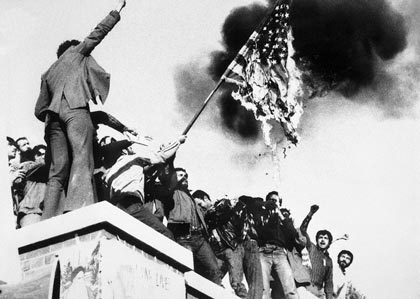
Burning-flag Scott Lucas guides us through the president's statement on 13 Aban:

At first glance, it is extremely clever: Obama turns the history of the 1979 Embassy takeover into his desire to “move beyond this past and seek a relationship with the Islamic Republic of Iran based upon mutual interests and mutual respect”.

Obama then moves to the current nuclear talks — “if Iran lives up to the obligations that every nation has, it will have a path to a more prosperous and productive relationship with the international community” — but it is his shift to the situation inside Iran that is most significant. Having already declared, “We do not interfere in Iran’s internal affairs,” he concludes:

Iran must choose. We have heard for thirty years what the Iranian government is against; the question, now, is what kind of future it is for. The American people have great respect for the people of Iran and their rich history. The world continues to bear witness to their powerful calls for justice, and their courageous pursuit of universal rights. It is time for the Iranian government to decide whether it wants to focus on the past, or whether it will make the choices that will open the door to greater opportunity, prosperity, and justice for its people.

To my knowledge, this is the first direct comment by a high-level US official, let alone Obama, on Iran’s political situation since June.

Full statement here.

Violence Breaks Out

NIAC compiles the early reports:

According to Parleman News, scattered clashes have taken place between the security forces and protestors in Seven Tir Square in Tehran.  The security forces have reportedly used tear gas several times while the number of protesters is increasing. 

Mowj Camp reports that Tehran University students have left the university to join the demonstrations.  According to Mowj Camp, anti-riot police has attacked the protesters who were going from the university to Seven Tir Square and there have been clashes in other parts of Tehran.  Bullets were also shot in the air around Seven Tir Square.

Enduring America has more footage. Another clip after the jump:

The Guardian blog captions:

This one is appears to have been shot undercover so it is difficult to get a sense of what is going on, but the crowd can be heard chanting "don't be afraid, we are altogether" and "down with the dictator". Fires can also be seen burning in the streets – a sign that teargas has been used as the smoke weakens the power of the gas.

Regime At The Ready

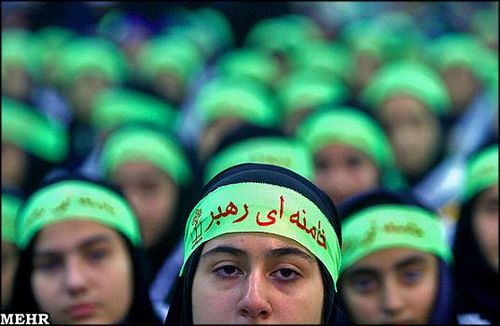
Headband-girls

Newest Deal's sets the stage:

Basiji commanders have announced that three million members of their militia will be deployed. Supreme Leader Khamenei again gave stern warning to the Green movement just last week, stating that the questioning of the June election is a crime. If there was any doubt whether his words were empty rhetoric, then the proceeding sentences handed down to 50 political detainees for committing just this "crime" should suffice. The regime is preparing for confrontation, perhaps because it has no choice — no choice but to retreat and wither.

The Basij headband above reads: “Khamenei is the leader.”

Our Man In Afghanistan

Jean MacKenzie reports:

As interim president after the American invasion, Karzai systematically drove out anyone who did not agree with him or who challenged his power. One of them was Ashraf Ghani Ahmadzai, who held the post of finance minister from 2002 to 2004 and who can legitimately be credited with creating the post-9/11 structure of Afghanistan. (Ghani came in fourth place during the recent elections.) Based on his own experience, Ghani told me that any attempt at power-sharing is doomed to failure. “Karzai will make it impotent within three months,” he said.