The Michael Moore Of Israel

A reader writes:

You've recently posted several quotes by Gideon Levy of Haaretz. I'm an Israeli leftist, operate a leftist blog, participated in the Bil'in demonstrations, and I can tell you that most leftists won't touch Levy with a ten foot pole. He's our equivalent of Michael Moore; mostly he interviews Palestinians about the horrors they go through.

Having served in the territories, I can testify to some horrors – but Levy, who spent some 20 years in the territories and has a weekly spot about this, does not speak Arabic. Somehow he never bothered to learn it. He gets his information via translators, many of whom are employed by the Palestinian Authority. Now, the IDF has a penchant for lying, but it's got nothing on the Palestinians when it comes to deception. Levi, for all practical purposes, is a Palestinian fellow-traveler and useful idiot. He has basically zero credibility or influence among Israeli Jews, even leftist ones. His columns should be viewed in that light.
Apologizing For The Hostage Crisis

The Iranian opposition movement makes a grand gesture:

On the occasion of the anniversary of the occupation of the US embassy in Tehran, moderate cleric, Ayatollah Hoseinali Montazeri, revisited the event which he had approved of at the time, and claimed “considering the negative effects and heightened sensitivity” it produced amongst Americans, he believes it was a “mistaken” act. The Shiite cleric added, taking over the embassy of a country that was not in “official war” with Iran was akin to “declaring war on that country.” He claimed even “some of the revolutionary and committed youth, who were instrumental in that act at the time, now believe that it was a mistake.”

Full statement here.

13 Aban

Embassy

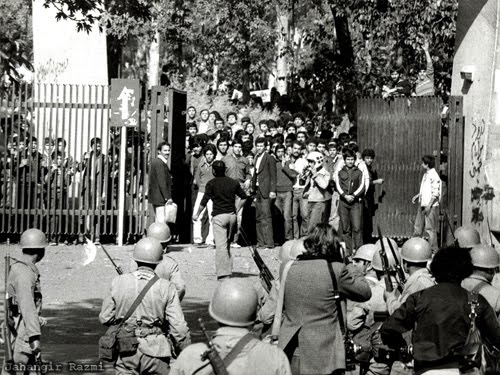
Tehran Bureau puts together a primer on the historical significance of today's date – known on the Iranian calendar as "13 Aban":

Nov. 4 marks the the day, 30 years ago, when Islamic leftist students stormed the U.S. Embassy in Tehran and took 69 people hostage. Seventeen of them were released at various times, but the remaining 52 remained captive for 444 days. The event was a watershed in U.S.-Iran relations with repercussions still felt today. The main consequence of that event has been that the United States, the most powerful nation on earth, and Iran, the most important country in the Middle East, have not had diplomatic relations for three decades.

Nov. 4 also marks the anniversary of two other important events in the history of contemporary Iran. On that day in 1964, Shah Mohammad Reza Pahlavi forced Ayatollah Ruhollah Khomeini into exile, first to Turkey and then to Najaf, Iraq. The Ayatollah returned to Iran triumphantly on February 1, 1979, after the Shah had gone into exile on January 16, 1979.

It was also on Nov. 4, 1978, that a gathering of students on the campus of the University of Tehran was attacked by the Shah's security forces. Scores of young people were killed, including students as young as 13. That event made it clear that the confrontation between the Shah and the Iranian people had entered its final stage, and that it could end only if the Shah was removed from power.

Much more here.

Off-Year Election Reax

92645737(2)

We will have more reaction later this morning. But for now, here's a round-up of bloggy goodness, assessing the still-incomplete results from tonight. First up, the always essential  Ambers:

Yes, independents are moving to the GOP. That's a big headline. Bad

news for Dems, etc, etc. But. And this is important: these are conservative independents. Many disassociated with the GOP — at least in terms of what they tell pollsters — because of the GOP brand problems and because it's cool to be independent in parts of the country and in parts of states. Don't confuse "moderates" with "independents."  Still, it seems clear that for people who call themselves independent, Republican messages wear better than Democrats.

DiA:

As for the wider implications of the elections, the Wall Street Journal points out, "Going back to 1989, one party swept the off-year gubernatorial elections five times. Three of those times, that party also won the following year's congressional elections; twice it did not." So, nothing.

Jonathan Chait:

It seems pretty clear that new Jersey and Virginia vote for the out-of-power party every four years now. Yes, there's a lot more energy on the right, but no, this election (the outcome of which I don't yet know, except Virginia) isn't evidence of it. I think basically everybody in politics understands this. I also think the political news media will tend to treat the elections as important, because the media has a bias toward reading importance into every new thing that happens. If you're going to have a discussion on cable news about what the elections mean, the producer isn't going to be very pleased if everybody says it doesn't mean anything.

Jennifer Rubin:

Multiple news outlets are calling the New Jersey gubernatorial race for Republican Chris Christie. Yes, this is largely a referendum on the incumbent governor and the tax, corruption, and budget woes which bedeviled his administration. But this is New Jersey, a Blue state where Obama campaigned hard for the Democratic candidate, Jon Corzine. He made five separate stops. Corzine’s ads looked like Obama ads. Corzine tied himself tightly to Obama, but it helped not at all.

McArdle:

2010 won't be about Obama either.  Oh, his performance over the next year will matter–but he's not going to get that surge of voters out to the polls for house and senate races.  The Blue Dogs who are up for election in 2010 aren't worried about Obama, or his voters.  They're worried about their own political fates.

Yglesias:

I think you can see from the unexpected closeness in the NYC mayor’s race that an economic catastrophe is not a good time to be an incumbent elected official.

The Other Marriage Nail-Biter: Victory

In Washington State, another referendum on gay couples' equality was also a squeaker. But in this one, gay couples won. The state's domestic partnership law grants gay couples all the rights of married couples at a state level. The usual forces tried to reverse it, as they tried in Maine. But in Washington, the gay side won by 51.1 to 48.9 percent. Again, it's such a slender margin, it's stupid to draw any vast conclusions.

But I do want to point out that, from the perspective of just a decade ago, to have an even split on this question in a voter referendum is a huge shift in the culture. In Maine, where the Catholic church did all it could to prevent gays from having civil rights in a very Catholic and rural state, gays do have equality but may now merely be denied the name. The process itself has helped educate and enlighten and deepen the debate about gay people in ways that never happened before the marriage issue came up.

I am heart-broken tonight by Maine, and I'd be lying if I said otherwise.

Somehow losing by this tiny margin is brutalizing. And because this is a vote on my dignity as a human being, it is hard not to take it personally or emotionally. But I also know that the history of civil rights movements has many steps backward as forward, and some of those reversals actually catalyze the convictions that lead to victories. A decade ago, the marriage issue was toxic. Now it divides evenly. Soon, it will win everywhere.

I know for many younger gays and lesbians, this process can seem bewildering and hurtful. But I'm old enough now to be able to look back and see the hill we have climbed in such a short amount of time, and the minds and hearts we have changed. Including our own.

Know hope.

Maine Update

It looks as if a recount is now a possibility. One glimmer of hope: there are uncounted votes from Cumberland County, which includes parts of Portland. The city voted 73 – 27 percent for keeping marriage rights. A reader writes:

I'm nervously watching the Q1 results. I was involved in the Q4 discrimination referendum years ago and was a team leader for the Obama campaign. Even though we moved to Texas this summer, I have been making calls to Maine. I am not surprised by the results so far. From my perspective the challenge was always to get a sufficiently high voter turnout in friendly towns in Southern Maine to offset the rest of the state. Knox is very encouraging. I am quite concerned about York as we normally count on it to counter northern Maine–looks like Biddeford, Saco, and Sanford are driving the Yes votes–all highly Catholic towns.

Another Maine reader notes:

Kittery, and York are likely to follow the pattern of EliotWells, or even Kennebunkport, all neighboring towns. That said, compare the 3 Berwicks and you can see how the differences can swing by 10% or more within 10 miles…

The Daily Wrap

Today on the Dish we tracked the remarkable turnout in Maine, where a loss for marriage equality could very well be the national Dems' fault. Regarding the other races, Nate Silver and Josh Green downplayed the potential outcomes, Scarborough stayed positive on the Beck-Palin insurgency, and some readers from NY-23 chimed in. (Read just below for late-breaking election results.

While Palin continued to meddle in NY, NJ, and VA, Levi turned up the tabloid heat. Readers sounded off – and one nearly stomped off. On the war on prohibition, we examined the distorted "danger" of drugs in the UK and watched a remarkable mother of two expound the conservative case for legalization.

In other commentary, Andrew engaged Goldberg over Parsi, Carol Platt Liebau got a Hewitt, Larry Stickney got a Malkin, the Dish got snarky with Stickney, Southerners shunned Bush even more than Obama, John McWhorter talked language, and Matt Steinglass and a reader discussed dog-eating. 

— C.B.