Deeper vs. Broader

Massie on today's off-off-year elections:

[N]o-one thinks it impossible for the GOP to win. The argument in conservative circles is what kind of conservatism is needed to give conservatism the best chance of winning on a regular basis. That is, what kind of conservatism is best-placed to counter some of the structural advantages that, right now and for the foreseeable future, will run in the Democratic party's favour?

It may be that the conservatism of Limbaugh, Mark Levin, Sarah Palin, Sean Hannity and all the rest of them is the best bet for a conservative revival. I'm unconvinced by that, to put it mildly. Republicans need to be broader, not just deeper. Conservatives will have their victories but they may also have fewer of them to celebrate than need be the case the longer they insist that the old tunes, played more loudly, are all that's needed.
When Languages Die, They Stay Dead

John McWhorter defends his recent article on whether dying languages should be saved and spoken:

I write that within a context: of the 6000 languages on earth, it is estimated that only about 600 will exist a hundred years from now. The big languages are edging the tiny ones, and even the medium-sized ones, out. In recent centuries, this has been first because of active extermination – Native Americans were often forbidden to speak their home languages in school – and later because of “globalization”: children raised in a city by migrant parents are unlikely to learn the language their parents spoke back in the village…

[In] 2009 the simple fact is that there is a single example of a language brought alive from the page and now used as a native language by a massive population of users: Hebrew, and that was a very unusual story driven by a unique confluence of religious commitment, a sudden mixture of people speaking many different languages, and arrangements such as children early in the experiment that became modern Israel being removed from their parents and raised on kibbutzes where only Hebrew was spoken. This kind of thing can’t ever happen in, say, Ireland.

Hewitt Award Nominee

"No one but the President and members of his inner circle know the real reason that President Obama has refused to go to Berlin. It’s hard not to suspect, however, that his reluctance springs both from a misplaced sensitivity to the feelings of our former Soviet adversaries – and worse yet, from a misguided sense of shame about America’s Cold War triumph," – Carol Platt Liebau, Townhall.com.

The Tea-Leaves Of Off-Year Elections, Ctd

Kristol, who is always wrong, parrots the same line as Jonah Goldberg:

Now, obviously, there are times when divisions in parties can be damaging. But what's happening in the GOP right now looks to me more like healthy turmoil than destructive recklessness, more like vigorous competition than bitter fratricide.

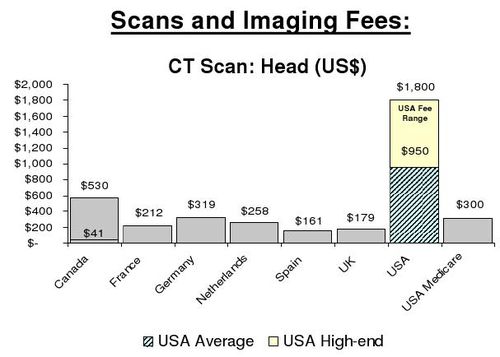
Chart Of The Day

USAScanPrices

Ezra Klein passes along some striking charts (pdf):

There is a simple explanation for why American health care costs so much more than health care in any other country: because we pay so much more for each unit of care. As Halvorson explained, and academics and consultancies have repeatedly confirmed, if you leave everything else the same — the volume of procedures, the days we spend in the hospital, the number of surgeries we need — but plug in the prices Canadians pay, our health-care spending falls by about 50 percent.

Social Engineering

Mark Kleiman finishes up some guest blogging about his new book over at Volokh’s place. In response to comments:

The suggestion that various non-punitive programs might control crime, and that doing so was preferable, ceteris paribus, to controlling crime by inflicting damage on offenders, met with an especially furious response, mostly centered on the phrase “liberal social engineering.”  But the project of putting 1% of the adult population behind bars — an incarceration rate five times as high as any other advanced democracy, and five times as high as the U.S. ever had before 1975 — is itself a massive, massively risky, and expensive  social-engineering project, and no less massive, risky, or expensive for never having been thought through.   It also involves a completely unprecedented expansion of the power of the state over the individual.

The Daily Wrap

Today on the Dish we continued to track coverage of NY-23. John Cole commented on the lack of party loyalty, Jonah Goldberg declared ideological victory, Mark Blumenthal and PPP predicted a big Hoffman win, Nate Silver looked at the consequences that outcome, Josh Marshall anticipated a new model for upcoming elections, Larison sounded off, Weigel reported from NY-23, and a reader who grew up there wrote in. Also, while Hoffman was also raised in NY-23, nearly all of his campaign funds were raised out of state (as well as his political profile).

In the Afghan election debacle, Mac McCallister sized up Abdullah's scheme, Crowley showed that he still has some kick for Karzai, and Peter Galbraith gave some perspective from the ground. In other foreign coverage, an Iranian student faced down the Supreme Leader, Gideon Levy dispensed some tough love to Israel, and Goldfarb and Goldblog got into some hot water over NIAC's president. 

In other commentary, Michael Wolff tried to make sense of the Palin circus, Andrew dressed down Laura Ingraham, James Joyner saw The Advocate's demise as a good sign, Gene Weingarten waxed eloquent about old dogs, and

What Happens In NY-23 Now?, Ctd

Larison makes several strong points:

The GOP seems to be making what ought to be an easy win into a national Phyrrhic victory in which the relative strength of conservative activists inside the party becomes vastly exaggerated and identifies the flailing, failing party even more closely with its conservative members. This will make it very difficult for conservative activists to disassociate themselves from the outcome of the midterms next year.

What I find strange in the fixation on NY-23 is that the off-year gubernatorial elections probably serve as a much better indicator of large-scale movements in public opinion. Larger, more diverse electorates in large states are involved in Virginia and New Jersey. If things go as I expect them to with a Republican pick-up in Virginia and a Democratic hold in New Jersey, the message will be rather muddled. It will mean that Virginia will have chosen a Northern Virginia moderate who successfully ran away from his earlier social conservatism while New Jersey re-elected an incumbent who was thought to be highly vulnerable and discredited by corruption. Those results could be explained by pointing to the nature of the electorates in both states, but this does not lend itself to a triumphant narrative of Republican resurgence fueled by true believers.

Theocracy Watch

Box Turtle Bulletin brings us the latest from Uganda:

As we reported last week, several Ugandan Christian leaders have spoken out on the Anti-Homosexuality Act which has been introduced in that nation’s Parliament, but their statements have largely been in full support with the bill – with a few reservations about the proposed death penalty for “serial offenders” and those who are HIV-positive…While some Ugandan Christian leaders have expressed reservations about the death penalty provisions – while being perfectly happy with lifetime imprisonment for being gay, at least one prominent Uganda preacher has given the new law his total support. Martin Ssempa of Makerere Community Church was not at the parliamentary meeting, but he did send a statement to Grove City College professor Warren Throckmorton in which he offered his “total support of the bill and would be most grateful if it did pass.”

Running The Competition Out Of Business

Joe Fiorito argues against mandatory minimum sentences for drug offenses:

[Eugene Oscapella, a founding member of the Canadian Foundation for Drug Policy] said, “If you’re a mom-and-pop producer of marijuana, mandatory minimums will scare you out of business.” Yeah, so? “Organized crime will step in; the government has moved the competition out of the way.” This is an unintended consequence of the worst kind: Banning a substance makes it wildly lucrative; punishing the small fry makes it easier for the bad guys to do business.

(Hat tip: Drug WarRant)