A reader writes:
I've seen several other blogs react. I'm waiting for your head to blow up.
It already did. I'm just picking up stray bits of cranial matter while having a second cup of coffee. Stay tuned.
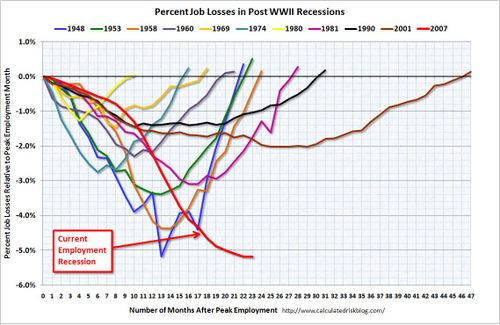
Calculated Risk has the graph. Leonhardt explains the significance:
The economy lost only 11,000 jobs in November, the Labor Department reported. That’s down from 111,000 last month and a peak of 741,000 in January. Economists had been expecting a loss of more than 100,000 in November…How much should we make of one month’s report? It’s probably best to be conservative. I’d be surprised if this rate of progress continues in coming months. But this is still very good news: many fewer people were out of work last month than expected.
"Now, after someone dies and someone comes in and steals from them, we consider that in most society reprehensible. … But when the government comes in, because we have the power to pass laws and legalize theft that otherwise would be considered reprehensible, it’s okay. But it is not okay. … Jesus never advocated the government go steal. He said ‘you do it. Do it with your own money, don’t steal it from somebody else.’ And that is why this should not pass," – Congressman Louie Gohmert (R-TX), opposing a 45% tax on estates valued at more than $3.5 million ($7 million for a couple).
I seem to recall Jesus urging his followers to pay Caesar what was due to him – and never to confuse that with anything to do with God. I also seem to recall his saying quite clearly that only by giving away one's entire wealth to the poor could one enter the kingdom of heaven.
A reader writes:
Can you tell me how you know that the Israeli settlement freeze is "meant to make Israel look less intransigent than it actually is," instead of making Israel actually less intransigent? I think it is again quite imperious of you to conclude that an action taken at the behest of the international community, and the United States specifically, is actually just a ploy. In the future it may well prove to be that way, but that you know that now displays quite a bias in your writing.
It seems absurd to me that you, a) want Israel to stop settlement construction, and b) criticize their halt of settlement construction as a ploy for the "future total annexation." Was them the Israeli pull out of Lebanon merely a ploy to annex southern Lebanon at some point in the future? Was the disengagement from Gaza a similarly devious plan? And do you really think that Netanyahu does not want peace?
While you may disagree with him about what that peace looks like or the best way to get there, how can you say he wants permanent war? Was your brother killed in a battle? You supported war in Iraq and Afghanistan after one terrorist attack in the United States. Maybe he is more skeptical of how to get to a peace agreement because his family, friends and neighbours have fought in numerous wars, been kidnapped, and had bombs, somewhat regularly, explode in their streets. For you to say that his goal is, "the expansion of Israel in a forever war funded in large part by the US," is not proven by the evidence you cite.
The facts remain that Israel outright refused to freeze all its settlement activity as requested by the US, and indeed continued building settlements in East Jerusalem, thus ensuring the still-birth of the peace process under Obama. In the month before Obama took office, it is also true that the Israeli government pulverized the Gaza ghetto with immense and unrelenting war, killing hundreds of innocents and polarizing the region in ways that made Obama's task all but impossible – and strengthened Hamas. The news from yesterday was that Netanyahu has now stated that even his temporary and incomplete freeze will end soon, after which, in his words, "we will continue to build."
In my judgment, these are not the actions of a government seeking peace or trying to work things out constructively with an ally. And when you look back and see the constant building and settlement in the West Bank, uninterrupted for two decades, you see that there is no way Israel will ever give this land up, and has no sense of how humiliating and provocative this policy is to the people it needs to negotiate a future with. Yes, of course, the Palestinians have hardly been able or united negotiating partners in this. But they are the ones now disenfranchised from any stable home, and powerless in the face of the bulldozers and the construction workers and the roadblocks. Even with a giant wall, the settlements continue far beyond its reach. I'm tired of pretending this isn't happening.
If they don't want to annex the West Bank, they can stop colonizing it. When they colonizing it, as Obama has requested, I'll believe their good intentions for peace.
A reader writes:
I agree with your reasoning in Leaving the Right, but I am confused as to what you have just left. It forces me to question whether the terms we use to describe ourselves and our beliefs are losing their distinctions? If the right is synonymous with Republican, then I think you walked away many years ago, like myself. But I certainly hope that there is still a distinction between the words conservative and Republican, since I have always referred to myself as the former, and attacked the entirely non-conservative policies of latter.
Do you think that individuals like Bush and Palin, or entire movements like Christian fundamentalism and neo-conservatism, have co-opted the term conservative as well? If we say that the conservative movement has left us, have we not conceded the term to its modern twisted definition? And if so then I have to ask what are we? And what are we entering on our way out?
There's been some confusion here, probably because of the title of the post. The only person who just announced a break with the conservative movement is Charles Johnson. My own spur-of-the-moment manifesto was merely inspired by his. And quite obviously, as I explained in the post, I left that movement many years ago, in so far as I was ever a part of it. (Which "movement conservative" backed Clinton in 1993 and Kerry in 2004, as I did?)
But as I quixotically insisted in The Conservative Soul, I refuse to give up the term 'conservative' and any fair-minded reader of that book would understand why.
I continue to call myself a conservative, of the tradition of Burke and Hume and Montaigne and Oakeshott. I suspect that all four of them would regard the term "conservative movement" an oxymoron anyway, as I do, even if they understood it at all. And although I have deep respect for the liberal tradition, I am much too much a skeptic, and an individualist, and an anti-collectivist to join the Democrats. I try to join as few organizations as I can get away with. And I lived under socialism so know how poisonous it can be.
So my reader and I remain conservatives without a home. That happens in life and politics. Perhaps one day the GOP will return to its saner, calmer roots, and we can feel more comfortable supporting them from time to time. But I suspect that the fundamentalist and neocon take-over will prevent that any time soon. So we carry on without a home but with an argument and a tradition instead. Good enough for me.
Moreover, conservatives of the sort I describe should not be dismayed by the lack of a party. It may even increase our leverage to hover between the two, goading each toward the center-right in the long run, while tolerating various adjustments in response to changing circumstances all the while. And it's certainly more symptomatically conservative not to get too attached to any political party. In fact, factionalism and partisanship has helped destroy conservatism in America almost as much as religion. Burke, one recalls, was not a Tory but a Whig. Churchill was a Liberal as well as a Tory. Reagan began life as a Democrat.
The point of conservatism, you see, is not political. Real conservatives get involved in politics because they have to, not because they want to. And they have to to rectify obvious disasters or utpoian assaults on freedom or radical attacks on established modes and orders. We are conservative in politics in part to restrict the claims of politics and to enlarge the claims of life.
So cheer up. I certainly feel less gloomy about America than I did two years ago, and confident that the good sense of its silent center will navigate the treacherous waters ahead. Yes, America is in much worse shape today than a decade ago – but some of that is the dispelling of illusions, the pricking of bubbles and the consequence of hubris. This will not deflate the conservative. There is always something bracing about rediscovering reality, however grim the disillusionment may be. For conservatism begins in a lack of illusions and builds from there.
Jeb Golinkin argues:
If [Ted Olson and David Boies] were to succeed in showing the California ban to be what it is, an unconstitutional law that is, in Olson’s words, “utterly without justification” and that brands gays and lesbians as “second-class and unworthy” in the eyes of the law, Republicans will owe the two a debt of gratitude for saving the party from twenty years of supporting a position that 20 years from now men and women will view as utterly abominable. Not only will they save us from the eyes of history, they will save us from the electoral losses that the public’s general condemnation of the position will turn into at some point.
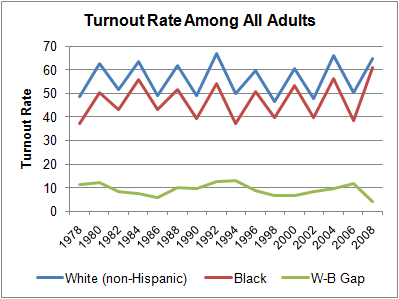
Nate Silver frets over a Daily Kos/Research 2000 poll from last week about whether voters intend to vote in 2010:
Whereas 68 percent of white voters told Research 2000 they were definitely or probably planning to vote in 2010, just 33 percent of black voters did. Although whites have almost always turned out at greater rates than blacks, the racial gap has never been nearly that large, and indeed was at its smallest-ever levels in 2008 with Barack Obama on the ballot.
Sager points us to a new study:
[Nicholas Epley at the University of Chicago] found that when people contemplated God’s opinions, their brains activated similarly to when they were contemplating their own opinions — the same was not true when they contemplated the opinions of other people.
DiA takes stock of marriage equality:
Washington is likely to legalise gay marriage next week, so the momentum has not completely changed direction. And one could argue that the Washington vote is more important than the defeat in New York for the sole reason that federal lawmakers will be confronted with the issue at close range, forced to witness what I believe will be the non-disastrous affects of two men or two women marrying.

Sulaymaniyah, Iraqi Kurdistan, 7.03 am
 The Dish