West Point Reax

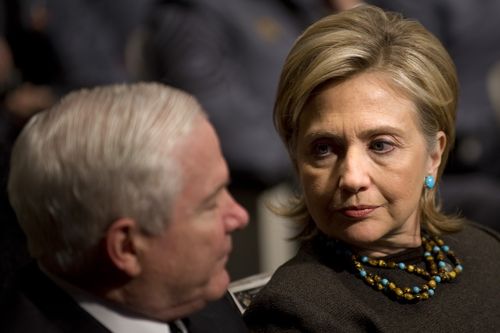
CLINTONGATESJimWatson:Getty

Ackerman:

I think it’s fair to say the following: we knew since Obama began running for president in early 2007 that he would escalate the Afghanistan war. But we didn’t know that he would so thoroughly embrace the counterinsurgency template that Petraeus and his circle began to create. I explored this in my essay for The National recently. But tonight really underscored it.

Reihan Salam:

Assuming this really is a conditions-based decision, setting a target date for withdrawal isn't necessarily a bad thing. The trouble is that the timetable might be so overoptimistic as to set unreasonable public expectations, and I think that's what worries Senator McCain. Given the political constraints the president faces — less than a quarter of Democrats believe that a troop surge will improve the security situation in Afghanistan and a large and growing number want out — I'm inclined to give him the benefit of the doubt.

Nate Silver:

Politically, this seems very risky: in the long run, there's much more downside to breaking the promise than there would be upside to keeping it. If nothing much has changed in Afghanistan and our troops aren't getting out 20 months hence, we can presumably expect some major blowback, especially from liberals — a primary challenge from Obama's left flank would not be entirely out of the question.

Armchair Generalist:

I still think the rationale that the Obama administration uses is shit – that somehow, securing Afghanistan is vital to our interests and that AQ is just chomping at the bits to move back into Afghanistan while

eyeing Pakistan's nukes.

It's weak, it's not a supportable defense to address violent non-state actors. But at the least, he offered goals, he stated his rationale, and he clearly stated that he's not relying on strictly military power. He demonstrated a basis for using all the elements of national security. And he's committing to start pulling out in mid-July 2011 (none too late to influence the 2012 elections).

Ben Smith:

Tonight's speech includes a passing, abstract reference to "human rights" — but not a single reference to Afghanistan's women and girls. That, presumably, falls into the category of "nation building." "As President, I refuse to set goals that go beyond our responsibility, our means, our or interests," Obama said tonight.

DiA:

[T]here basically wasn't anything in there about any of the fascinating strategic issues that have been raised over the past couple of months. We have no idea what the split in emphasis is on population security v counter-terrorism, no idea if or when American forces will pursue Taliban/AQ inside Pakistani territory, no idea whether the "tribal" strategy is a reality. Guess we'll have to keep following developments on the ground and the articles at the think tanks to see how things are headed. This is less of a clear signal than George Bush provided, actually, in December 2005 when he used the language "clear, hold and build", or in his later descriptions of the strategic thinking behind the "surge". Again, I guess the calculation is that most of the public doesn't really care about that stuff or understand it.

Jim Geraghty:

My relief at Obama's decision comes with a nagging sense of having written about expiration dates. I think he's making the right call tonight; I hope he sticks by it, if, say a year from now his approval numbers are ten points lower, the base of his party is in revolt, flag-draped caskets are returning home, and the sense is that all of our progress has come at a supremely high price.

David Kurtz:

The Republican talking point this evening in reaction to the speech is that if Obama is really, truly, unconditionally committed (no fingers crossed behind his back) to the Afghanistan effort, he wouldn't set an "artificial" deadline for withdrawing troops.

Ace Of Spades:

Basically, when you tell your ally you're bugging out in a couple of years, and they know when you do bug out they lose, you have incentivized them to begin defecting to the enemy early.

Jennifer Rubin:

So far this speech should have been delivered at a DNC meeting — the Democratic base seems to be his primary concern and audience.

Patrick Barry:

This vehement opposition to timelines has never totally made sense to me.  Of course it's important to demonstrate commitment, but its equally important to gain leverage, something that timelines can give you.  One surefire way to make countries like China, Iran and Pakistan start taking affairs in their backyard more seriously is to make them aware that there is an end-date to their riding on America's coat tails.  Right now, Pakistan has less incentive to behave productively in Afghanistan, mostly because it's mostly consequence free. We're the ones holding the bag!  But if they're forced to reckon with a future where it's not as easy to hide in America's shadow, it would be reasonable to assume more responsible behavior.

(Photo: Jim Watson/AFP/Getty.)

The Ailes Line

Watching Fox, you can see the core line of attack now decided upon. The GOP will support the surge as McChrystal's effort, but spend the entire war to denigrate Obama as commander-in-chief and implementer of it. They will attack him as weak even if he adds 30,000 new troops under the smartest strategy he can. I have to say I have now watched the entire Fox coverage and all of it – all of it – is hostile to a president at war in a conflict he inherited spiraling into collapse.

Only O'Reilly has a smidgen of fairness. O'Reilly is now the independent voice on Fox. Now, I'm now watching Karl Rove use McChrystal against Obama and accusing the president of isolationism. Yes: he used the term "isolationist" to describe the addition of 30,000 more troops. If they're going to call you isolationist anyway, why bother intervening?

Obama's answer is that we cannot tolerate another terror attack. But at what cost? Is there any limit to the cost?

The way our politics of fear is now constructed, there is no limit to the costs involved in nation-building in every conceivable failed state that could be a safe harbor for Jihadists. We cannot have the adult conversation about how much terrorist damage the US should tolerate compared with the costs of trying to control this phenomenon at its source. We are not mature enough as a country to have that conversation. And Obama has decided it isn't worth confronting that question now.

I just don't believe that Afghanistan will be in much better shape in 2011 than it is now, or that withdrawal in 2012 will have any greater a chance of avoiding subsequent implosion than withdrawal now or withdrawal from Iraq in 2010.

So I am left with this deep ambivalence and concern. But we are at war and he is the president and he has committed the troops. I'll do with this what I did with the 2007 surge: support the troops once the decision is made, even though I disagree with the decision. And I fervently hope and pray this strategy succeeds in ways that the Iraq surge has not yet succeeded. And I just as fervently pray that the uncertainties and risks of those two countries do not destroy this president as they destroyed the last. And that they do not take this country with him..

Live-Blogging West Point

WESTPOINTChrisHondros:Getty

8.35 pm. "Not the deepest of fears but the highest of hopes."

I confess I do not feel those highest hopes. I do not share his confidence in American military and civilian power to turn the roiling region of Afghanistan and Pakistan into something less threatening. I see no reason after the last eight years to see how this can happen, even with these new resources. But if you rule out withdrawal right away, then this seems to me to be about the smartest strategy ahead. But I see absolutely no reason to believe that it will mean withdrawal of any significant amount in Obama's first term.

8.34 pm. "I refuse to accept that we cannot summon that unity again." He will have to overcome Cheney.

8.32 pm. Is he choking up? I get a sense that these cadets in front of him are affecting him. He seems different now than before he became president: a commander-in-chief of a different timbre.

8.30 pm. A reprise of liberal internationalism, and a Niebuhrian mix of military realism and global hope. "We do not seek to occupy other nations." And yet we do. And we will.

8.29 pm. The reiteration of America's commitment to human rights and dignity, in stark – and unspoken – contrast with the war crimes of his immediate predecessors.

8.27 pm. "The nation I am most interested in building is our own." But Afghanistan is a close second. Yes: Afghanistan.

8.25 pm. Here's the insistence on a limited commitment to keep the pressure on Pakistan to cooperate. It makes no sense to me. Why would they not wait for us to leave? And if we recommit now, won't that take the pressure off the Pakistani and Afghan governments?

8.23 pm. The argument for staying on offense is pure Giuliani. If you thought you were voting for a peacenik last year, you weren't paying attention, were you? The notion that we do not face a popular insurgency as in Vietnam is also unconvincing.

8.22 pm. The Pakistan pivot: what sounds like a major reset with a critical country. But the description of Pakistan sounds hopelessly utopian to me, does not address the extremist forces within Pakistan's military.

8.20 pm. A direct straight to camera appeal to the Afghan people declaring an absence of any desire to occupy the place for longer than, er, a decade. I have no idea how many actual Afghans will see this statement. Or how they will respond.

8.18 pm. And now an unconvincing passage on Afghan responsibility for their own country. If so, why can they not do so already?

8.16 pm. He has stated that no war plan he contemplated advocated deploying more troops before 2010 and he has now also said that he has approved the fastest possible pace of deployment next year.

8.15 pm. A statement that there remains a clear threat to the security of the United States. But at what cost? And by what means?

8.14 pm. A somewhat moving account of how seriously he takes this decision.

8.10 pm. An utterly and self-evidently convincing defense of the deliberations Cheney has called weakness.

8.09 pm. An utterly and self-evidently unconvincing defense of the legitimacy of the Karzai government and the recent rigged elections.

8.06 pm. A careful repetition of the Iraq diversion without any direct criticism of the last president. Classier than Cheney, though that isn't exactly a tough bar.

8.05 pm. A reprise of the original rationale – under domestic and international law – for invasion.

8.01 pm. I'm watching it on FNC to see how the far right will react. So far, the GOP position is that the new strategy is great because it means more troops and war, but not great because, well, the president is a patsy who is not interested in staying there indefinitely. They will target him as weak because they know how to do that. and they will ensure that if the war fails, he will be blamed, and if he succeeds and tries to withdraw within three years, he will be blamed. The Republicans are out to get this president, whatever he does.

Face Of The Day

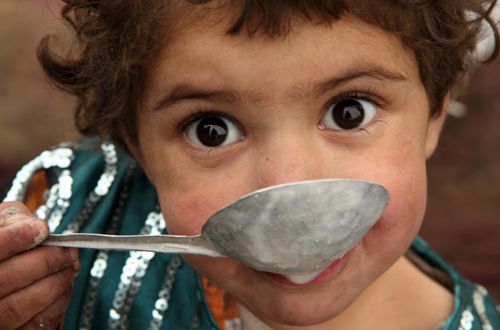
AfghanGirlMajidSaeediGettyImage

A young girl eats some food as displaced Afghans queue to receive relief aid from the United Nations High Commission for Refugees (UNHCR), on December 1, 2009 in Kabul, Afghanistan. As temperatures begin to drop around the country, the UNHCR and the Afghan government are providing relief supplies, including blankets, sweaters, plastic sheets, jerry cans and bags of charcoal, to help some 200,000 vulnerable people cope with the harsh winter. By Majid Saeedi/Getty.

For A Weak Central Government

Steve Coll discusses Afghanistan:

Afghanistan's most successful period of modern politics occurred between the late 1920s and the late 1960s. The country was very poor but it managed a sustainable, multi-ethnic system of governance that included a role for a weak central government and diverse regional powers — some tribal, some other — backed by a national Army. The present circumstances are different — huge flows of international money and support tend to seek and even require a strong central government. But the model I elude to is probably more plausible. It's a balance between central and local authorities. That's more plausible than wishing for a central government that can deliver presence and justice in every nook and valley of this mountainous country.

Obama’s Strategic Vision

Before the speech tonight, these words are worth recalling:

In addition to freeing up resources to take the fight to al Qaeda, ending the war in Iraq will allow us to more effectively confront other threats in the world – threats that cannot be conquered with an occupying army or dispatched with a single decision in the middle of the night. What lies in the heart of a child in Pakistan matters as much as the airplanes we sell her government. What's in the head of a scientist from Russia can be as lethal as a plutonium reactor in Yongbyon. What's whispered in refugee camps in Chad can be as dangerous as a dictator's bluster. These are the neglected landscapes of the 21st century, where technology and extremism empower individuals just as they give governments the ability to repress them; where the ancient divides of region and religion wash into the swift currents of globalization.

Under His Thumb

Jean MacKenzie traces Karzai's rise and fall from grace. On the present moment:

“Karzai knows very well that the United States is not going to pull out its troops,” said Afghan political analyst Waheed Mojda. “He does not have to comply with their demands; there is nothing they can do. They are in Afghanistan for their own strategic interests, not for him.”

Those strategic interests are coming under increasing scrutiny, but the administration, and numerous commentators, are bending over backwards to make the case for the U.S. military presence in Afghanistan. They conflate the Taliban with Al Qaeda and argue confidently that a loss in Afghanistan could trigger a regional collapse. Those who remember Vietnam and the Cold War experience a shudder of recognition. “It’s called ‘the domino theory,’” said one expert on Pakistan, speaking privately.

Keeping His Promise

Greenwald unpacks justifications for Obama's troop escalation:

 The most bizarre defense of Obama's escalation is also one of the most common:  since he promised during the campaign to escalate in Afghanistan, it's unfair to criticize him for it now — as though policies which are advocated during a campaign are subsequently immunized from criticism.  For those invoking this defense:  in 2004, Bush ran for re-election by vowing to prosecute the war in Iraq, keep Guantanamo opened, and privatize Social Security.  When he won and then did those things (or tried to), did you refrain from criticizing those policies on the ground that he promised to do them during the campaign?  I highly doubt it.

Leaving the Right, Ctd

A reader writes:

Your sixteen theses are compelling individually and damning in aggregate. But wouldn't it be simpler just to say: 'I cannot support a movement'?

Earlier this year, you noted that the "really interesting conservative icons I revere – Hobbes, Hume, Burke, Oakeshott and Hayek come to mind – show that liberal strains are intrinsic to sophisticated conservatism," praised "their lack of political monochrome," and wrote of your own desire to "embrace these various strains, sometimes one, sometimes another, in response to a fluid world and an evolving soul." That suggests, to your credit, that your disquiet with partisan loyalty and movement solidarity runs deeper than any particular policy disputes.

You list your choices in the last seven presidential contests – and six of them would have represented the defeat of the incumbent party. You illustrate the post with a pair of individual portraits, but they're not Reagan and Thatcher – they're Burke and Oakeshott. Your post, in short, makes the case for the integrity of principles and ideals, and for those who articulate them. And the history of your allegiances suggests that as parties and their leaders betray those ideals in the messy business of politics, you tend to hold them to account and join your voice to the opposition.

I agree with your theses. But I suspect that if you were to try, you could compile sixteen sins of the progressive movement. Which is not to suggest a mindless equivalence. After eight years of excess in one direction, a corrective is clearly needed. But in time, I suspect, the pendulum will swing. And I'll be disappointed and surprised if, within fewer years than might now seem likely, you're not declaring your general disgust with the Democratic Party and calling for a change in power. That's the nature of a fluid world, after all, and an evolving soul.

Yes, and that's also, by the way, why I have always felt very uncomfortable in a gay "movement". "Virtually Normal" was an attempt to apply an Oakeshottian approach to the emergent social reality of a large number of openly gay citizens. Only Kenneth Minogue understood this of the reviewers. And my own dismay at movement politics has made it impossible for me to really become a political actor in the gay community. A political writer and critic and speaker maybe. But I do not do campaigns or organize or fund-raise or seek coalitions or all the other necessary and useful tasks of movement politics.