The Stimulus Worked?

Brace Bartlett highlights this CBO report (pdf) on the stimulus. The bottom line:

CBO estimates that in the third quarter of calendar year 2009, an additional 600,000 to 1.6 million people were employed in the United States, and real (inflation-adjusted) gross domestic product (GDP) was 1.2 percent to 3.2 percent higher, than would have been the case in the absence of ARRA [American Recovery and Reinvestment Act]…Those ranges are intended to reflect the uncertainty of such estimates and to encompass most economists’ views on the effects of fiscal stimulus.

Climategate, The Consequences

Wilkinson finds a silver lining:

Though I’m sure some ideologues will merely amp up their armtwisting thug tactics to protect the fragile perception of consensus they had achieved (precioussssssss!), I predict that the overall response from the scientific community will be healthy and invigorating. Climate science will become more transparent and more rigorously by-the-book because climate scientists are becoming more fully aware that the impulse to jealously protect a public perception of consensus can undermine itself by producing questionable science and a justifiably skeptical public.

Cycling Through The Stereotypes

A reader writes:

I found this statement from your dissenter mildly ironic:

Just like Europeans shouldn't extrapolate US views of people of color from things that happen in West Texas, please don't judge "Europe" based on what one country in it does. It's offensive and it obscures the much more nuanced truth.

As a Texan who has been all over Texas, I have to correct our Swedish friend and provide him with some "nuanced truth." West Texas is less racist than East Texas (think Jasper), and Texas as a whole is less racist than the Deep South. I have no idea why the guy went straight to West Texas to make his point. I know West Texas to be a very tolerant and easy-going place. Cowboys are that way – they live and let live, as long as you show common courtesy and mind your business.

It's funny – as soon as anyone tries to overlay a moral map on a place they know little about, they just ending up undermining their case and sounding like a fool. It's best to avoid even going there, whether it is Americans judging Europe, Swedes judging Texas, or Neocons making snap judgments about the Middle East. Your next e-mail will probably be from a Southerner who is up in arms about my views of the South.

As it happens, yesterday was the annual commemoration of 16th-century Swedish King Charles XII by skinheads in Sweden.  Another reader amends the history lesson of the earlier reader:

I just snorted my diet coke through my nose when I read your reader talking about how hunky-dory religious freedom was in Poland thanks to the wonderful Warsaw Confederation of 1573.

In 1648 Bohdan Khmelnytsky massacred 100,000 Jews in the Khmelnytsky Uprising. While the Jewish population had the support of Poland's kings for a time, they were not liked by many of the lesser nobility and much of the peasantry; in time they lost even the support of Poland's kings. Through the sixteenth and seventeenth century Poland saw huge numbers of towns expel their resident Jewish populations, and merchants were in the vanguard of pogrom organization. Students regularly assaulted Jews in the major Polish cities, and police paid very little attention to these crimes.

So, I'd like your reader not to assume that because some document in the 1570s said something, that it meant a damn thing to the actual people who suffered violence, or to those people charged with enforcing that document against the vast anti-Semitism that characterized much of European society, and well, still does, but mainly in the form of a different Semitic people. It is, in your reader's own words, "offensive and it obscures the much more nuanced truth."

Go to the extensive Wiki entry to weigh the history for yourself.

On World AIDS Day

I'm not one for commemmorations; I am one for keeping HIV at the forefront of our consciousness as a serious threat to public health at home and a deadly killer abroad. And for doing what we can to mitigate its spread  – from safer sex to sero-sorting to abstinence to aggressive public education.

A friend of mine, on the other hand, just did his job. He worked in an ad agency and simply donated his time and his skills to hone a message to save his friends and people he never knew. Here's his Condoms113009big

If you fear you have HIV, get tested and get treated.

If you know you have HIV, and are getting treated, live your life. 

On Saint Andrew’s Day, Ctd

A reader writes:

I'm entertained that you managed to frame the case for Scottish independence almost entirely in terms of English concerns – how typically Sassenach. Still, I'll offer a couple of thoughts from the perspective of the classic Scot, i.e., the long term expat.

It seems to me that the whole tone of the English wanting to offload the Scots is tied to three basic issues: 12 years of a Scottish-dominated Labour Party government, the drying up of oil revenue, and the extent to which Scottish devolution did nothing to address the more contentious issues of the West Lothian and English questions of governance or the Barnett formula.

The first of these three stirs basic little Englander bigotry – things aren't going well, let's blame the Scots, they're everywhere. It's the middle class version of English shopkeepers refusing to take Scottish pound notes as far as I'm concerned. The second of these was inevitable, and one might say in return, the revenue went to HM Treasury while the oil was flowing at a rate far greater than it came back north, so don't be a bunch of ingrates.

The third is the hardest to deal with, which is presumably why no government has bothered to take a comprehensive and coherent approach. Structurally, the current approach to the Scottish Parliament and Westminster Parliaments is an affront to equity in self-governance among the Home Nations. There's no reason for it not be addressed beyond, I would suppose, party politics, and the challenges of having a Parliament for the Union that could be completely at odds with any or all of the Home Nations Parliaments / Assemblies. Certainly if I were English I'd be exercised about MPs from Scottish constituencies voting on purely English matters.

As for the Barnett formula, that's going to fade in time anyway, and it's not like there aren't funding inequities at the regional level within England – they just don't have an official name. It's also not like the Tories couldn't have taken a swipe at it before, since it's not like there was much Tory support in Scotland to lose, electorally speaking. If Thatcher was willing to write off Scotland for a generation or more by giving them the preview of the Poll Tax, I can't imagine (or remember, to be honest) why she was unwilling to kill off the Barnett formula.

I must admit to bristling at your suggestion that Scotland could be disposed of by the English as being an artifact of history, a relic of empire, but mostly that's a small country chip on the shoulder. We helped build the empire, and kill the natives, but you're right, those days are past now… and after generations of inept government policy at a national and local level, and a wholesale failure to innovate, there's really not much else for Westminster to take.

And in truth it would probably only do Scotland good to be cast off. If nothing else, it would force some clear choices about taxation, the size and scope of the public sector, industrial and education and policy, and so on. I'd like to believe that my long-left-behind countrymen-and-women could recreate themselves to be a Tartan Denmark, but I suspect that old political habits would die hard and there'd be a rush to get money from the EU. Still, we've already got the chilly disdain of Eurocrats, being shot of the English might not be the worst thing ever. It would be typical if after more than 30 years of talking about finding a new landlord or maybe even buying their own place, Scotland was evicted.

One small note: when I said that Britain was a function of empire, I didn't mean that England colonized Scotland. The union, one might recall, began with a Scottish king (and queen, of course) assuming the English throne. I meant that colonizing the rest of the world was a critical Scottish-English project that brought the two countries together. The Scots played an enormously disproportionate role in seizing new territory and policing the planet in the eighteenth and nineteenth centuries. With that joint mission over, it's hard to see why the two countries need to stay together as rigidly as they now are.


Size Matters

Ackerman calls out the WSJ:

[H]ow is this a “limited” troop increase? The Journal says that the troop increase will total around 30,000. The Washington Post’s headline says 34,000. If either figure is correct, that means Obama will order tonight a greater troop increase into Afghanistan than President Bush ordered into Iraq in 2007 for the iconic troop surge. What’s more, there are about 68,000 U.S. troops in Afghanistan today, versus about 140,000 U.S. troops in Iraq in January 2007, so relative to the existing base total of troops, this Afghanistan troop increase is way bigger than the Iraq one. Agree with it or disagree with it, there’s nothing “limited” about it.

The degenerate right has to find a way to attack Obama even if he is doing what they support. That's why I assume and hope that Obama is not fool enough to believe that the GOP will ever ever back a Democratic war president – even if he does everything they want. Their partisanship is total, as Cheney demonstrates. Cheney, the de facto GOP leader on the war, could even interpret the biggest proportional surge in either Iraq or Afghanistan as "weakness". It may be madness; but it's a funny form of weakness.

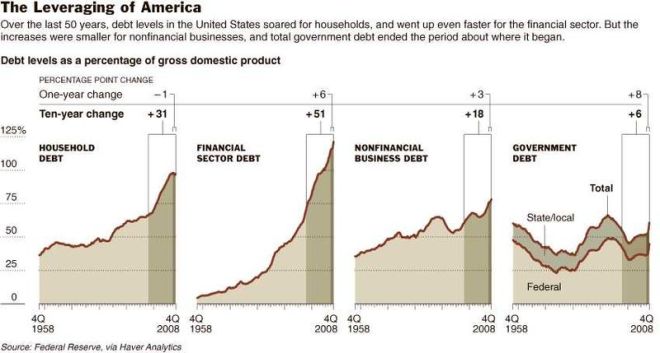
Chart Of The Day, Ctd

Chart-financial

A reader writes:

Your series of charts on debt appears to be conflating consumer credit and private sector debt.  Private sector debt includes businesses as well as households.  Although much attention is paid to household and government debt, these are both smaller than the debt of the private financial sector, according to the Federal Reserve.  What is even more worrisome is the rate of growth in financial sector debt:  In 1958, financial sector debt was 6% of GDP.  Last year, it was 115% of GDP.  Compare this to total government debt, which is actually little changed as a percentage of GDP since 1958.  If you want to get a handle on what's going on with the financial crisis, an examination of the explosion of debt in our financial institutions would be a good place to start.

Larger image here.