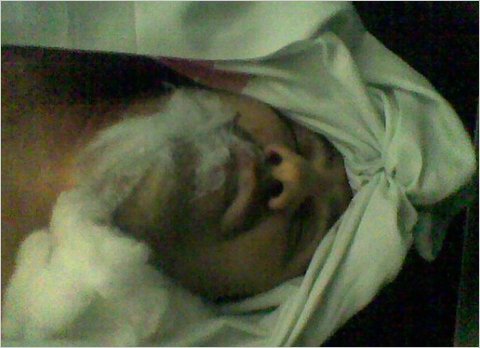
The Arrested

It's a long list:

Ebrahim Yazdi (former Foreign Minister)
Emad-e’Din Baghi (Human Rights Activist)
Morteza Hadji (Minister of educaion during Khatami era)
Leila Tavassoli, daughter of Mohammad Tavassoli
Seyed Hosein Mousavi Tabrizi (Head of the clerical Association of Teachers and Researchers of Qom)
Alireza Beheshti Shirazi (Editor in Chief of Mousavi’s online journal Kalameh Sabz)
Ghorban Behzadian Nejad (Mousavi consultant)
Mohamad Bagherian (Mousavi consultant)
Rasouli (deputy of President Khatami’s Baran Foundation)
Forouzandeh (Manager of Mousavi’s office)
Mohammad Sadegh Rabbani (retired university professor who used to be the general prosecutor 20 years ago, arrested yesterday 27 December)
Mohammad Moin (son of former Presidential candidate Mostafa Moin, the former Minister of Science and higher education, arrested 27 December)
Heshmatollah Tabarzadi (Student Activist)
Haleh Sahabi (Women’s Rights activist)

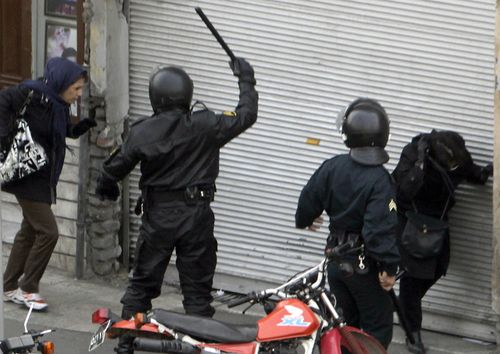
“Maddening Stupidity”

Goldblog reads the new airport security guidelines:

Thanks for letting us know, TSA, that the search should be focused on the upper legs and torso. As I've said on numerous occasions, pat-downs that ignore the crotch and the ass are useless. We recently saw in Saudi Arabia the detonation of a rectal bomb, so it really doesn't take much creativity to imagine that terrorists will be taping explosives to their scrotums. Of course, TSA is not going to be feeling-up people's scrotums anytime soon, so the question remains: Why does our government continue to make believe that it can stop terrorists from boarding civilian planes when anyone with half-a-brain and a spare two minutes can think up a dozen ways to bypass the symbolic security measures at our airports?

Quote For The Day

"I remember you asked me back in January if I loved my guy. And in light of all that's happened in this first year, I still do. Even more so. And I also have a strong sense—based not just on polls but on a lot of folks I've talked to who don't always pay attention to politics—that he DOES have that base of people who still love him too. It's hard to detect, because the part of the 'base' that's represented on cable and on blogs is so vocal (and by vocal I mean shrill), but it's there. I also read it in the letters he gets. Some of them are amazingly poignant and appreciative of what he's done and what he's doing. Some of them are tough—very tough—but still respectful and hopeful that he's doing the right thing. Even if they're unsure right now, they want him to succeed. . ." – an Obama administration worker who feels as I do about this president.

Heckuva Job, Janet

The head of DHS had the gall to say that "the system worked." What she meant is that after the incident in Detroit, the response was good. Fine. But she has no assurance that this could not happen again, and even declared that the would-be terrorist was properly screened.

More to the point, she evinces no sense of responsibility for this lapse in security. I'm sorry but that's her job and instead of preening about how she handled it after the fact, she should be apologizing for yet another instance of government incompetence and complacency. She is stonewalling and smug.

Really: disgraceful, glib, complacent, moronic. I want to know who is being fired for not taking the warning about this ooon seriously enough, and if Napolitano really believes that a near-miss, averted by the terrorist's incompetence and the passengers' courage, is a sign that the system is working, then she needs to be fired as well.

I understand the imperative to remain calm, not give these incidents more media oxygen than they deserve, not responding with hysteria or panic. But this interview went far too far in the opposite direction. She sounded like Brownie during Katrina. I have no confidence in her as head of DHS if this is her attitude. It's reminiscent of the Bush-Cheney years: arrogance and a refusal to take responsibility.

Will Rafsanjani Finally Get Off The Fence?

Masoud discusses the widening gulf between conservatives and Khamenei in the wake of Ashura:

If Rafsanjani decides to take the unprecedented step of coming out against Khamenei, which is not as outlandish of a possibility as it once was prior to Karoubi’s blatant condemnation of the regime last night, it would undoubtedly be a game-changer. Simply put, it would openly signal political abandonment of the regime by the country’s second most powerful figure. If Rafsanjani remains quiet, however, questions will surely begin to be raised as to where his true allegiances lie. Consequently, as the demands of a galvanized and broadening opposition grow, he will arguably be less and less able to hedge his bets.

Khamenei The Uniter

Meir Javedanfar insists that the Supreme Leader has brought an "intifada" upon himself:

His decision to allow the Basij to mount an attack on mourners at Ayatollah Montazeri's funeral was one factor leading to the spread of opposition in rural areas, faster and more efficiently than any campaign the reformist camp could have orchestrated. Yes, members of the opposition tried to take advantage of the mayhem, but also many genuine mourners had come to pay homage to a Grand Ayatollah. […]

If the Shah had committed such an affront, one could have attributed it to his brute dictatorial secularism. But for the Supreme Leader of an Islamic Republic to order violence against Islamic institutions means turning against the very establishment that formed the foundation — or the very DNA — of the current regime.

Letting The Regime Collapse

Stephen Walt reiterates the restraint he believes the US government should have towards the Iranian protestors:

If you’re looking for a useful historical analogy, think back to the "velvet revolutions" in Eastern Europe. Neoconservatives used to argue that the rapid and mostly peaceful collapse of communism proved that rapid democratic transformations were possible in unlikely settings, and they used that argument to justify trying the same thing in Iraq. (We all know how well that turned out.) In fact, the velvet revolutions were a triumph of slow and patient engagement from a position of strength. The upheavals in Eastern Europe were an indigenous phenomenon and the product of containment, diplomatic engagement, and the slow-but-steady spread of democratic ideals through the Helsinki process and other mechanisms. And the first Bush administration was smart enough to keep its hands off until the demise of communism was irreversible, which is precisely the approach we ought to take toward Iran today.

The Assassination Of Ali Mousavi

Ali-mousavi

More details emerge:

Unlike the other protesters reported killed on Sunday, Ali Moussavi appears to have been assassinated in a political gesture aimed at his uncle, according to Mohsen Makhmalbaf, an opposition figure based in Paris with close ties to the Moussavi family. Mr. Moussavi was first run over by a sport utility vehicle outside his home, Mr. Makhmalbaf wrote on his Web site. Five men then emerged from the car, and one of them shot Mr. Moussavi. Government officials took the body late Sunday and warned the family not to hold a funeral, Mr. Makhmalbaf wrote.

Juan Cole adds some punch to what we already know about Ali:

Killing a sayyid is a blot on any Iranian government. Doing so on Ashura, the day of morning for the martyred grandson of the Prophet, Imam Husayn, borders on insanity.