
Washington, DC, 12.03 am
Washington, DC, 12.03 am
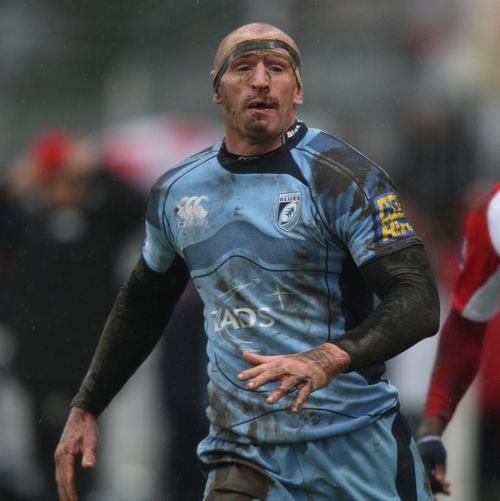
Yes, rugby is a rough and dirty sport. It's also now a gay one. Gareth Thomas, above, just came out in Britain, another landmark for inclusion and equality in a major sport in Europe. Thomas comes out as an active player, which is somewhat ballsier than in retirement. It's hard to express what this means in such a man's sport as rugby. But it's a big deal.
"Arrogant&Naive2say man overpwers nature. Earth saw clmate chnge4 ions;will cont 2 c chnges.R duty2responsbly devlop resorces4humankind/not pollute&destroy;but cant alter naturl chng," – Sarah Palin, commenting on Copenhagen.
In office, she took climate change seriously – or at least purported to. But in order to become a leader of the fundamentalist religious movement that is now the GOP, she has to invoke the Inhofe position that "God is still up there" and that any attempt to conserve our planetary inheritance is not wise stewardship but a kind of arrogant blasphemy. Insofar as Palin is able to understand these issues, she favors more oil drilling but no pollution. Yes, I know. But I have long since stopped trying to engage Palin rationally, because there is nothing rational or reality-based to engage with.
But the interesting aspect is her insistence that any attempt to mitigate climate change or develop new non-carbon energy sources is some kind of arrogance and naivete – as if the massive growth in human carbon use in the past two centuries was the divine norm for aeons. The point, however, is a classically fundaentalist one: is to posit their contemporary grip on reality as an eternal and unchanging reality under God's control, rather than a snapshot of a constantly changing and evolving planet, affected by what happens on it and beyond it. Fundamentalist religious movements can only have religious approaches to pragmatic problems. That's why Iran has to import refined gasoline, because religious fanatics know only doctrine, not reality.
If you want that kind of government in America, you know who to vote for. The Republicans will deal with the climate according to fundamentalist Biblical principles: more oil drilling, more carbon energy, and a religoius war with Islam over these resources. If that's your vision of the future, you need to become a Republican.
This whole idea of actually having a vacation before Christmas hell turned out to be a wondrous one. It’s been one of the best breaks I can remember, possibly because I was so wiped out beforehand. I want to thank my trusty under-bloggers, Chris and Patrick, for holding down the fort and proving yet again how this blog is now far more than my lone efforts. But a special thanks to Andrew Sprung and Conor Friedersdorf. Conor, a Dish alum, has swiftly become one of the more lucid, calm and persuasive right of 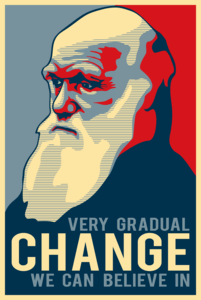 center voices out there. Andrew’s blog is one of my secret Internet pleasures, another oasis of reason and insight in a blogosphere with plenty of emotion and propaganda. Keep up with Andrew here.
A small word about the increasingly collaborative nature of the Dish, since some strangers to the blog seem to have misunderstood its structure. This is understandable since the Dish has, since its beginning, been a consciously and continuously evolving site. Some blogs are basically now what they were when they started, and that’s a fine thing. But since this blog started when Bill Clinton was president, and since I’m a restless and curious spirit, that hasn’t happened here. The original 2000 concept – one writer sending his wisdom to the world – almost immediately succumbed to the medium. The minute I started blogging, the readers insisted on being an integral part of the project. Their contributions, emails, tips, links, harangues, praise, and criticism became a form of lodestar for the Dish. From the dissents to the window views to the email threads (“The View from Your Recession,” “It’s So Personal” on late term abortions, etc) the Dish is as much your blog as mine at this point. And it’s much stronger for it. (I recount some of this in my 2007 essay, Why I Blog.)
In the last three years at the Atlantic, I also experimented by marshaling interns to filter the web. They began by writing me memos of links I might have missed or new bloggers I couldn’t keep up with. The best and most attuned to Dishness eventually became staffers – all two of ’em – and went from memos to draft posts, which I then edited, tweaked and posted. That’s still the basic structure. But as time has gone on, and Chris and Patrick have become so skilled – the Iran coverage of last June was a genuine three-man-effort round the clock – I’ve been able to delegate some more. This coming year, I hope to evolve this concept even more to include a couple more under-bloggers.
I’m doing all this experimentally and provisionally, figuring out what works, what doesn’t, and trying to learn all the time. We’re pioneers here at the Dish and that means knowing what you don’t know. But my sense of the current intimations is that the Dish has organically evolved into an edited viewspaper, which has at its core my own take on the world, but which hopes to incorporate as many alternative views as possible in a coherent and entertaining conversation.
Is this an evolution in the idea of a “magazine” online? Who knows? What I do know is that the collaborative nature of the Dish is something I regard as a strength and something unique to the web and therefore worth exploring further in this open source medium.
If new readers are deluded at first blush in thinking that all this is the result of one man alone typing into a laptop, then they’ll soon figure out what’s going on. Should there by bylines at all times? My sense right now is not. Since almost everything goes through my frontal cortex, and very very little (and nothing substantive) appears without my clicking publish, I function as the editor and chief writer. Any editorial views published as such on this blog are therefore mine and mine alone. But the content and counter-argument are generated by the collective mind of the readers, under-bloggers and the rest of the blogosphere. I think it’s cleaner and simpler not to clutter the blog up with bylines, and to retain its identity as one single narrative conversation. As long as you’re transparent about that, and we have been, I see no problem.
In fact, this is what magazines used to be in the good old ancient days. Think of the Economist, one of the few old magazines to have retained its by-line-free content. No one believes that everything is written by one person; but it is all part of collective effort ultimately overseen by one editor. It was like that when it started and it retains a simplicity and coherence that other magazines do not have. Its point is the content not the authorship, like our emails, which have always been anonymous. An online blogazine will never be quite like that, since it’s far more open-source, but I like the idea of importing a classic magazine form into a new medium (remember when the New Yorker’s Talk of the Town was also non-by-lined and when TNR was largely one unsigned editorial after another?). No one else is doing the web quite like this – evolving a one-person blog into a collaborative but edited news and views stream – and it may all end in tears; but the reason I jumped into this medium a decade ago was to experiment in ways I couldn’t elsewhere. Ten years in, the Dish is still experimenting, and I’d get bored and move on if it weren’t. As we add new under-bloggers and mature as an organization, we’ll be as transparent as feasible without somewhat solipsistic posts like this one appearing too often.
Plans are still fluid and provisional, but the next year could take the Dish to a new level and in a new direction; and if I can find a way to do that without driving myself to exhaustion, I will. In fact, finding a way to share this burden is the only way a single human being can continue to do this at this pace for this long. The principle will be as it always has: a pursuit of the intimations within the medium, executed very gradually and transparently. It’s an adventure. And I hope you’ll stay with us for the ride ahead.
(Darwin poster by Mikero.)
by Andrew Sprung
Time to sign off. Blogging here at the Dish this week has been a joy to me, and I hope of some use or pleasure to readers. Please stop in at my blog, xpostfactoid, and let me know your thoughts.
Many thanks to Andrew, who I hope returns recharged, and to Patrick and Chris for working my posts into the flow while keeping things lively all week.
by Chris Bodenner
A reader writes:
My all-time favorite, because it is both an amazing song and amazingly depressing, is Prince's "Another Lonely Christmas." The narrator is mourning the loss of his lover seven years prior on Christmas Day. Terribly depressing. And yet, it rocks incredibly hard.
Another writes:
Has special meaning to me, as my mother passed away on December 28, 1984, three days after Christmas. I well up almost every time I hear it.
I couldn't find a video for the song, but here is a link to an audio version. The video above is a different song by a very different artist, but it hits the same basic theme. Lyrics for the Prince version after the jump:
Last night I spent another lonely Christmas
Darling, darling, U should've been there
Cuz all the ones I dream about
U are the one that makes my love shout
U see, U are the only one I care 4
Remember the time we swam naked in your father's pool
Boy, he was upset that night
But boy, was that ever cool
Remember that night we played pokeno 4 money
And U robbed me blind
Remember how U used 2 scream so loud cuz U…
U hated that number 9
Hey, I saw your sister skatin' on the lake this afternoon
Good heaven, how she's grown
She swoons the boy skaters cuz she's so tall
But of all your father's children
All your father's children, baby
U know U are the finest of them all
U are brighter than the northern star and I…
Last night I spent another lonely Christmas
Darling, darling, U, U should've been there
Cuz U see, of all the ones I dream about
U are the one that makes my love shout
U see, U are the only one I care 4, listen
Do U still like banana daiquiris
boy we used 2 get so touched
U use 2 get so horny
U'd make me leave the lights on
I'd pay money just 2 C
your happy dancin silouette upon the pier
Sometimes I think I hear U smilin
Sometimes I think your here
I find myself holding every pillow
N the bed U and I used 2 share
Last night I spent another lonely Christmas
Darling U shouldn't B
U shouldn't B there, cuz U C
Last night I spent another lonely Christmas
Darling, darling, U, U should've been there
Cuz U see, of all the ones I dream about
U are the one that makes my love shout
U see, U are the only one I care 4, yeah
My mama used 2 say always trust your lover
But now I guess that only applies 2 her
Cuz baby, U promised me
Baby, U promised me U'd never leave
Then U died on the 25th day of December
Oh baby, last night, oh, I spent another lonely, lonely Christmas
Darling, baby, U, U should've been there
Cuz all the ones I dream about
U are the one that makes my love shout
U see, U are the only one I care 4, yeah
Your father said it was pneumonia
Your mother said it was stress
But the doctor said U were dead and I…
I say it's senseless
Every Christmas night 4 7 years now
I drink banana daiquiris till I'm blind
As long as I can hear U smiling, baby
U won't hear my tears
Another lonely Christmas is mine, yeah, mine, yeah
Another lonely Christmas is mine
Last night, yeah, I spent another lonely, lonely Christmas
Darling, darling, U should've been there, yeah
Cuz all the ones I dream about
U are the one that make my love shout
U see, U are the only one I care 4
by Andrew Sprung
listen to its godfather. Jacob Hacker throws his support behind the surviving health care reform legislation and tells progressives where to concentrate fire in the House-Senate reconciliation process:
The lack of a public option also makes even more imperative tough requirements on insurers to make them live up to their stated commitment to change their business model and slow the spiraling cost of coverage. The most important way to do this is to move away from the Senate bill’s state exchanges and toward a national exchange such as that contained in the House bill. The federal government needs to be directly involved in implementing and enforcing strong national regulations of insurers and creating the new exchange. Otherwise, the effort for reform might fail at the hands of hostile governors.
The federal government is the only entity big enough and powerful enough to ensure a highly consolidated private insurance industry follows the law. It can and must demand transparency and obedience to the new rules. Insurers must open their books, and subject their rates, administrative costs, and profits to federal review. These new rules must apply to all plans, not just those within the exchange. And states should have authority not only to enforce these rules, but to innovate beyond them as well.
These are not politically unrealistic goals. Most are already embodied in the House bill. In bridging the differences between the two bills, Democratic leaders and the President must insist on a final bill that delivers on these fundamentals.
Health care experts and commentators including Alan Garber, Jonathan Gruber, Ron Brownstein, and Atul Gawande have advocated or praised the cost control measures packed into the Senate bill. But most of these measure, including the strengthened MedPAC and an array of pilot programs and efficiency incentives, pertain mainly to Medicare and Medicaid, over which Congress maintains power of the purse (an exception is the excise tax on expensive employer-provided plans). The House bill, Hacker reminds us, provides the means for stronger control of private insurers. Viewed another way, the Senate bill's best cost control measures mainly focus on changing the behavior of health care providers; the House's, on reshaping private insurance.
It's easy to imagine a bill that combines the best — or worst — elements of the House and Senate bills. What we'll probably get is a messy mixture.
by Patrick Appel
Currently there is no federally imposed minimum on the percentage of premium dollars that insurers must spend on health care, a statistic known as a "medical loss ratio." States typically require only 55 percent to 60 percent. The House bill requires 80 percent. Reid modified that to 80 percent for family policies and 75 percent for individual policies, then bumped it up to 90 percent to compensate for the loss of a public option. The manager's amendment now sets it at 85 percent for large-employer-based policies and 80 percent in the nongroup and small-business markets. According to a little-noticed Dec. 13 CBO analysis, setting the medical loss ratio any higher would have compelled CBO to consider private insurers to be part of the federal government!
by Patrick Appel
Austin Frakt looks ahead:
Though some provisions begin sooner, full implementation will not be achieved until 2014. Between now and then there will be two congressional election cycles, two congressional sessions, and one presidential election. Given the controversial nature of some elements of reform, the slim margin by which it will pass (assuming it does), and the political importance of its success for Democrats, it is clear that changes will be proposed. Some may be deadly.
It is possible to kill health reform without repealing it, which would be politically difficult. Death by underfunding or otherwise undermining its intentions is politically possible and even likely if Republicans regain control. In large part, the success of health reform or at least successful implementation of it depends on winning and re-winning debates over its provisions.

 The Dish