The Uniqueness Of Humans

by Patrick Appel

A reader writes:

I know this is a long video, but it seems to touch on many of the ideas you have been swirling around on this blog this past year.  For me, the Daily Dish (whether I agree with the sides it takes or not) has been all about defining humanity and putting it under the lens.  From the mental health breaks to the view from your window to the long actual ongoing discussions, it is all about looking at the world through the shoes of others and embracing mankind. The lecture is beautifully written and delivered by the renowned primatologist and neurobiologist Robert Sapolsky, enjoy.

The speech starts exactly at the 5:00 mark and is well worth watching. I know that I deserve a Poseur Alert nomination for saying this, but the way this reader describes the Dish corresponds well with what I think of as the overarching goal of the blog.
Fake War Ends

by Patrick Appel

Chris Beam thinks that the war on Christmas is basically over:

Just as the "war on Christmas" has obscured legitimate debate over church and state, other national issues seem to be overwhelming the "war on Christmas." Health care reform, climate change talks, and tax breaks for bankers provide plenty of fuel for conservative anger—and eat up plenty of air time. And perhaps Obama is diffusing some of the fear that his election would usher in an era of secular humanism. A devout Christian, he has continued many of the religious traditions of his predecessor, including the National Day of Prayer.

Then there's the rise of third-way groups like the Advent Conspiracy, which embraces the religious aspects of Christmas but rejects the consumerism surrounding it. (Watch their promo video here.) Rather than a war on Christmas, they're fighting a war for Christmas.

The Speed Of Thought

by Patrick Appel

Carl Zimmer studies it:

[R]educing the speed of thought in just the right places is crucial to the fundamentals of consciousness. Our moment-to-moment awareness of our inner selves and the outer world depends on the thalamus, a region near the core of the brain, which sends out pacemaker-like signals to the brain’s outer layers. Even though some of the axons reaching out from the thalamus are short and some are long, their signals arrive throughout all parts of the brain at the same time—a good thing, since otherwise we would not be able to think straight.

Moral Facts And Honda Civics

by Patrick Appel

Wilkinson debates moral realism:

I’m definitely a realist about institutional facts, such as the fact that I own my 1996 Honda Civic. As John Searle helpfully puts it, these kinds of facts are ontologically subjective — they are facts in virtue of mental states — but epistemically objective. If you believe that I don’t own my 1996 Civic, you’re just wrong. I do own it. And I have a piece of paper from the State of Iowa that proves it. That this piece of paper proves it is due to a firmly-established, widely-shared set of beliefs and intentions.

I think moral facts are a lot like the fact that I own my car. But the firmly-established, widely-shared beliefs, sentiments, and dispositions to judgment in virtue of which moral claims are true or false vary over time and space. I do think some of these moral facts give us rationally authoritative reasons for action, but others don’t. (There are bad moralities!) So, I’m still not sure whether or not I count as a moral realist.

Montazeri, RIP

52014379

by Chris Bodenner

Scott Lucas reacts to the passing of Ayatollah Hossein Ali Montazeri, who died in his sleep this morning:

Montazeri, 87, was one of the most prominent clerics in Iran since the 1979 Islamic Revolution. In the 1980s he was the designated successor to the Supreme Leader, Ayatollah Khomeini, until he was sidelined because of political and religious divisions and a falling-out with Khomeini. Ayatollah Khameini eventually became Supreme Leader. Montazeri was isolated and then placed under house arrest after clashes with Khamenei.

In recent months, Montazeri was one of the most vocal supporters of the opposition movement, going as far as to criticise the legimitacy of the Supreme Leader. … On 11 December, the Defenders of Human Rights Center in Iran named Montazeri as its Human Rights Activist of the Year. In his acceptance speech, Montazeri said, “None of those [aggressive actions by the Iranian Government] are legal.”

Masoud discusses the implications for the protest movement:

It is significant that yesterday marked the first day of Moharram, the current holy month that has several consecutive days of mourning and public ceremonies. As with previous occasions, the opposition will no doubt exploit the ceremonies to launch political protests. Ashur, the most important day when Imam Hossein is mourned, falls on December 27th.

Montazeri's death just before this day has significant implications. While the regime may be glad to have one of its harshest critics gone, his death is only bound to lead to an enormous outpouring in the streets of Tehran next week. The demonstrations, in fact, may likely be the largest in months.

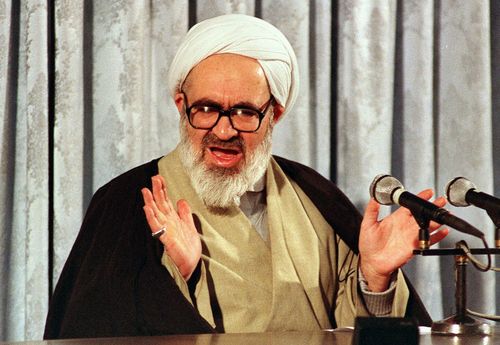
Picture dated 05 February 1989 shows Ayatollah Hossein Ali Montazeri speaking on the occasion of the 10th anniversary of Iran's Islamic Revolution. Montazeri, the second most powerful man in Iran until eight years ago, has become one of the Islamic Republic's leading dissidents and a catalyst of recent political unrest. (NORBERT SCHILLER/AFP/Getty Images)

The Benefits Of Free Will

by Patrick Appel

Jonah Lehrer highlights a few studies suggesting that not believing in free will adversely impacts ethics. The gist:

At the very least, free will is a useful illusion, leading us to be more prosocial and ethical. Because even if we are just "a vast assembly of nerve cells and their associated molecules," we're a vast assembly that feels like so much more. William James, as usual, said it best: "My first act of free will shall be to believe in free will."

Some related thoughts by Jonah here:

When we learn that the amygdala is an ancient part of human nature, pumping out fear and anger, does that make it harder to resist the amygdala? When we learn that sugar activates the same dopaminergic areas as sex and crack, does that make it harder to not eat the candy bar? The brain has preserved a small space for executive control, which is a weak synonym for free will. Is modern neuroscience, by describing the determinism of the fleshy machine, undermining that sense of control? My worry is that we've come to see our imperfections as inevitable, just like those testosterone fueled subjects acting greedy in the ultimatum game.

Face Of The Day

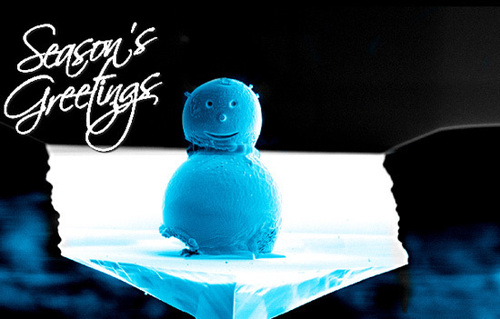
Face-snowman

by Chris Bodenner

TDW:

Tis the season to be silly at the National Physical Laboratory, where scientists have constructed the world’s smallest snowman by shooting a focused ion beam at nano-scale tin beads used in the correction of electron microscope astigmatism. The final product measures a ridiculous 10 µm across — 1/5th the width of a human hair. Check out the making of here.

The Internet And Democracy

by Patrick Appel

Clay Shirky responds to Evgeny Morozov:

It is impossible to know how the next few months in Iran will unfold, but the use of social media has already passed several tests: it has enabled citizens to coordinate with one another better than previously, to broadcast events like Basij violence or the killing of Neda Aga Soltan to the rest of the world, and, by forcing the regime to shut down communications apparatus, the protesters have infected Iran with a kind of technological auto-immune disease. However great the regime’s short-term desire to keep the protesters from communicating with one another, a modern economy simply cannot function if people can’t use their phones. The regime may yet crush protests, but even if they do, the events of June to November this year will still have broken the old illusion of a happy balance between democratic, theocratic, and military power in Iran.

Depressing Christmas Songs, Ctd

by Chris Bodenner A reader sends along a song by Jonathan Coulton. Lyrics after the jump:

You have put on your feety pajamas
It’s time for a long winter’s nap
There’s a knock on the door and a stranger is there
He wants you to sit on his lap
He takes your watch and he gives you a hairbrush
Your wife gets a wig on a chain
He says he can’t stay
Cause he’s got a long way to go
And it’s starting to rain

Christmas is interesting
Like a knife in your heart
Christmas is interesting
How it tears you apart
Christmas is interesting
Like a stick in your eye
It’s so freaking interesting
That it might make you cry

So you’re an elf, but you’d rather be a dentist
Maybe you’re a train with square wheels
Maybe you’re a squirt gun that only shoots jam
Now you know how Jesus feels
He is riding a sleigh he calls Rosebud
His mansion is lonely and cold
He can’t remember a pleasant December
When he wasn’t tired and old

Christmas is interesting
Like a knife in your heart
Christmas is interesting
How it tears you apart
Christmas is interesting
Like a stick in your eye
It’s so freaking interesting
That it might make you cry

So you’re drunk and your name is Jimmy Stewart
You once had a wonderful life
Then you lost all your money, you cracked up your car
You yelled at your favorite wife
You go to bed and you wait for Jacob Marley
He comes to make you feel brave
But under his cloak he is nothing but smoke
And a finger that points at your grave

Christmas is interesting
Like a knife in your heart
Christmas is interesting
How it tears you apart
Christmas is interesting
Like a stick in your eye
It’s so freaking interesting
That it might make you cry