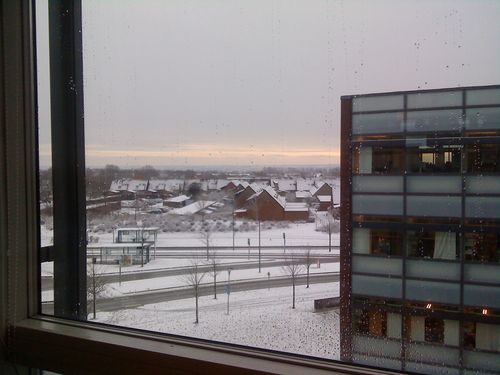
Lund, Sweden, 2.10 pm
Lund, Sweden, 2.10 pm
by Conor Friedersdorf
A reader writes:
A chicken and an egg are making love.
The chicken climaxes, rolls over, lights up a cigarette and says, "Well, I guess that settles that!"
by Andrew Sprung
Tariq Fatemi, a Pakistani career diplomat and close associate of former Prime Minister Nawaz Sharif, who briefly served as Pakistan's Ambassador the U.S., was not reassured by Obama's speech at West Point. In his weekly column in Dawn he voices a spectrum of anxieties and grievances that bedevil the Pakistani end of the Pakistani-U.S. relationship.
First, that Pakistan will be the U.S. scapegoat:
But [Obama] having made this commitment [of additional troops], what measures can one expect from the administration to eliminate Al Qaida and weaken the Taliban? Undoubtedly, it will be Pakistan where henceforth the ‘buck stops,’ and which will be held responsible for America’s failure in Afghanistan.
Then, that Pakistan will alienate historic allies in Afghanistan — while India encroaches unchecked by the U.S.:
But if the Americans are supposed to start withdrawing their troops in less than two years, would Pakistan not be justified in hedging its bets? After all, if we are to live next to a Taliban-dominated Afghanistan, why annoy them? Even more worrying is the absence of evidence of US willingness to use its influence to bring India back to the negotiating table, or even of asking it to end its alleged interference in Fata and Balochistan.
And again, that India will outflank Pakistan in its relationship with the U.S. — and in its influence in Afghanistan:
Within a fortnight, New Delhi has notched up two major diplomatic successes. Last month, Prime Minister Manmohan Singh was the first state guest of the Obama administration, where he was able to get a reaffirmation of the US-India ‘global strategic partnership.’ Though he could not obtain an irrevocable commitment regarding the provision of advanced enrichment and reprocessing technologies, he did achieve success on the issue of counterterrorism.
The two countries expressed their ‘grave concern’ over the continuing terrorist threat ‘emanating from India’s neighbourhood,’ while agreeing that ‘resolute and credible steps be taken to eliminate safe havens and sanctuaries that provide shelter to terrorists and their activities.’
Also surprising was US appreciation for India’s role in Afghanistan. This, after Pakistan’s claim that the administration had been asked to use its influence to urge India to reduce its presence in Afghanistan.
The image accompanying Fatemi's piece: Obama toasting Indian Prime Minister Manmohan Singh. The caption: "What was surprising was US appreciation for India’s role in Afghanistan. This, after Pakistan’s claim that the administration had been asked to use its influence to urge India to reduce its presence in Afghanistan."
by Patrick Appel
Megan tells it like it is:
Ultimately, the moderates had a very good alternative to negotiated agreement, and the progressives didn't, and that was crystal clear from Day 1. That meant the progressives were never, ever going to get very much. This was not a failure of political will or political skill. It was the manifestation of a political reality that has long been obvious to everyone who wasn't living in a fantasy world. If progressives decide that the lesson from this is that they haven't been sufficiently demanding and intransigent, they are going to find themselves about as popular with the rest of America as the Bush Republicans, and probably lose their party the House next year.
by Chris Bodenner
A reader writes:
The most depressing Christmas song I have ever heard, the one that makes me cry, consistently, every time, is "Wintersong," by Sarah McLachlan. Sarah was the soundtrack of my high school years and I associate her voice with all the pain and angst of adolescence. When she released a Christmas album in 2006, at the same time as I was breaking up with a wonderful man (who I am still not over), a perfect storm of depression came together. Even without that background, I think anyone would agree that this is a seriously depressing Christmas song.
Lyrics after the jump:
The lake is frozen over
The trees are white with snow
And all around
Reminders of you
Are everywhere I go
It's late and morning's in no hurry
But sleep won't set me free
I lie awake and try to recall
How your body felt beside me
When silence gets too hard to handle
And the night too long
And this is how I see you
In the snow on Christmas morning
Love and happiness surround you
As you throw your arms up to the sky
I keep this moment by and by
Oh I miss you now, my love
Merry Christmas, merry Christmas,
Merry Christmas, my love
Sense of joy fills the air
And I daydream and I stare
Up at the tree and I see
Your star up there
And this is how I see you
In the snow on Christmas morning
Love and happiness surround you
As you throw your arms up to the sky
I keep this moment by and by
by Patrick Appel
Josh Marshall gets an e-mail:
If I feel abandoned, it's not by Obama and the Democratic party, it's by those on the left advocating to kill the bill.
I am unemployed and have a pre-existing condition that requires daily medicines, quarterly doctors visits and an annual test. I am on COBRA, which runs out mid-2010, when I will have to find new health insurance. I will need to purchase some kind of health insurance, assuming I can find provider who will insure me
I don't pretend to understand all the intricacies of the health care reform bill, but I do read a lot. From what I can glean, if the bill passed, I would be able to find health insurance because I could not to be turned down due to my pre-exisiting condition. And based on my income at the moment, my premuims would be subsidized.
by Patrick Appel
Matt Steinglass makes what should be a familiar argument by now:
I remember what it felt like to move to the Netherlands and be told that I would have to buy health insurance, or I'd be kicked out of the country. For an American, it certainly felt…different. Then I encountered the other difference: I signed up for a plan, and found my premium cost me a quarter what I'd been paying in America. That was the result of decades of constituent pressure on politicians to get health-insurance costs down. Mr Olbermann and Mr Moulitsas are still thinking like free-market consumers of health insurance: they don't like it, so they want out. Of Albert Hirschman's trio of options for consumers in failing organisations, "Exit, Voice, and Loyalty", they're choosing "exit". When you move to universal health insurance, you have to get used to choosing "voice": if you don't like it, you fix it.
by Chris Bodenner
A reader writes:
Hard to beat Dwight Yoakam's "Santa Can't Stay" for a depressing xmas song. It's one of my very favorite xmas songs for its Jerry Springer lurid charm. Story is, kids' dad dresses as Santa and goes to visit kids at ex-wife's house and ex-wife throws him out. Here is the only version I could find online for free. I don't think it warranted a video.
Lyrics after the jump:
Cold tears fall from his eyes
As he turns into the night and walks away
Lucille runs outside
Just to see if there might be a sleigh
Little Bobby stares down
At the plate where cookies still lay
And tries to understand
Why momma said Santa can't stay
Momma said Santa can't stay
Said she told him that twice yesterday
Then a car just like Dad's
Pulled out and drove away
After mom said Santa couldn't stay
They both heard him coming
Saw Mom run down the hall and holler wait
Doug you're drunk don't come inside
I'm not joking I've had all this I can take
He threw a present really hard
That almost hit Mom's new boyfriend Ray
And yelled ho-ho lucky for you she's here
And said that Santa can't stay
Today on the Dish we moderated more debate on healthcare from John Cole, Ezra Klein, Nate Silver, Matt Yglesias, James Joyner, James Poulos, Keith Hennessey, and Marc Ambinder. The Catholic Church backed off its threat to DC over marriage equality and Dale Carpenter shared his related thoughts. Congressman Aaron Schock became the latest Republican to embrace torture. Readers reacted here. More reader discussion of detainees here and here. Santa got the Schock treatment here and here.
In the guest-blogosphere, Friedersdorf diagnosed the ills and contractions of the current conservative movement, reflected on the state of reality TV, aired emails about what the press should cover, and narrated a photo essay of Kansas City through the lens of the talented and lovely Lara Shipley (whose other work you can find here). Sprung confronted Clive Crook over the feasibility of French-style healthcare in the US and pondered the American "abandonment" of Afghanistan in 1989. A reader pushed back against the latter. Patrick responded to all the haters.
A wave of depressing Christmas songs have started to roll in from readers – the first batch here, here, here, and here. We also posted a touch of Christmas hathos.
— C.B.
by Patrick Appel
Ambinder sums up the current state of affairs:
The two arguments are these: the White House contends that the bill is a foundation — and will meaningfully improve the lives of 30 million people without insurance — and represents the greatest advance for American health care since LBJ and Medicare. The activist left, broadly, has come to the view that the Senate (and the White House) are held hostage by the forces to whom we've outsourced our health care: the insurance industry, who've just received a massive subsidy in exchange for minimal sacrifices.
The truth, of course, is that both of these arguments are valid. Which one you accept is a matter of taste, preference, mental furniture, ideological commitment, geography.
Beyond this, though, it's a matter of respect: liberals aren't feeling the love. They feel taken for granted. They feel as if the president hasn't done enough to bring them into his coalition. They projected a lot onto candidate Obama, and — for a variety of reasons, some valid — don't see the same guy. It is as if Obama's approach to governing assumes that the only influential audiences are the ones he has to court. The White House is looking for ways to palliate the anxiety.
 The Dish