The Sex Crime Hysteria

by Conor Friedersdorf

If you aren't reading The Agitator you should be.

Today its author, Radley Balko, is highlighting this story:

23-year-old Matthew Freeman is facing a year in jail for violating Michigan’s laws for convicted sex offenders. He was caught by a police officer playing basketball within 400 feet of a school. He also happened to be in front of his own home. Michigan law requires him to remain more than 1,000 feet away from places where children congregate. Freeman’s mother says she checked with Pittsfield Township police before moving to the home to be sure it complied with Freeman’s status. She says they told her it did. They now say it’s Freeman’s responsibility to make sure he doesn’t violate the sex offender law.

Freeman was convicted of fourth-degree sexual assault in 2003 for having sex with his 15-year-old girlfriend. He was 17 at the time. The conviction required him to spend 10 years on the state’s sex offender list. After seeing the girl again and later getting caught stealing a video game, he was sentenced to 90 days in jail, and ordered to remain on the list until 2028. At that point he dropped out of high school, and hasn’t gone back.

But let’s not be too harsh on Michigan’s law. I’m sure that because of the continuing harassment of people like Freeman, 17-year-boys and 15-year-old girls are no longer having sex in Michigan.

The injustice in these stories never fails to upset me, but you'd think that even folks whose only concern is stopping sexual predators would see that putting men like Matthew Freeman on them undermines their usefulness, both by spending finite criminal justice resources on people who don't present a threat to anyone, and by sending a far weaker signal than we'd have if predator lists were restricted to actual child molesters and rapists.

On a related topic, see Mark Bowden's eye-opening piece in Vanity Fair. And while we're at it, take a look at Mr. Balko on sexting too.

Denigration by punctuation

by Andrew Sprung

Glenn Greenwald goes another round on Joe Klein's rebuttal of his attack yesterday, and also engages my response:

In a post yesterday about public opinion and war, I noted that Joe Klein justified the war in Afghanistan by claiming it was necessary to prevent war between Pakistan and India — a justification and purpose never cited by the U.S. Government.  To justify the fighting of a war for reasons different than the stated official reasons, Klein propounded the highly undemocratic proposition that "some of the best arguments about why this war is necessary must go unspoken by the President."  Yesterday Klein and Andrew Sprung, writing at Andrew Sullivan's blog, both responded to what I wrote — Klein by pointing to Obama's statements in a 2008 interview about the need to diplomatically resolve the India-Pakistan dispute and Sprung by pointing to statements made by various commentators and experts about the importance of the India-Pakistan dispute in the region.

None of that really disputes, but rather bolsters, what I wrote. I wasn't disputing Klein's reporting that many people, including inside the administration, privately claim that we need to stay in Afghanistan to prevent conflict between India and Pakistan, nor was I criticizing him for reporting that this was the case, nor was I even commenting on whether that war justification is valid.  My objection is that the U.S. Government, in all the times it explained why this war was necessary, never cited that as a justification or a goal.  If, as Klein and Sprung both claim, that is truly one of the Government's primary goals, then we're fighting this war for reasons different than what the public is being told.

It's true that Greenwald's main focus was on the government's alleged hiding of its main reason for fighting in Afghanistan. But before getting to the secrecy charge, Greenwald indulged in a bit of denigration by punctuation  — deploying scare quotes, italics and Winnie-the-Pooh caps to imply that this rationale for engagement was being ginned up to bolster a weak case, if not made up out of whole cloth:

But even with all of the "debate" over the war in Afghanistan, there are still significant anti-democratic features to it.  Over the weekend, Time's Joe Klein, undoubtedly reciting what his hawkish government sources told him, trotted out a brand new "justification" for the war in Afghanistan:  we have to stay in order to prevent India and Pakistan from going to war with each other.  The U.S. government excels at finding brand new Urgent National Security Reasons to continue fighting wars once the original justifications fail or otherwise become inoperative:  no more Al Qaeda in Afghanistan? Still have to stay, otherwise India and Pakistan will fight.

That innuendo is dropped in part of Greenwald's his response today — he was not "commenting on whether that war justification is valid."  In fact, though, this sarcasm weakens his main complaint about Obama's alleged secrecy, insofar as it implies that neither the arguments nor their bearers are central to the Administration's thinking or worth taking seriously:

The fact that a bunch of super-smart, highly Serious, in-the-know Washington insiders chatter with one another that India-Pakistan tension is a Key Reason for the war — while the public at large is fed a bunch of melodramatic, scary cartoon claptrap about 9/11 and Terrorists and Al Qaeda — doesn't undermine the point I made.  It is the point.  Now that there's virtually no Al Qaeda left in Afghanistan, if a primary reason we're now fighting that war is to prevent conflict between India and Pakistan, if that's really the war aim we have, then the President is compelled to say so.

Greenwald seems to want us to believe simultaneously that a) this is all a bunch of pointy-head chatter, deployed either for the chatterers' amusement or to add faux pillars to the Administration's argument edifice, and b) that it's the secret heart of the Administration's case for war that dare not speak its name.

Take it as a given that concern over Pakistan's worries about India is part of the Administration's calculus in Afghanistan. In that case, I think Greenwald overstates Obama's alleged secrecy. The challenges of dealing with Afghanistan, "Pashtunistan," Pakistan, Kashmir, and India are devilishly convoluted. The direct national security aim is  to neutralize the Taliban so that a measure of stability can be restored in both Afghanistan and Pakistan and al Qaeda's freedom to operate can be shrunk to as near zero as possible. Ultimately, one of Greenwald's  "Serious, in-the-know Washington insiders" — Steve Coll — argues, that goal depends on development in Pakistan — and so on peace between Pakistan and India:

American policy over the next five or 10 years must proceed from the understanding that the ultimate exit strategy for international forces from South Asia is Pakistan's economic success and political normalization, manifested in an Army that shares power with civilian leaders in a reasonably stable constitutional bargain, and in the increasing integration of Pakistan's economy with regional economies, including India's

A means to that end is to convince the Pakistanis that the U.S. is not scheming with India to extend Indian influence in Afghanistan. Is it incumbent on Obama to go that far down the aim chain in the public case he makes for war? Even if it is, does failure to do so constitute deception? Few people accuse Obama of talking down to the electorate or failing to acknowledge the complexity of issues. 

Klein, I think answers the secrecy charge well, even as he returns to his own claim that Obama could widen the case he's made for his AfPak policy:

He's concerned that the regional strategic concerns that I've described are a secret causus belli on the part of the Obama Administration. That's rather melodramatic. What's actually happening here is…diplomacy. It would be indelicate for the Administration to talk about its fears that Pakistan will trend toward an Islamist takeover if we leave–because the Administration doesn't want to rile or insult the Pakistanis (although Bruce Riedel, who led the first Obama Afghan review, has said so very publicly, both to me and in an article in the National Interest). It is also impossible to speak publicly about Kashmir because the Indians go berserk whenever we do so (as the Indians did, when Obama mentioned Kashmir in the interview with me cited above) [in Oct. 2008].

As I said, these are matters of diplomacy, not intelligence. They have nothing to do with the sort of government secrecy that so concerns civil libertarians like Greenwald. Indeed, the argument I laid out is not considered news in the foreign policy community; I felt the need to repeat it in order provide some context for the Afghan decision. I also believe that the Administration could have done a better job in providing that context. But the President–or any of his top officials–would be foolish to comment on it, since that would work at cross-purposes with our diplomatic mission in the region.

Face Of The Day

DedeKoswaraUletIfansastiGettyImages
Indonesian man Dede Koswara poses for a photographer in his home village on December 15, 2009 in Bandung, Java, Indonesia. Due to a rare genetic problem with Dede's immune system he has been unable to fight the HPV infection or Human Papilloma Virus causing his body to produce tree like warts mostly on his arms and legs. Dede's family including his two children have supported him while he has suffered with the debilitating virus. Following a diagnosis by US doctor Dr Anthony Gaspari, Dede has been able to start treatment for the warts which will improve his quality of life. By Ulet Ifansasti/Getty Images.

Equality In DC

by Patrick Appel

Here's Adam Serwer on what happens now that DC has voted for marriage equality:

Shortly after the D.C. City Council voted 11-2 to extend marriage rights to same-sex couples in the District, the room erupted into cheers and applause. Leaders from each side scrambled into the hallway to field questions from reporters. Bishop Jackson warned that his group would be "bringing their voices to the Hill" in the hopes of persuading a Democratic Congress to overturn the marriage equality bill; Congress has a month to overturn D.C. laws after they've been passed and signed by the mayor. Overturning the law this way would require majorities against the bill in both houses and the signature of the president, which Mike DeBonis points out is an unlikely scenario. But DeBonis also notes that there are other ways Congress could circumvent the law, either by restricting the city's funding or by adding riders to unrelated bills. Still, all that it will take for marriage equality to become law in the District is for Congress to simply do nothing — something which Congress is generally pretty good at.

DCist argues that the marriage proceedings are also a victory for home rule.

Where Will The Push For Prison Reform Come From?

by Patrick Appel

Douthat puts forward a thought I've had as well:

My column tried to make the substantive case for why Republicans should champion alternatives to mass incarceration. But bring the African-American vote into the equation, even on the margins, and you can make a politically self-interested case as well. In the age of Obama, in a country that will be majority-minority in a few short decades, the Republican Party needs to do something to alter its image with non-white voters. And championing criminal justice reform seems like a much more plausible way of changing how blacks think about the G.O.P. than all the “hip-hop” Republicanism that Michael Steele can muster.

Lieberman’s Game, Ctd

Lieberman

by Patrick Appel

A reader writes:

Your reader must have smoked something potent this morning if they think there is even a snowball's chance in HELL that Lieberman will be re-elected.  I can GUARANTEE that Sarah Palin will have a better shot at being the next Senator from Connecticut than ole Joe.  He is universally hated by all in Connecticut – save for a few Republicans. I think after Obama's mistake in campaigning for him in '06, and being summarily back-stabbed, he will make it a personal mission to make sure that POS goes down and goes down HARD.

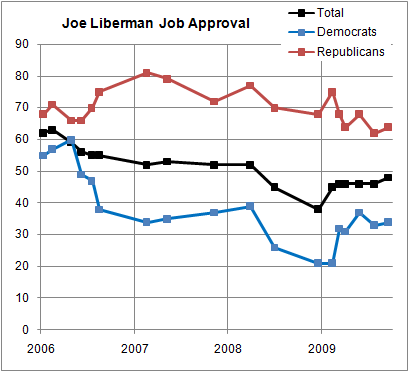
Nate Silver looked at Lieberman's favorables a few months ago (which is where I got the outdated graph above). Don't underestimate the advantages of incumbency, and don't forget that most voters are not paying much attention to health care negotiations but will notice whether a bill gets passed or not. I'd not bet on Lieberman but I'm not counting him out either. Another reader thinks Joe is cooked:

I have to disagree with your reader.   This isn't smart politics by Joe.  It is Joe being Joe.  He is burning bridges, taking revenge, and maybe even acting out of some sincere philosophical position.  

Joe won in 2006 because a significant chunk of Democratic voters still identified with him as a Democrat, just one somewhat more centrist than Lamont (that, and Lamont was an amateurish mediocre candidate).  People I know who supported him saw him as a good Democrat who was being punished for his pro-war stance.  This group, combined with the overwhelming support of Republican voters got him elected.  Since then Joe has worked overtime alienating the rest of the Democratic party.  The Party establishment in CT wanted to censure him after the 2008 election and only did not at the behest of Obama.  It is simply impossible that he would be the Democratic nominee in 2012.  If he were to run in 2012 he would probably do so as an Independent, and he would be cross endorsed by the Republicans.  This time no one will be fooled.

Secondarily, the "attack, attack, then vote for the final bill" ploy will not work this time, though it is a favorite of Leiberman's. Why?  Because this whole process is just so public.  Between the importance, size and complexity of the legislation and the long time it's taken to get this far, the sausage making has been far too public, and far too nauseating.  The usual veil of ignorance and apathy that makes that ploy so effective does not apply to health care reform.

Third, your reader is wrong on the money angle.  He already gets tons of money from the health insurance industry.  They are corporate contributors – they won't go to the mat for anyone.  Sure, they'll give him money.  But they will also give the Democratic nominee money.  And remember, every time Joe opens his mouth his future Democratic opponent will raise another million from enraged liberals across the land.  Is there anyone in the Senate with a bigger target on his back?

He won't run in 2012

Illiterate By Choice?, Ctd

by Patrick Appel

A reader writes:

What I think your reader (and perhaps Scott) are missing in the debate about illiteracy is that the question is not whether writing can be a powerful tool of social control – it can be – but whether societies as a whole make a conscious decision to reverse literacy in their move to Zomia. That strikes me as significantly more problematic; both of the examples your reader cites involved societies in which certain groups resisted the introduction of writing, not societies in which literacy was abandoned for social reasons after having already become part of the culture.

“One Of Texas’ Best Kept Secrets”

by Chris Bodenner

A reader writes:

Regarding your reader who complains about Houston's sprawl and equates Houston and Portland: a Portland to Houston comparison is weak at best, considering that Portland has barely a quarter of the population of Houston.

His example of driving 50 miles and still being in the city seems to me, a native Texan who has lived in Houston for most of my adult life, the exception: he and his parents must have lived in two of the few parts of the city where this is actually possible. I live in the heart of Houston and drive 60 miles to see my parents, who live in a small town in a completely different county, and my partner drives 20 miles for work and ends up in a completely separate city, also in a different county. It is more accurate to compare Houston to the other top 5 cities: New York City, Los Angeles, Chicago, and Phoenix. I have visited New York and Chicago, and it can take quite a while to travel between points within them.

Just because a city has grown out instead of up doesn't make it less of a city. While I'm generally against urban sprawl for environmental reasons, it does have it's advantages. As I mentioned, I live in the central part of the city. When I go out — to one of two train stations, half a dozen museums, the park, a bar, or a handful of restaurants within walking distance — I stroll along tree-lined streets. And my commute to work doesn't involve a single freeway. I can sit in the living room of my second-floor apartment and see the trees and the sky — without having to strain my neck at odd angles. And this isn't because I'm wealthy and can afford to live in an upscale neighborhood; my partner and I both work in education and have the salaries to prove it. That's another great thing about Houston: it is incredibly affordable.

While I think Houston is a great city, I'm not usually one of it's big cheerleaders. But the publicity surrounding Parker's election — much of it incredibly stereotypical — has made me defensive. Houston is one of Texas' best kept secrets. I could go on and on about it's positives — the thriving theater scene, the eclectic arts community, the world-class medical center, the business opportunities, the diversity of people and cuisines, the great people. But perhaps the best part about Houston is that we don't take ourselves too seriously.

Another writes:

I'm very proud of myself for having seen all those sites at my last visit!  One more not to be missed: the Art Car Museum.

Another:

The tunnels underneath downtown are a marvel. Most people don't know the exist but there is a vibrant culture below the streets of downtown Houston. Since this city is so blasted hot during the summer our forefathers decided to connect most of the buildings by an extensive tunnel system. You can get everything from a haircut to a 5 course meal. However you have to do it Monday thru Friday 8 to 6pm. as the tunnels are only open during the regular white collar work week.

A boat tour of the ship channel is another interesting thing most people have not done. Not only will you see why we are the 4th largest city (it's the refineries stupid) but the natural beauty along some of the route is in direct contradiction to the refineries and shipping lanes. We have the second busiest port in the country.

What is most interesting about our city is our diversity. You can hear every language in the world here. You can also find every type of food as we eat out more often than any other city except New York. Do you have a Bosnian restaurant in your town?

Houston is not a tourist city. Nor is it very pretty overall. But if you have a dream or are just a hard worker, this is the place to be. Come on down, make a good living, and then retire somewhere else.

Not Vietnam. Not Vietnam. Not…not Vietnam?

by Andrew Sprung

Whatever the nature of the U.S. engagement in Afghanistan, the Administration and supporters have labored to convince themselves and others of one thing  it is not.

Here's the President at West Point, Dec. 2:

First, there are those who suggest that Afghanistan is another Vietnam. They argue that it cannot be stabilized, and we're better off cutting our losses and rapidly withdrawing. I believe this argument depends on a false reading of history. Unlike Vietnam, we are joined by a broad coalition of 43 nations that recognizes the legitimacy of our action. Unlike Vietnam, we are not facing a broad-based popular insurgency. And most importantly, unlike Vietnam, the American people were viciously attacked from Afghanistan, and remain a target for those same extremists who are plotting along its border. To abandon this area now — and to rely only on efforts against al Qaeda from a distance — would significantly hamper our ability to keep the pressure on al Qaeda, and create an unacceptable risk of additional attacks on our homeland and our allies. 

Robert Gates, before the Senate Foreign Relations Comimttee, Dec. 3:

What makes the border area between Afghanistan and Pakistan uniquely different from any other location – including Somalia, Yemen, and elsewhere – is that this part of the world represents the epicenter of extremist jihadism: the historic place where native and foreign Muslims defeated one superpower and, in their view, caused its collapse at home. For them to be seen to defeat the sole remaining superpower in the same place would have severe consequences for this country and the world.

Some say this is similar to the “domino theory” that underpinned and ultimately muddied the thinking behind the U.S. military escalation in Vietnam. The difference, however, is that we have very real – and very recent – history that shows just what can happen in this part of the world when extremists have breathing space, safe havens, and governments complicit with and supportive of their mission. Less than five years after the last Soviet tank crossed the Termez Bridge out of Afghanistan, in 1993 Islamic militants launched their first attack on the World Trade Center in New York. We cannot afford to make a similar mistake again.

Point taken by Fareed Zakaria, Dec. 5:

The picture today is more promising on all three fronts. In Afghanistan, for all its problems, the Karzai government has been elected and does have the support of significant sections of the population. More important, the Taliban is deeply unpopular almost everywhere. As for safe havens, it's true that the problem of Pakistan is perhaps the central challenge in defeating the Taliban and Al Qaeda, both of whose leaderships are now based there and not in Afghanistan. But the United States has been getting better at attacking these safe havens using drones, while Pakistan's military is beginning, slowly and reluctantly, to accept that some action will have to be taken against militant groups that it has long supported. Perhaps because this war is seen as one of necessity and not choice by most of the American public, there is much greater support for such policies than there was for the very similar efforts to attack the Ho Chi Minh Trail in Cambodia.

That argument played out at length within the Administration.  George Packer, shadowing Richard Holbrooke reported back in September:

There were obvious similarities between Afghanistan and Vietnam: a rural insurgency, a weak and corrupt American ally, and an enemy sanctuary across the border. The differences were also worth noting: the Vietcong had a strong base of support in South Vietnam, while the Taliban were reviled across much of Afghanistan, and their popularity, confined to Pashtun areas, was based on tribal and ideological, not nationalistic, grounds. In the view of Holbrooke and the other members of Riedel’s group, one difference was paramount: Vietnam had never posed a direct threat to the United States, but the Taliban, because of its alliance with terrorist networks, did. This argument won the day, and it set the Obama Administration on a course of escalation that would be difficult to undo. But a shadow hovered: a prolonged war had once destroyed a Democratic Administration. As Riedel put it, “Johnson sort of slid into an escalatory ladder, without any strategy for measuring the results.”

Criminalizing Kids For Cartoons

by Chris Bodenner

This local story is absurd:

A Taunton father is outraged after his 8-year-old son was sent home from school and required to undergo a psychological evaluation after drawing a stick-figure picture of Jesus Christ on the cross. The father said he got a call earlier this month from Maxham Elementary School informing him that his son, a second-grade student, had created a violent drawing. The image in question depicted a crucified Jesus with Xs covering his eyes to signify that he had died on the cross.

Conservative blogs are interpreting this is an affront to Christianity, and understandably so, but I tend to think it's more a symptom of the post-Columbine lunacy in many suburban school "safety" policies. From that same article:

This is not the first time in recent years that a Taunton student has been sent home over a drawing. In June 2008, a fifth-grade student was suspended from Mulcahey Middle School for a day after creating a stick figure drawing that appeared to depict him shooting his teacher and a classmate. The Mulcahey teacher also contacted the police to take out charges in the 2008 incident.

By the way, here is the demented drawing that required a psychological evaluation:

Drawing