The Weekend Wrap

Over the weekend the White House and Senator Grassley joined the growing chorus of voices against the Uganda bill – though a brave Uganda lesbian beat them to it. Annise Parker, who is gay, became mayor of Houston – the nation's 4th largest city.

In home news, Andrew took a much deserved break from the blog; he'll be off for a week. Andrew Sprung introduced himself to the Dish and Conor Friedersdorf returned to guest-blogging. Patrick exposed the men behind the Dish curtain, which disillusioned many readers. Sprung rounded up commentary on the Afghan timeline and corralled coverage of the burning Khamenei photo. Friedersdorf, along with John McWhorter, addressed the Tiger Woods scandal. Conor also discussed a discussion by Hitchens and Wright over terrorist blowback. And Patrick shared his thoughts about the President.

In prurient postings, Jonathan Littell won the worst sex writing award, Christina Davidson talked to a prostitute, and Reebok leered at a lady. In Sunday musings, Julian Sanchez and Dish readers philosophized over free will while William Deresiewicz and some readers mulled over the meaning of friendship. We wrapped up our week-long discussion of the Greatest Generation here, here, and here.

— C.B.

On Human Cloning

Baby
by Patrick Appel 

 A reader writes:

It's a shame you agree with Leon Kass on anything, let alone his arguments against cloning. When you say you'd feel differently if "cloning no more dangerous than natural reproduction," it makes me suspicious you have a rose-tinted view of the process. People often assume much lower rates of miscarriage and birth defects, thereby giving a false impression that natural reproduction is already a "safe" behavior. In reality, it's the best version we have so far. Any bioethicist with a shred of decency argues that human cloning should obviously not occur until it is proven not just as safe as, but safer than natural pregnancy among animal test subjects. Natural processes are akin to Churchill's perspective on democracy: it's the worst form reproduction except for every other that has been tried. Cloning requires an intimate knowledge of natural processes. In fact, it requires such complex and nuanced understanding that the research required to create a successful, completely healthy clone of any kind would provide scientists with the knowledge necessary to make reproduction of all forms safer.

Yes, human cloning should not even be attempted until the mechanisms are understood and it can be done with a very high degree of safety. But that is not what Caplan is critiquing when he picks apart Kass' argument. Kass' uses the spaghetti method, tossing fist fulls of arguments at the wall until something sticks. Some people it is his repugnance argument (which Caplan dismantles) that connects, while for others, like yourself, its the "pain and suffering argument." This latter argument sounds like a reasonable critique to cloning until one realizes that it is a legitimate critique for any medical procedure. It is why the FDA exists and why scientists go through phased testing, to minimize pain and suffering at all costs while still moving forward with a beneficial and useful procedure. To presume cloning would somehow be exempt is naive. In all likelihood, the whole situation is a false threat anyway. The benefits of cloning someone exactly are small, while the benefits of the knowledge acquired while learning how to clone someone exactly are enormous. Organ transplants, genetic engineering, stem cells and a host of other branches of medical research are watching the progress made in cloning hoping for research that can be cross-applied.

I suggest you pick up a copy of Ronald Bailey's Liberation Biology. A less developed version of the argument he makes in the book appears here.

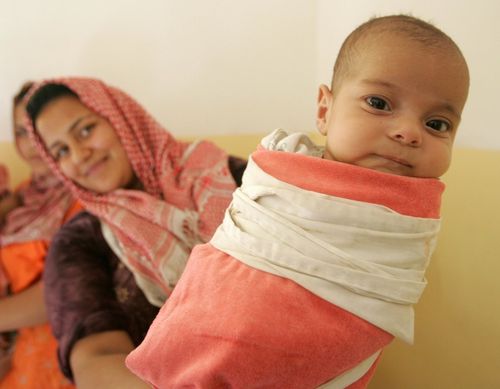
Points taken. (Image: Roslan Rahman/AFP/Getty Images)

2010

by Patrick Appel

Josh Marshall provides some early handicapping:

My own take at the moment is that the Dems are in for a really tough election but that Republicans are also indulging in a lot of wishful thinking. Two factors — whether Health Care passes and whether there's significant improvement in the economy by next summer — will decide things, not any amount of strategery and messaging.

“Nothing Is More Poignant”

by Chris Bodenner

The Ugandan Daily Monitor runs a front-page profile of Val Kalende, a lesbian who refuses to cow to the threat of life imprisonment, or even death, at the hands of the state:

The Sunday before last, Val Kalende listened quietly as her pastor’s sermon digressed into aKalende soft tirade against homosexuals. “We may even have one in our midst,” the cleric told a congregation of about 50 born-again Christians. If Ms Kalende did not know her pastor to be an honourable man, a father figure, his sudden anti-gay remarks would have left her shifting uncomfortably in her chair, wondering if those dreaded words were meant for her.

In the end, the woman who also serves as a minister, regularly taking her place on the worship team at her church of eight months, chose to let it go. It would not be her last time there.

Continued here. GayUganda is in awe of Kalende:

Val comes out, full face photo. With her partner. And the partner is disguised. Nothing is more poignant. They both are risking their very lives, grabbing the headlines like this, when they can. For, when the bill is passed, this kind of article will not be possible. But, she dared to do it. […] I salute you. Me, who is still hiding in my anonymity, I salute your reckless courage.

Meanwhile, David Bahati – the Ugandan MP who proposed the anti-gay bill – is digging in his heels against mounting pressure from Christian conservatives like Warren, Coburn, and Grassley.

Blowback Matters

by Conor Friedersdorf

Christopher Hitchens debated American foreign policy with Robert Wright on Bloggingheads.tv, a pairing I'm glad to see happen, since Mr. Hitchens is a prominent hawk capable of making an eloquent case for his convictions, and Mr. Wright is an agile thinker whose particular take on the War on Terror is too seldom grappled with in foreign policy debates. I've absorbed it over the course of many Web video segments, dating back to years when my own views were closer to Mr. Hitchens, and I've certainly been persuaded to modify my thinking by his core insight: that a successful counter-terrorism strategy doesn't measure success by the number of terrorists killed, but by the total number of terrorists who harbor ill will toward us. Put another way, American behavior that kills or detains 10 terrorists but inspires 20 people to take up terrorism is an obvious failure.

But! Surely we should persist in championing equality for women and gays even if Islamist terrorists target our society for doing so, Mr. Hitchens counters. Moreover, he says, terror cells are always going to have propaganda for recruiting extremists, even if they make it up.

Mr. Hitchens believes that Islamist radicals would be acting in accordance with their extremist ideology regardless of our behavior, at least assuming that we don't compromise our core beliefs in obviously unacceptable ways. That he is correct, however, is hardly as conclusive as he imagines. Islamist radicals may well be enraged by women without burkas, or hell bent on harming America regardless of our behavior. But Muslim moderates who'll never be radicalized into violent acts by jihadist sermons at a mosque may well find themselves inspired to fight against the United States if instead of offending them somewhat by letting our gays marry, we inadvertently kill their wives and 6-year-old daughters with a cluster bomb, or take naked photos of Muslim men on leashes, or round up innocent Muslims only to detain them without end at Gitmo.

Do you hate the Taliban? Wish them dead, even though you haven't any intention of fighting them yourself? Okay, imagine that you're at a family wedding, and a stray Taliban missile kills everyone in your immediate family, and much of your extended family. Is it more likely that the Army could convince you to embark on a revenge mission?

Of course we shouldn't compromise core Western values to appease terrorists. But those who argue that we must compromise our values to kill terrorists–or launch discretionary wars to eradicate them–must grapple, among other things, with the fact these anti-terror actions sometimes come at a cost of making more terrorists.

Few people if anyone in American politics argue the extreme case that we should never aggressively kill terrorists. But even fewer people who insist that we kill terrorists hedge their recommendations with a realization that indirect, unintended consequences matter.

Keep at it, Mr. Wright.

Waving the flaming photo in Iran

by Andrew Sprung

The latest political football in Iran is the alleged burning of the image of Ayatollah Khomeini during the student protests on December 7. From the AP today:

TEHRAN, Iran – Hundreds of students at Tehran University renewed anti-government protests for a second week on Sunday, accusing authorities of fabricating images of demonstrators burning photos of the Islamic Republic's revered founder.

Students moved to the forefront of opposition on the streets with massive protests last week. They say authorities are using the images of burning photos as a pretext to crack down on their protests, which have helped revitalize the pro-reform movement.

State television has repeatedly shown images, ostensibly taken during student-led protests on Dec. 7, of unidentified hands burning and tearing up pictures of Ayatollah Ruhollah Khomeini. It was a grave and illegal insult against the former leader, still widely respected in the country. The elite Revolutionary Guard, the country's most powerful military force, called for the trial and punishment of those responsible.

The regime is using these images to turn the screws on opposition leaders. In a speech earlier today, Supreme Leader Khamenei portrayed the act as a kind of blasphemy, an attack on the foundation of a "divine" state. While he did not accuse opposition leaders of direct responsibility for the alleged desecration, he accused them of fomenting conditions enabling it. From PressTV, the Iranian government's English language news organ:

Ayatollah Seyyed Ali Khamenei condemned the desecration, saying it was the result of the violation of law and clinging on to the encouragement of foreign media. Now to cover up this travesty, the Leader said, they have turned to "philosophization and false reasoning."

Ayatollah Khamenei said the group which violated the law was responsible for encouraging riots, laying the grounds for insults to the late Imam Khomeini, and helping the "frustrated, hopeless" enemy gain momentum.

"The geometry of this establishment is divine, its basis was established by a divine man and its survival relies on a divine nation," the Leader said. "Its enemy will not achieve its goals."

The Leader reiterated that the defeated presidential candidates, who have failed to prove their claims of vote fraud, should return to the right path as the election file has come to a close.

Ayatollah Khamenei, who called for calm to return to the country, said those who call for protests should stop such moves as the riots are backed by the enemies of Iran.

The Daily Telegraph quotes excerpts of Khamenei's speech that constitute a more a direct warning to opposition leaders:

"Those who shout slogans in the name of these people (opposition leaders), hoist their pictures and speak of them with respect are in a point which is the exact opposite of the Imam (Khomeini), revolution and Islam," the Supreme Leader said on state television.

"When you see this, step aside," he said in remarks addressed to the two opposition leaders, who he referred to as his "former brothers".

"I don't believe in purging, I believe in maximum attraction, but it looks as if some people insist on distancing themselves from the system and they have turned a family dispute into a battle against the system," the Ayatollah said.

Khamenei's speech comes in the wake of reports suggesting that the regime is finally on the point of arresting Mousavi, Karroubi and Khatami. Scott Lucas relays the following from the Iranian expatriate scholar/journalist Alireza Nourizadeh, who, Lucas says, "lives outside Iran but claims good sources inside the country":

"Dear iranians! According to confirmed and very reliable news source, this evening, there was a 3 hour meeting in the house of the Leadership of Iran between all coup leaders including Commander Vahid, Commander Jafari, Commander Firoozabadi, Sheikh Hossein Taeb, Asghar Hejazi, Mojtaba Khamenei, Gholamali Haddad Adel, Ahmadi Moghadam, Heidar Moslehi, Commander Mohamad Reza Naghdi and the leadership Seyed Ali Khamenei himself and his chief officer Mohamad ali Golpayegani.

During the meeting the majority of participants requested the arrest of Mirhossein Mousavi, Mehdi Karroubi, Seyed Mohamad Khatami and putting Rafsanjani under survellience. Khamenei however postponed his final decision to tomorrow.

Nevertheless according to a very reliable source it is very probable that the coup leaders take series of important measures including arrest of a number of opposition figures tonight.

Lucas adds an update:

Based on the Supreme Leader’s speech this morning, we think the Green movement(s) are on a “final warning”. That would mean no immediate arrests of opposition leaders, but if there is protest during Moharram….

I would add as a postscript that Khamenei is acting very much in Khomeini's own spirit in waving the flaming photo, the desecrated icon, blaming that alleged desecration on outside enemies, and suggesting that the perpetrators are in league with Israel.  More of Khamenei's speech from PressTV:

A sign that the enemy supports these riots, the Leader said, was when in the rallies on Quds Day, which were supposed to defend the rights of the Palestinians, some chanted slogans against the people of Palestine and backed Israel.

"How are they not awakened when leaders of oppression and arrogance — which can be characterized by the United States, France and Britain — show their support for them?," the Leader asked. "Why don't they realize [they have taken the wrong path] when fugitive, corrupt monarchist and communist figures lend their support to them?

Compare a crux from one of Khomeini's most influential speeches, the denunciation of the Shah's regime delivered in Qom on June 3, 1963, which led to his exile. The occasion was the 40-day anniversary of a raid on the prominent Faiziyeh madreseh, in which many students were beaten, some arrested, and two killed. Khomenei cast that assault as an attack on Islam itself, ultimately directed by a certain ally of the Shah:

We come to the conclusion that this regime also has a more basic aim; they are fundamentally opposed to Islam itself and to the existence of the religious class. They do not wish this institution to exist; they do not wish any of us [mullahs and talebs] to exist, the great and the small alike.

Israel does not wish the Koran to exist in this country. Israel does not wish the mullahs to exist in this country…It was Israel that assaulted the Faiziyeh madreseh by means of its sinister agent. It is still assaulting us, and assaulting you, the nation; it wishes to seize your economy…to appropriate your wealth…The religious scholars are blocking [Israel's] path; they must be eliminated  (quoted in Roy Mottadedeh, The Mantle of the Prophet: Religion and Politics in Iran elisions in the original).

The continuities are worth keeping in mind as the regime and the established opposition continue to compete for the "mantle of the prophet."

Happy 40th Birthday

by Conor Friedersdorf

One pleasure of The Atlantic's offices, where I once worked, was wandering into the room where the magazine's archives are housed, choosing an issue at random, and exploring whatever fine writing editors past published that month. It is impossible to do that for very long without marveling at the number of cover stories that James Fallows has written. In fact, it is hard for me to understand how he ever found time to write anywhere else, but the 40th anniversary of the Washington Monthly, celebrated by a collection of the best stories published in that magazine, remind us that he worked there too, along with so many other greats inside and outside The Atlantic family.

Another one to single out is Nicholas Lemann, who writes:

The Monthly, methodologically, was always reportorial, and it was never conservative—but, when I joined the magazine, the other editorial employee besides me and Charlie was Tom Bethell, an actual conservative, and it seemed as if the magazine devoted its main energies to attacking conventional liberal positions. When I first came to the magazine’s office for my job interview in the winter of 1976, I was amazed to see an issue just back from the printer’s with the cover line “CRIMINALS BELONG IN JAIL.” Charlie thought we would purify liberalism, the naturally dominant strain in American politics since his New Deal childhood in West Virginia, by relentlessly ridding it of tired, automatic bromides and by insisting that liberals see government’s performance as it actually was, not as liberals wished it to be. He wanted to understand and call attention to government’s failures so that in the future it would work properly, not so that people would stop believing government could solve problems. Nonetheless, issue by issue, this entailed criticizing liberals more often than conservatives.

The Monthly was always hard to classify. It investigated, but it wasn’t exactly investigative in the traditional sense, because its main interest was not in catching officials breaking the law but in understanding why, without being corrupt, government agencies didn’t get the job done. It was reformist, but it lacked the patrician hostility to democratic politics that has often characterized good-government reformers. It was not conventionally liberal, but it wasn’t centrist, moderate, or pro-business in the manner of the Democratic Leadership Council, which was founded in the 1980s. It wanted liberal politicians to hold the policymaking reins, but, at least in the early years, it almost never published articles proposing winning political strategies for its side. It was interested in policy, but it mainly eschewed traditional policy analysis. It was interested in ideas, but—in contradistinction to the Public Interest crowd, as its views developed—it was far more interested in facts on the ground.

It is still a first rate magazine — may it last another 40 years.

On Funding Wars, Ctd

by Chris Bodenner

A reader writes:

I agree the heaping of praises on the greatest generation can get a little old.  But consider my grandfather.  Came from rural South Carolina.  After Pearl Harbor he got an operation specifically to allow himself to fight.  He was gone from my grandmother from 1941-1945.  He was in North Africa, Sicily, D Day, Battle of the Bulge.  He came back an alcoholic.  He never talked about the war except sometimes to my Dad.  And my sister said one time he told her, "You don't know what it's like to lie in an icy trench while bugs are crawling over the bodies of your friends."  I remember at the 4th of July asking him why he never would come with us to see the fireworks and he didn't say anything.  Now it makes me cry to think about it because I know they reminded him of being shelled.  He wasn't a perfect man free of prejudiced by any means.  But he and his generation did recognize that they couldn't allow a world run by Adolf Hitler.  And they sacrificed a hell of a lot for it.  For that I'll always be grateful.