Life As Part Of Sully’s Brain

by Patrick Appel

A reader writes:

To learn that nearly half the posts on Andrew's blog are not his posts proper (but admittedly prepared under his aegis) is somewhat disheartening. I think the blog owes it to the readers and its own high standards to start putting bylines on all posts.

We tried bylines once and it made the blog read funny. Almost all the posts I write are naked links or excerpts, which makes Andrew a weather-vane in the gale of the larger debate.

I've marinated in Sullivan's cerebral juices for a few years now and know intuitively what he interested in and what to bring to his attention. If Chris and I were forced to byline the posts we write under Andrew's supervision, we would have to own those opinions and draw contrasts with Andrew, as we do when he takes vacations. Bylines would fracture the solitary voice of the blog.

Chart Of The Week

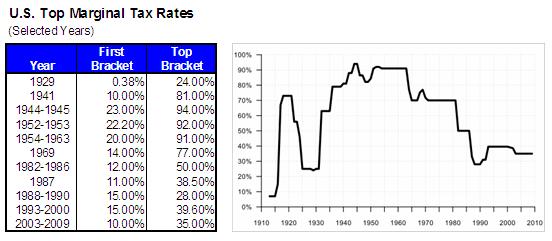
Graph-taxe-rates

by Chris Bodenner

Building off the Dish's discussion of war-time taxes this week, Jon Perr provides the above chart and re-quotes Palin:

[O]ur Greatest Generation did not hesitate when asked to sacrifice for their country. American men enlisted in droves, American women went to work in the factories that became our "Arsenal of Democracy," and many Americans gave what little money they had to buy the war bonds that funded it all.

Why Church Isn’t The Same Thing As Faith

Churchwater

by Andrew

"Ecclesiology is also unimportant for a negative reason. Ecclesiology is an actual ill! By definition it places the human church in some kind of special zone — somehow distinct from real life — that appears to be worthy of study and attention. The underlying idea is that the church is in a zone that is free, or at least more free, from original sin and total depravity than the rest of the world, but the facts prove otherwise. The facts of history run counter to ecclesiology. They reveal a grim ersatz thing carrying the image of Christ but projected onto human nature and therefore intrinsically self-deceived. The gospel of grace, based on relational love that is entirely one-way, is at odds with ecclesiology. Whatever 'ecclesiology' comes in the train of grace is variable, secondary, contextual, and contingent…Emil Brunner's little-read book, The Misunderstanding of the Church (1953) is a devastating critique of the idea of church.

Brunner can find almost no evidence in the New Testament for anything like what many Christians consider to be the church. For Brunner, the New Testament describes a fluid and Holy Spirit-filled movement of people gathered together within an experience of God that involves massive individual changes of plan. There is a collective dimension to this: all the early Christians experienced the same thing. Like alien abductees, the first Christians had a shattering experience in common. This brought them together. But this experience was not an institution." – Paul Zahl, Grace in Practice: A Theology of Everyday Life.

Money And Happiness

by Patrick Appel

A new study suggests that we massively overestimate the the strength of the link:

The study worked by asking people what their own income and happiness levels were and then asking them to estimate the happiness of people on lower or higher incomes than themselves. The participants' estimates of the happiness of people on high incomes was largely accurate, but they massively underestimated the happiness of people on lower incomes. The picture was the same in a second study that asked people to estimate how happy they'd be if they earned more or less than they really did.

Living In A Battery

by Chris Bodenner

Scientific American describes a new term:

Overlooking the city of Stuttgart in southern Germany, a four-story modern glass house stands like a beacon of environmental sustainability. Built in 2000, it was the first in a series of buildings that are "triple-zero," a concept developed by German architect and engineer Werner Sobek, which signifies that the building is energy self-sufficient (zero energy consumed), produces zero emissions, and is made entirely of recyclable materials (zero waste).

The homes – which are also popping up in Boulder, Colorado – produce more energy than they consume.

(Hat tip: 3QD)

AfPak triptych

by Andrew Sprung

On Friday, The New York Times op-ed page put up a neatly modulated triptych of informed opinion on Obama's AfPak strategy.  Assessments by Ahmed Rashid, Nathaniel Fick and Marc Lynch all centered on the imposition of a timeline for the beginning of a draw-down of U.S. forces.  Read left to right, their verdicts formed a continuum: the timeline is a mistake (Rashid), the timeline is a calculated risk (Fick), the timeline is a brilliant strategic stroke (Lynch).

Each argument was compelling in its turn; taken together, they probably echoed the debate as it played out in the White House. They also illustrate Andrew Exum's observation: "I know about 50 really smart people on Afghanistan with lots of time on the ground there, and no two have the same opinion about what U.S. policy should be."

Rashid argues that the target date for the beginning of draw-down sends the wrong message to the Taliban, the Afghan government and the Pakistani government. The Taliban, he argues, may "melt into the north and west of the country, where NATO troops operate under caveats that limit their ability to go on the offensive." Afghanistan's "ruling elites are nervous about being dumped by America, as they were in 1989 after the

Soviets withdrew."*  As for Pakistan, it's

the biggest problem. While President Asif Ali Zardari has said all the things Washington wants to hear, there is no agreement as yet from the Pakistan military to go after the Afghan Taliban strongholds in Baluchistan and the North-West Frontier Provinces. The Pakistan military is unlikely to act unless there is a parallel movement by the Americans to defuse Indo-Pakistani tensions over Kashmir, and unless India is more willing to reduce its forces on Pakistan’s eastern border.

Here Rashid's argument seems incomplete. What is the likely effect of the withdrawal date on Pakistan?  As it turns out, Steve Col (who called Obama's speech "the right choice in a difficult situation" but also has acknowledged multiple difficulties with Administration strategy) completed Rashid's thought (voiced elsewhere) a week prior:

The problem lies in how the Taliban and the Pakistan Army will read the explicit use of a calendar. Ahmed Rashid, on NPR’s Morning Edition, speaking from Lahore, voiced the same fear that seized me when I heard the President be so explicit about 2011: No matter how nuanced the invocation, Pakistani liberals fighting against the Army’s hedging strategy of support for the Taliban and Al Qaeda will be demoralized by the use of a specific date. They will interpret it as evidence that the United States has already made a decision to leave the Afghan battlefield and that it will ultimately repeat its past pattern of abandoning Pakistan periodically. This may be unfair, but the perception is inevitable.

Fick, in contrast, argues that while the timeline "makes no sense…from a purely military perspective," it  may  be effective in prodding to the Pakistani as well as the Afghan government to do what the U.S. thinks is necessary:

Progress depends on two political developments: inducing the administration of President Hamid Karzai to govern effectively, and persuading Pakistan that militant groups within its borders pose as great a threat to Islamabad as they do to Kabul. A limit to America’s commitment may actually help us meet these goals. (The Democratic victories in the 2006 midterm elections, for example, convinced Iraqi Sunni leaders that the United States was on its way out, inspiring them to join the Awakening movement that led to better security across the country.) The strategic benefits of setting a timeline, in this case, may outweigh its tactical costs.

 To Fick, the strategy constitutes a huge, if exquisitely calculated, risk:

Announcing the timeline was risky, and it could turn out to be our undoing. The president delivered two intertwined messages in his speech at West Point outlining his Afghan policy: one to his American audience (“I see the way out of this war”), and one to the people of Afghanistan and Pakistan, including the Taliban (“I’m in to win”). The danger of dual messages, of course, is that each may find the other audience, with Americans hearing over-commitment and Afghans hearing abandonment.

The only way to reassure both is to show demonstrable progress on the ground. A credible declaration of American limits may, paradoxically, be the needed catalyst.

Lynch sees the pullout date as not so much a risk as an absolute necessity. Back on Nov. 11,  the Times' Helene Cooper reported that Obama, in choosing "none of the above" when the military presented him with four options, sent them back primarily to find some form of leverage  to prod the Karzai government to reform. The timeline, according to Lynch, is that lever:

The deadline is essential politically because it will provide the necessary urgency for Afghans to make the institutional reforms that will ensure their own survival. An open-ended commitment creates a terrible moral hazard in which Afghan leaders, assuming American troops will always be there to protect them, may make risky or counterproductive decisions. A limited, conditional commitment creates the leverage needed to generate the institutional transformation necessary to cement any gains made by the military.

Lynch's chief worry is the mirror image of those who fear that the timeline will embolden the enemy.  He fears that it won't sufficiently frighten our allies and thus jolt them into action (as he alleges Obama's pending election victory did the Iraqi government — because the U.S. won't stick to it:

The greater problem for the Obama administration will be to make the commitment to the drawdown credible. Many expect that the military will come back in a year asking for more troops and time. The blizzard of conflicting messages coming from Washington this week did little to diminish the expectation. This is troubling, because the political logic of the deadline works only if Afghans on both sides believe in it.

So there you have it. The quick-release surge may embolden the Taliban. It may weaken those in Pakistan who support full-scale cooperation with U.S.-led efforts. It may not have the desired effect on the Afghan government. It may turn Americans against the effort to stabilize Afghanistan. Or it may fool no one and devolve into open-ended commitment.

But who has a better idea?
“Respect The Rights Of All Persons”

by Patrick Appel

Timothy Kincaid posts a statement against anti-gay violence from the Vatican. It doesn't mention Uganda by name but Kincaid thinks the timing isn't a coincidence:

[E]ven though the Catholic Church does not have the courage or integrity to directly oppose Uganda’s proposed legislation by name nor the moral character to oppose the criminalization of homosexuality in general, I do welcome this very powerful voice to the chorus who oppose draconian laws such as the one proposed.

If Free Will Isn’t An Illusion

by Patrick Appel

Julian Sanchez points to this fascinating John Searle lecture from a few years ago which contains a partial defense of free will and goes through some of the relevant theory. Searle's argument against determinism, which he admits is imperfect and a view he doesn't necessarily endorse, rests on the idea that consciousness and free will are too expensive evolutionarily to arise in a determinist universe. Sanchez complicates Searle's view:

Consciousness could well be a spandrel.  That is to say, it may just be that when you have a sufficiently complex information processing system made of the particular kind of physical stuff our brains are composed of, the processes involved will have some kind of subjective character. If conscious mental activity just is brain activity, and not some kind of strange excretion from it, however, then they have precisely the same causal properties, and it’s just a confusion to describe it as “epiphenomenal.”…Or to put it another way: The alternative picture is that evolutionary selection pressure might have produced these very strategic zombies—like vastly more complex insects, say, all stimulus-response with nobody home— but then some mutation won out that added this further feature, consciousness, to the system, because it yielded some additional improvement.

Arguments like Thomas Metzinger's understanding of the self make it hard for me to defend free will from a scientific perspective. But my inability to fully explain free will through rational thought shrinks somewhat in importance when considering that we all live our lives as if free will exists. Even if I cannot satisfactorily resolve free will intellectually, I take some comfort in the lived embrace of it. Searle poses a good question that highlights the inability to shake off the experience or illusion of free will: "if determinism were shown to be true, would you accept it?"

First Dish

by Andrew Sprung

Greetings, Dish readers, from the newest Dish understudy.  My warmest thanks to Andrew, who is I think all but unique among top-tier bloggers in his receptivity to a multitude of voices and willingness to link to anything he thinks deserves a hearing. Thanks also to Patrick and Chris, who help him cast such a wide net. The Dish has been a key support of my blog, xpostfactoid, ever since its birth in October 2007, right around the time that Andrew was helping the world begin to imagine an Obama presidency.  The emergence of Obama and my addiction to the Dish will be forever associated in my mind.

By way of brief introduction: I'm a media consultant with a lasting interest in how democracy works, how it malfunctions and self-corrects. I have a Ph.D. in medieval English literature and a propensity to parse the rhetoric and logic of our political leaders as well as that of media pundits and scholars who jump into the national debate.   I wrote a dissertation on the remarkably humane and subtle medieval English anchorite Julian of Norwich, a mystic nun whose knack of squaring circles and framing paradoxes reminds me a little of our current President. Who knows, maybe I'll pursue that strained analogy later this week.