The Limits Of Character

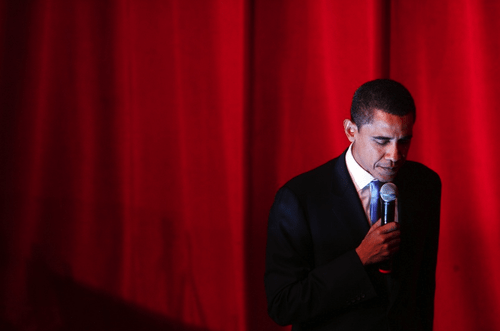
ObamaByHiroko MasuikeGetty

by Patrick Appel

Glenn Greenwald's post earlier this week about the persona of the President and that his fans, and the Dish posts surrounding it, attacked or defended Obama's character without entirely challenging the premise of the debate. Profiles of managed personalities –actors, athletes, politicians – are often of little worth because that Person Of Note is actively crafting a branded identity. They are working against the intent of the profile. No persona is more managed than that of the President.

I don't doubt that Obama is a good person, I'm likewise told by those who have met George W. Bush that he is quite charming, but this focus on the individual, and the mettle of his conscience, misses what is the more important and observable part of a presidency: management style. When debating an executive decision like the escalation in Afghanistan or the transfer of Guantanamo detainees to a US prison, we write that "Obama should do this…" or "Obama shouldn't have done that…" when what we often mean is the executive branch as lead by Obama should or shouldn't have taken a given action. By focusing on the President, we ignore the system surrounding him.

There are symbolic moments where Obama can act unilaterally, but major actions rely on the consultation of experts, the collection of information, and weeks of debate at lower levels of the executive. This system has been constructed by Obama, his advisers, previous occupants of the White House, and Congress. It's not as sexy or as emotionally charged as defending or attacking the character of the President. But thinking of the executive as a bundle of conflicting personalities and incentives funneled through the authority of one man is truer to reality than pretending the President is sitting in a room with a red phone and barking out orders based solely upon the swinging needle of his internal compass.

The Obama executive can be summed up in three words: no sudden moves. Like Greenwald and Andrew, I've been disappointed by parts of the Obama executive's civil liberties record. I regain a smidgen of hope on this issue, and gay rights, and foreign policy, and numerous other topics, not because I trust in the character of the President. I have never met or spoken with the man. Thousands of people have spent endless hours trying to influence my feelings about Obama the person. I discount it all.

What I see from watching the Obama administration is a meticulous consideration of multiple options and a resistance, if not immunity, to the demand that the President act swiftly in all instances. The degree of change in this regard from the last administration cannot be overstated.  And though the Obama management system has not always produced results I agree with, wide-reading and my gut tell me to cut losses in Afghanistan, Obama's method of deliberation at least suggests that he has a larger strategy, what Sullivan has called the long game. I concede that the demonstration of failure may well be the fall back strategy in Afghanistan. I also concede this may be false hope on my and Sullivan's part.

I will be unsurprised if I am disappointed, but I'm more confident that Obama's executive will change course when confronted with failure than I ever was that the Bush executive would do so, which isn't saying much.

(Image:Hiroko Masuike/Getty Images)

The Exobrain Grows More Powerful

by Patrick Appel

Scott Adams is hard to refute:

Technically, you're already a cyborg. If you keep your cell phone with you most of the time, especially if the earpiece is in place, I think we can call that arrangement an exobrain. Don't protest that your cellphone isn't part of your body just because you can leave it in your other pants. If a cyborg can remove its digital eye and leave it on a shelf as a surveillance device, and I think we all agree that it can, then your cellphone qualifies as part of your body. In fact, one of the benefits of being a cyborg is that you can remove and upgrade parts easily. So don't give me that "It's not attached to me" argument. You're already a cyborg. Deal with it.

Minding The Store

by Patrick Appel

As always, it a pleasure to step in while Andrew gets some much needed rest. Guest-blogging is not all that different than my day-to-day activities on the Dish – 24 of the 50 posts currently on the front page were written by me. All the substantive posts are Andrew’s work, but it’s my and Chris’s job to read through the blogosphere and pick out the choicest bits. Andrew edits, approves, and spins what we find, but the illusion of an all-reading blogger is maintained by employing two extra sets of eyes.

I’ll be checking Andrew’s general e-mail account this week (andrew@theatlantic.com). We typically get around 450 e-mails a day, but correspondence drops significantly during Andrew’s absences. If you want to see an e-mail of yours posted to the Dish, you have a much better chance of not being overlooked if you write this week. 

Andrew will return December 21st.

A Vacation

Jonah Lehrer describes the cognitive benefits of travel:

For the first time in human history, we can outrun the sun and segue from one climate to another in a single day. The reason such travels are mentally useful involves a quirk of cognition, in which problems that feel "close" – and the closeness can be physical, temporal, or even emotional – get contemplated in a more concrete manner. As a result, when we think about things that are nearby, our thoughts are constricted, bound by a more limited set of associations. While this habit can be helpful–it allows us to focus on the facts at hand–it also inhibits our imagination.

On that note, I'm handing over the Dish for the next week to the capable hands of Patrick and Chris who will be joined by Conor Friedersdorf, who needs no intro, and Andrew Sprung, whose superb blog can be found here. It's been an amazing year at the Dish and exhausting too. See you December 21.

Old Habits

Gary Sick gives his version of recent events in Iran. After the original uranium agreement fell through, he faults the US and its allies:

[T]he United States and its partners could have responded with a counter-offer that would, for example, sequester the Iranian LEU under strict safeguards until the replacement fuel cells were available, thus accomplishing most, if not all, of their original objectives. Instead, they ended all negotiations and introduced a sharply critical resolution by the International Atomic Energy Agency board.

Iran predictably responded by declaring it would reduce its cooperation with the IAEA and, in a fit of blustery indignation, announcing a new plan to build 10 additional enrichment sites – a hollow threat since Iran lacked both the centrifuges and the necessary raw uranium fuel to carry it out.

Iran withdrew into its cocoon of haughty and pained victimization. The United States and its allies made a similar retreat to a posture of righteous indignation, the better to fashion “crippling” sanctions designed to force Iran to change its policies.

He also argues against sanctions because he seems them as ineffective.

“Ain’t No Shame in Bein a Ho”

Christina Davidson profiles a prostitute in Philly:

"I cause pleasure. I provide a service that brings people pleasure. I won't service married men or women, men of the cloth. See even hos got rules of morality," she laughs. "But seriously, I can understand why people who been brought up one way think it's immoral. I don't understand why it's illegal. With our government needing money, I wish I could pay taxes."

On Funding Wars, Ctd

A reader writes:

Just wanted to weigh in on your fascinating discussion of the Greatest Generation.  What has crossed me over and over again about that generation — in talking to relatives, in talking to seniors, or even in watching documentaries (I just watched Burns' outstanding "The War") is the recurrence of this phrase: "We did what we had to do."

I can't imagine a more perfect statement of the concept of duty and fortitude.  No one was eager to go to war or raise taxes or ration.  But it was something that had to be done.  It was as simple as that.  There was a near-universal recognition that we didn't want a war, but we would do what we had to do.  Yes, there was a draft.  But that was mainly for organizational purposes.  There was no shortage of volunteers.  They knew what was needed and, when called, they went, they fought, they came home when their tour was finished.

I see that today when I talk to soldiers.  They are not some crazy left- or right-wing caricature of a warrior.  This is their job, this is their duty, this is their mission.  They will do what has to be done.  The humility of it is is astonishing.

To hear self-aggrandizing politicians, riding around in limos and charter jets, invoke that humble, almost casual commitment to duty is infuriating.  I hear few voices saying that Americans need to do what must be done — pay higher taxes, cut popular programs, make sacrifices, etc.  And on the rare occasion when even a modicum of sacrifice is called for, it's wrapped up in the most purulent self-satisfied prose imaginable.

I will know we have returned from the partisan abyss when I hear a politician say, "This is what we need to do.  It's not going to be fun and it's going to cost a lot of money.  But it must be done."  Obama occasionally veers close to that, which is why I have yet to turn my back on him.

Another writes:

In addition to the MPR story, more man on the street interviews from a project Alan Lomax initiated after Pearl Harbor, courtesy of the Library of Congress's "After the Day of Infamy" collection, can be found here.

The Daily Wrap

Today on the Dish, Andrew delivered a lengthy take on the president's Nobel speech (and responded to a reader response). Peter Wehner praised the speech, as did Reihan. Peter Beinart and Andrew Sprung also gave upbeat assessments. Greenwald simmered over the left-right consensus, which received a reply from Andrew and a reader.

In Uganda coverage, Chuck Grassley ducked his involvement, Rick Warren's persuader spoke out, David Link considered whether the pastor is a bigot, Chris Orr bemoaned his religious rhetoric, and a reader passed along more disturbing details from the African nation. We capped off a week of Iran coverage with some epic poetry, a heartening map, and a Muppets remix.

— C.B.