I've been struggling with some kind of flu and so was unable yesterday to give Obama's Nobel Acceptance speech its due. It's a remarkable address – Niebuhr made manifest. What strikes me about it most of all – and I do not mean this in any way as a sectarian or non-ecumenical statement – is that it was an address by a deeply serious Christian. It was not Christianist. It did not seek to take sacred text or papal diktat to insist on a public policy or to declare that the president of the United States is somehow the instrument of God or good or that America is somehow more divinely favored than any other nation. It was written and spoken in such a way to reach anyone of any faith or none. It translated a deeply Augustinian grasp of history into a secular and universal language. It was an expression of tragic hope.
And that's one aspect of Obama's now-famous-phrase, the "audacity of hope", that is often overlooked.
Why is hope audacious?
Because the world is inherently tragic. Because, in Camus' words, men die and they are not happy. Because in Obama's words,
We will not eradicate violent conflict in our lifetimes. There will be times when nations — acting individually or in concert — will find the use of force not only necessary but morally justified… For make no mistake: Evil does exist in the world. A non-violent movement could not have halted Hitler's armies. Negotiations cannot convince al Qaeda's leaders to lay down their arms. To say that force may sometimes be necessary is not a call to cynicism — it is a recognition of history; the imperfections of man and the limits of reason.
When I have been asked why I, as a conservative, support this man the way I do, I can only answer: listen to him. What is the philosophy that most affirms "the imperfections of man and the limits of reason"? What philosophy sadly demurs when told that peace is possible on earth, that history is leading to utopia, that war is over, that "freedom is on the march"? And this is the critical distinction between Bush and Obama: Obama is far more conservative than his predecessor. He sees that the profound flaws in human nature affect us as well as them; that we "face the world as it is," not as we would like it to be; that the decision to go to war is a moral and a pragmatic one; that ends have to be balanced by a shrewd and sometimes cold-eyed assessment of means.
For peace to exist, there must sometimes be war. A statesman will sometimes have to bargain with evil men. A statesman will also sometimes have to let evil flourish because he simply does not have the proportionate means to counter it. Human nature is alloyed between good and evil, and evil often wins.
Hope is not optimism. We have little reason for optimism given the first decade of the twenty-first century. Hope is a choice. As much a choice as faith and love.
I am staggered that so many neoconservatives and conservatives seemed shocked and enthused by the address. This does not, it seems to me, reflect on the address's novelty for Obama. Nothing in it was very different from anything he has said before. Distilling it all in one 36 minute address may have clarified it for his opponents. But I have to say their welcome applause merely reveals that they have not been listening for so many months. They still do not grasp the president we have or the seriousness he has brought to the tragic dimension of a moral foreign policy in an immoral world at a perilous time. I asked Obama in the campaign about some of this. Here's a response worth recalling from more than two years ago:
Barack Obama: You know, reading Niebuhr, or Tillich or folks like that—those are the people that sustain me. What I believe in is overcoming – but not eliminating – doubt and questioning. I don't believe in an easy path to salvation. For myself or for the world. I think that it’s hard work, being moral. It's hard work being ethical. And I think that it requires a series of judgments and choices that we make every single day. And part of what I want to do as president is open up a conversation in which we are honestly considering our obligations – towards each other. And obligations towards the world.
Andrew Sullivan: But you don't think we're ever going to be saved on this earth do you?
Barack Obama: No. I think it's a … we're a constant work in progress. I think God put us here with the intention that we break a sweat trying to be a little better than we were yesterday.
"A little better than we were yesterday." Whatever that is, it is not utopian or liberal except in the deepest, Niebuhrian sense. Obama has never been a pacifist. Never. His opposition to the Iraq war, as he said at the time, was not because he was against all war, but because he was against a dumb war. He is, in so many ways, a Niebuhrian realist. And with Niebuhr, there is the deeper sense that even though there is no ultimate resolution in favor of good over evil on this earth in our lifetimes, we still have a duty to try. It is this effort in the full knowledge of ultimate failure on earth that is the moral calling. It is to do what we can, knowing that it will never be enough.
The problem with Bush's foreign policy was that it was based on a "doctrine" which is never a good thing to base any politics on; that it was far too sanguine about the power of good in the world; far too crude about the role of culture and history in limiting the universal appeal of Western freedom; far too reckless in deploying resources without any concern for their limits; and so convinced of its own righteousness that it could even authorize the absolute evil of torture in pursuit of the absolute good of freedom. Bush was riddled with all the hubris, arrogance, rationalism and utopianism of the worst kind of liberalism. Obama is not a Tory realist; he still believes in the slow, uncertain march of human enlightenment. But he sure isn't a Bush-style or Carter-style utopian. And he is such a deeper, calmer spirit than Clinton's always-maneuvring mind.
These are desperately dangerous times. They are dangerous primarily because religion has been abused by those seeking power and control over others – both in the mild version of Christianism at home and the much, much more pernicious and evil Islamism abroad. They are dangerous because the fusion of this kind of religious certainty with the sheer power of technological destruction now available could bring the planet to catastrophe if we are not very, very careful. Very few moments in history have required an Augustinian statesmanship as much as now.
This is why I have supported this unlikely man for several years now. Two quotes from Niebuhr help illuminate why. The first:
"The task of building a world community is man’s final necessity and possibility, but also his final impossibility. It is a necessity and possibility because history is a process which extends the freedom of man over natural process to the point where universality is reached. It is an impossibility because man is, despite his increasing freedom, a finite creature, wedded to time and place and incapable of building any structure of culture or civilization which does not have its foundations in a particular and dated locus."
That is our task now. How do we find the motivation to accomplish it? Niebuhr again:
Nothing that is worth doing can be achieved in our lifetime; there we must be saved by hope.
Nothing which is true or beautiful or good makes complete sense in any immediate context of history; there we must be saved by faith.
Nothing we do, however virtuous, can be accomplished alone; therefore we are saved by love.
No virtuous act is quite as virtuous from the standpoint of our friend or foe as it is from our own standpoint.
Therefore we must be saved by the final form of love which is forgiveness."
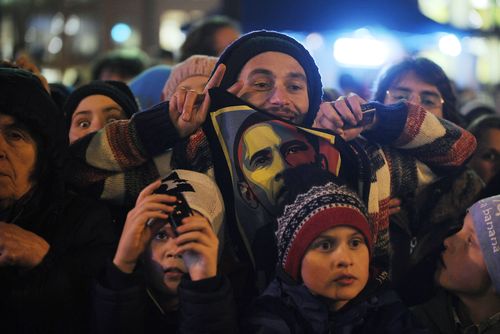
(Photo: People cheer for US President Barack Obama and First Lady Michelle Obama as they greet the Torch Parade from the Grand Hotel Balcony in Oslo on December 10, 2009. By Jewel Samad/AFP/Getty Images.)
 The Dish