Sam Roggeveen has an idea – offer to buy North Korea's nuclear materials:
Snyder admits there are moral hazard problems with this approach, in that it seems to reward North Korea's bad behaviour. But the proposal does play to one of America's great and largely unexploited strengths in this dispute: its wealth.
Frustratingly, Snyder never suggests a price for North Korea's plutonium, so can I suggest $1.2 billion per year? That seems rather exorbitant, but it's not a random figure. It comes from noted game theorist Bruce Bueno de Mesquita, who has used predictive models to come up with an annual amount that might persuade Pyongyang to give up its nuclear weapons.
One key religious leader has spoken out forcefully against the unchristian Ugandan law to inform on, arrest, forcibly "cure" and execute homosexuals. But where is the Pope in a country where 40 percent of the people are Catholics. When will Benedict speak out to prevent this bill? Or is his silence eloquent enough?
Obama is a man trapped amongst the contradictions created by America’s awkward place in the post-Bush world. Last week, Obama’s address on Afghanistan both escalated and promised an end to the war there. Today, Obama opened his Nobel Peace Price acceptance speech with a long disquisition on the nature of war and its necessity–complete with a brief survey of “just war” theory. (He even threw in a passage about the necessary role of coercion against states like Iran and North Korea that mess around with nuclear weapons.) I suppose it was the honest way to take such a prize at a time when America has about 200,000 soldiers occupying foreign countries. But it was something of a surreal exercise.
In a sense, this was one of the clearer statements of foreign policy principle that Obama has delivered to date: An extended defense of using realist means in the service of liberal internationalist ends. It’s an approach that fits at least some of the challenges we face, and the turn toward modesty and pragmatism, in particular — toward the pursuit of “a more practical, attainable peace,” to quote Obama quoting John F. Kennedy this morning — makes sense as a corrective to some of the more hubristic elements of Bush’s foreign policy. (Thought that corrective had already largely taken hold in Bush’s second term.) But of course, it’s also an approach that hasn’t borne any significant fruit as yet, in a presidency that’s only just begun to face its hardest challenges. Which is why an air of the ridiculous still hung about the ceremony, with its jazz interludes, defensive introductory remarks, and cutaways to Will Smith in the audience. As effective as the speech was in certain ways, it still should never have been given.
This is a video from University of Ghazvin on Dec. 7th, a city 3 hours west of Tehran. There is an amazing chant at the first 20 seconds that is very nostalgic for Iranians. During the 1979 revolution, in response to Shah changing Prime Ministers every other month to calm the revolutionaries, the chant went like this: “We are saying we don’t want the Shah himself, he changes Prime Minister" … Now they are saying: "We are saying we don’t want the Shah himself, they changed the name and call it Rahbar (Supreme Leader)" ..
Rick Warren disowns the new Uganda bill designed to inform on, round up, imprison, forcibly submit to "psychological cures", and execute homosexual Ugandans:
This is an extremely positive if overdue development. I remain deeply concerned that Uganda's public policy is based on the "curing" homosexuals rubric, but that sure is better than executing them. The Ugandan bill should be abandoned. And Warren's call on pastors to disown the bill is a real step forward.
I'm not the only person welcoming this:
"We applaud Rick Warren for speaking out with force and clarity on a bill that would lead to the persecution and prosecution of gay and lesbian Ugandans," said Wayne Besen, Executive Director of Truth Wins Out. "Today, Warren showed true moral courage and stood for what is right and just. We urge other leading pastors and world leaders to stand up and condemn Uganda's Anti-Homosexuality Bill."
What I think is most significant is that Warren called this bill "extreme, unjust and unchristian towards homosexuals". It is absolutely and unequivocally unchristian to demonize a whole group of people and to threaten them with execution simply because of their sexual orientation and their need for love and sex and intimacy and companionship like every other human being. And for Warren to deploy Christian arguments in defense of the dignity of homosexual persons is a big step forward in this debate. I am grateful to him for staying true to the Gospels.
The survey, by Jim Gerstein, asked Israelis (both Jewish and Muslim) whether a series of terms describe President Obama well, and 39% of respondents said the term "Muslim" describes the president, who is Christian, well. Of those, only 15% said the term described him very well.
A great deal of effort went into the homogeneity adjustments. Yet the effects of the homogeneity adjustments on global average temperature trends are minor (Easterling and Peterson 1995b). However, on scales of half a continent or smaller, the homogeneity adjustments can have an impact. On an individual time series, the effects of the adjustments can be enormous. [Italics mine.]
So, if you're a climate denier, what would you do? You'd look for local effects and you'd look for an individual time series. Look hard enough and you're bound to find some with large changes due to the homogenization. And then you'd cry foul. The books are being cooked!
Let me pile on in the Greatest Generation debate. We Americans like to think WWII began on December 7, 1941. It is telling that, despite the fact that Hitler had already conquered most of Europe and was driving deep into Russia, a majority of Americans on the eve of Pearl Harbor still opposed U.S. involvement. People forget that in his famous “date which will live in infamy” speech, Roosevelt asked for a declaration of war only against Japan. He wanted a declaration of war against Germany as well but feared the American public would not stand for it. We entered the war in Europe only after Hitler declared war on the U.S. several days later.
I appreciate all that the Greatest Generation did and fought for (my father was one of them), but let’s not turn them into superheroes of sacrifice straight out of a Marvel comic book. Remember that the war in Europe raged for over two years while the Greatest Generation sat by and watched. And self-interest was at the heart of it.
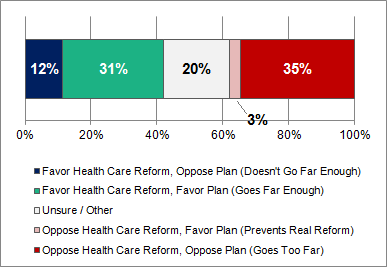
[T]he bigger problem is that Nate classified everyone opposing reform because it doesn't go far enough as opposing it from the left. Undoubtedly, that's true of many, even most, of those respondents. But I could go down to Cato right now and poll 65% support for the proposition that the health care reform doesn't go far enough–in the direction of taking away the employer health care tax exemption, means testing Medicare, and other ideas that no one would call "left". Republicans who want liability caps and bigger HSAs might have similar complaints.
Just wondering if anyone on the right is admitting they were wrong when they insisted – do they even remember? – that the President would have to back off doing much of anything in Afghanistan because he wouldn't want to disappoint the Nobel Peace Prize committee.
As with his Philadelphia speech, he made the speech about the most awkward issue of the moment, rather than trying to avoid it. (In Philadelphia, the racially inflammatory rhetoric of Rev. Jeremiah Wright; in Oslo, his predicament as a war president getting a peace price.) I don't think he provided even a five-second passage of the speech that could be isolated by U.S. opponents to show that he was "apologizing" for America
 The Dish