Obama’s Speech Worked?

 Weigel highlights a new poll:

In a November 18 Quinnipiac University survey, American voters said 48 – 41 percent that fighting in Afghanistan was the right thing to do. Since then Democrats have moved from 58 – 31 percent against the war to a 47 – 46 percent split. Republican support inched up from 68 – 22 percent to 71 – 21 percent and independent backing is up from 51 – 39 percent to 58 – 34 percent

Awakening The Kurds

Juan Cole reacts to yesterday's protests in Iran:

[They] were remarkable in several ways, I conclude on reading Borzou Daragahi's account in LAT. One is the sheer number of cities where students came out for rallies: "Esfahan, Shiraz and Kerman, in the eastern city of Mashhad and in the western cities of Tabriz, Kermanshah, Hamedan and Ilam as well as in Rasht on the Caspian Sea."

Another is that Iranian Kurds joined in the protests in Sanandaj and other cities, throwing a scare into the regime, which is said to be sending armored vehicles to help restore order. Iranian Kurdish dissidents have been targeted by the regime for harsh treatment in recent months. The rise of a semi-independent Kurdistan in northern Iraq has increased worries in Tehran about Kurdish separatism.

Leaving The Left, Ctd

A reader writes:

Thank goodness people are starting to leave the left.  Their abandonment of Obama is as unconscionable as the right's refusal to work with him.  This is not about Clintonian centrism.  This is about decency and working together to solve problems.  Neither end of the spectrum is able to deliver.  Obama is almost solitary in his desire and ability to tackle problems of epic proportion while realizing that we live in a very heterogeneous society.  More and more of the reasonable people have to speak up against the right and left.  This is not about following lockstep with an agenda or sitting on the fence.  It is about a willingness to solve critical problems with an acknowledgment that all people at the table cannot possibly agree on everything.

Another adds:

I agree with the blogger's sentiment. The loud-mouths on the Left are becoming nearly as hysterical and vicious as those on the right. 

Obama is studiously trying to avoid the recent practice of using the majority in the legislature to completely steamroll and/or ignore the other voices in our political discourse. In order to reach any kind of real 'bipartisanship' the party in power must be the one to be inclusive, to listen, and to not rub it in. The left needs to get over it, because Obama is practicing what he preached all through the campaign of 2008.

It seems that the left had deluded themselves into thinking that Obama was kidding with regard to some of his positions (like Afghanistan), was fibbing to try and win votes, but that he would revert to partisan form after he had won. If Obama catches heat from the left and right but maintains the middle, he is doing what I hoped he would do (and what he said he would do) when I voted for him.

Another adds:

I am so glad that I am not alone as a dejected progressive/democrat. At this point, politically, I am homeless. I marvel (unhappily) on a daily basis on how myopic and stubborn many of those on the left have become in regards to President Obama. I wonder if any of these people have ever truly had to make hard decisions in their lives. Have they not ever had to weigh all consequences? Have they never held a senior position at a company and had to examine and make a thoughtful decision that everyone at the company will not like, but will the company as a whole will be better for?

These are real choices people, not a schoolyard fantasy, in which our guy, king of the geeks, is finally captain of the kickball team, and now he can pick us fellow geeks and play us all in sweet revenge against the jocks. He is not playing. He is leading. Not even one year in, I am willing to continue to trust his instinct, his grace, his patience and his measured hand.

These are the reasons I voted for him. Hope for a leader, not hope for “everything to be completely different from the previous guy regardless of the consequences”, which is what I think many immature democrats are upset about.  What a bunch of selfish babies.

On Funding Wars

"The attack on Pearl Harbor launched America into the Second World War, and our Greatest Generation did not hesitate when asked to sacrifice for their country. American men enlisted in droves, American women went to work in the factories that became our “Arsenal of Democracy,” and many Americans gave what little money they had to buy the war bonds that funded it all" – Sarah Palin, today.

"Really? A tax on national defense? I hear liberal Congressional proposals and I, like most Americans, wonder if they’re serious. We’re going to put a price tag on security? With Congress and President Obama spending money on everything at breakneck speed, it’s interesting that they are only now getting nervous about spending – but only when it comes to providing the necessary funds to complete our mission in Afghanistan. They don’t need a new “war tax” to fund a strategy for victory in the war zone. They simply need to prioritize our money appropriately. I find it telling that the Pelosi-Reid Congress is only cost-conscious when it comes to our national defense. Scary. Nonsensical. Unacceptable." – Sarah Palin, two weeks ago.

Al Qaeda In Iraq

SADRCITY09AhmadAl-Rubaie:AFP:Getty

The good news is that the national election date has finally been set – March 4. The bad news is that al Qaeda is still able to mount rare but major attacks as happened yesterday. But what struck me in the reports today is the remaining insufficiency of the Iraqi security forces to get this under control:

Despite an overwhelming presence at checkpoints across the city, [Iraq’s security forces] appear unable to stop carefully orchestrated terrorist operations… American helicopters, drones and airplanes circled the city in the immediate aftermath, while sporadic gunfire could be heard. In addition to the aircraft, American troops, including explosives-removal teams, joined Iraqi security forces responding to the attacks, a military spokesman, Maj. Joe Scrocco, said in a statement. In the attacks in August and October, Iraqi forces kept the Americans at arm’s length, allowing them to play a minimal, and belated, role in helping assist the wounded and collect forensic evidence.

So between August and September 2009, US forces have actually had to increase their support of Iraq's security forces, not decrease it on the way out.

Now, of course, emergency response to this kind of spectacular mass murder is different than day-to-day policing. And the pace of attacks remains much much lower than the worst period. But what you have here is a Sunni Qaeda terror group still able to attack largely Shiite targets – in the recent case, even a particularly wicked attack on a school.

Sectarian tension pushed the election back two months; and al Qaeda is determined to exploit it again to rip the country to pieces. And this is happening with 120,000 US troops still in the country, and before elections that could generate any number of sectarian tensions.

Those who believe Iraq is over as a story are not, in my judgment, paying attention.

(Photo: Iraqis inspect damages following a blast at a school in Baghdad's Shiite neighbourhood of Sadr City on December 7, 2009. Six children were among eight people killed at a Baghdad school in what the Iraqi security forces said was an ammunition blast, among a total of 16 people killed in and around the capital. By Ahmad Al-Rubaie/AFP/Getty Images.)
Moore Award Nominee

"Instead of joining us on the right side of history, all the Republicans can come up with is, 'slow down, stop everything, let's start over.' If you think you've heard these same excuses before, you're right. When this country belatedly recognized the wrongs of slavery, there were those who dug in their heels and said 'slow down, it's too early, things aren't bad enough,'" Harry Reid, on healthcare reform.

The People Lead

March

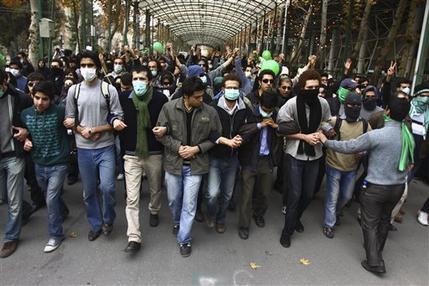
Josh Shahryar summarizes yesterday's protests:

Reports confirm dozens injured; however, no one was reported to have been killed. By the end of the day, reports emerged that at least three dozen people and possibly many more were arrested by the security forces. There were reports of guns being fired in some parts of the city, but all shots were confirmed to have been fired in the air to scare the protesters. The only major opposition figure that took part in the protests was former president Hashemi Rafsanjani’s daughter, Faezeh Hashemi. […]

It is fairly difficult to estimate how many people joined the protests. However, by looking at pictures and videos from different parts of the city and universities, it can be safely said that somewhere between five to ten thousand people took part in protests throughout the day. It is worth noting that there was a government-sanctioned protest in Tehran University as well and more than a thousand government supporters took part in that.

The Newest Deal adds:

Yesterday's demonstrations were organized by a fractal grassroots whose structure is horizontal rather than hierarchical. That is to say, it has no leader.

These were protests that saw Iranian flags whose white centers were bare, missing the iconic 'Allah' written in form of a red, martyr's tulip. Gone was the silent marching of peaceful demonstrators holding up 'V's' in the air. Instead, pockets of protesters confronted the Basij physically, and at times, overwhelmingly. And protests were not just limited to Tehran, either. Demonstrations have been verified in Mashhad, Shiraz, Rasht, Kermanshah, Hamedan, Arak, Kerman and Najafabad.

Though impossible to tell with the blanket censorship draped over Iran at present, it appears that the size of yesterday's protests were smaller than what was seen on 13 Aban, and on Qods Day before it. No matter. The demonstrations of 16 Azar signaled a shift — if not response — on the part of the Green movement to the tyranny and brutality that the regime has come to represent. The message was clear: there is no turning back.

(Hat tip: Mojtaba Samienejad)

The Genius Of James Hansen’s Carbon Fee

A reader explains:

One of the key differences between Krugman and Hansen is where the price on carbon is attached. Often when talking about cap-and-trade, the pricing of carbon is attached somewhere in the middle of the stream, not at the extraction of fossil fuels and not at the emission point. Because the price is attached in the middle, the policy gets wrangled between interest groups.

What Hansen is talking about is upstream pricing, or at the point of harvesting fossil fuels. Pricing carbon this way greatly reduces the amount of interest groups involved in making the policy to

coal, oil, and gas companies.

As both point out, the companies will pass on the price downstream ultimately to consumers, but think about the policy-making ramifications. Do you write a policy that basically involves every interest group on the planet (current cap-and-trade proposals) or do you write a policy that targets the fossil fuel industry, which is already pretty easy to pick on given, among other things, their ridiculous record profits. Cap and trade can also be made to work upstream, just as a carbon tax can be made for downstream. What Hansen and Krugman argue about is not only how to price carbon, but where, and the "where" has serious policy ramifications.

[This post's headline originally had Robert Hansen, the spy, not James Hansen, the scientist. Brain fart. Apologies.]

The Looming US-Israel Split

That's the likeliest consequence of the current awful choices the West has with respect to Iran's nuclear weapon capacity. In a diplomatic war-game at Harvard, various experienced officials tried to game out future negotiations, sanctions and alliances. Iran's revolutionary guard junta, which now runs almost all the country's key institutions, wins every time. Broad sanctions won't work; specific sanctions bring Russia and China again to Iran's defense; and in the end, the US comes to the obvious conclusion that, absent launching a war we can neither afford nor accomplish, the best strategy is containment of an Iran with nuclear latency or even a few nuclear bombs. This is certainly no riskier a strategy with respect to America's vital interests than letting Pakistan have a nuke. But it leaves an obvious problem: Israel. David Ignatius:

The trickiest problem for our imaginary Obama was his relationship with the fictive Netanyahu. As Burns and Gold played these roles, they had two sharp exchanges in which America asked for assurances that Israel wouldn’t attack Iran without U.S. permission. The Israeli prime minister, as played by Gold, refused to make that pledge, insisting that Israel alone must decide how to protect its security. Whereupon Burns’s president warned that if Israel did strike, contrary to U.S. interests, Washington might publicly denounce the attack — producing an open break as in the 1956 Suez crisis. The two key players agreed later that the simulation highlighted real tensions that the two countries need to understand better.

One reason I have been focusing on Israel lately is because I can see this conflict coming and do not believe it can be contained or managed without a more open and honest public dialogue than the cramped and emotional one that occurs in Washington. The truth is: Israel and the US have very different interests with respect to Iran, and if Israel launches a war on Iran, against US wishes, then the alliance will never be the same.

Gary Sick, who played the Iranian regime in the game, had the following to say on his blog:

This game provided an opportunity for me to test my understanding of the dynamics propelling each side in the Iran debate.

And the result, I am sorry to say, was even more depressing than I

would have imagined.

The fact that it was seasoned veterans of the policy process playing these roles makes it even more significant. The lesson was not so much that Iran could “win” this game so easily; it was that the US and its allies were unable even to imagine any alternatives.

The game was structured to inject maximum “reality” into the scenario: the real world as it existed on the day we started, real professionals with real experience playing the roles of real governments, total freedom of action, and an open-ended scenario.

Under those circumstances, the outcome was simply depressing!