Face Of The Day

Neda
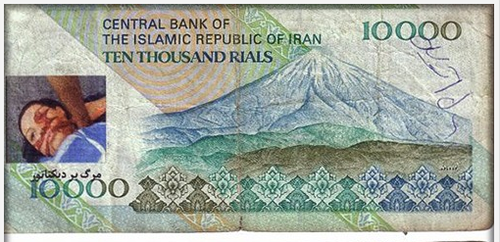
Via Robert Mackey come pictures of 13 Iranian banknotes re-purposed by the Iranian opposition:

Anti-government activists are not allowed to express themselves in [the] Iranian media, so these activists have taken their expressions to another high circulation mass-medium, banknotes. The Central Bank of Iran has tried to take these banknotes out of circulation, but there are just too many of them, and gave up. For the activists it’s a way of saying, “We are here, and the green movement is going on.”

“Got My Book!”

A reader writes:

Got it this evening … what a gem of a thing. It's nice to have the dead tree edition, in square shape, I wonder are e-books up to the images?

Beautifully done … a perfect holiday gift.  Bravo!

Another adds:

It arrived today and is stunningly beautiful. It took my breath away so I extend my deepest thanks to you, Patrick and Chris for something so simple and wonderful. Just wow!

They're still selling briskly. Buy one or more here.

Heads Up

Just a reminder that I'll be on the Joy Behar show on HLN tonight after Levi Johnston at 9 pm. Johnston, his aide, Tank Jones, and I had a fascinating chat in the green room. It was all off the record but I hope at some point to be able to interview Johnston on the record as a way to get some first-hand fact-checks on the Palin book and public statements.

As I say on Behar, this really isn't about Palin. Or about Johnston.

It's about our democracy's apparent lack of interest any more in what is true and what is false. It's about the mainstream media's willful decision not to tackle a story that was integral to a major candidate's core integrity; it's about the Republican party elite's cynicism and condescension to millions of voters; it's about the decision of Harper Collins, Adam Bellow and Jonathan Burnham to publish a book so riddled with untruth without even a gesture toward ensuring its accuracy; and it's about the recklessness of John McCain, a man hollowed out by careerism and cynicism, selling out every scruple or principle he may have had to make his way in the modern GOP; and it's about the power of fundamentalist religion to blind everyone to the banal but vital details of secular politics.

In other words, it's about the core reasons this country has gone off the rails these past few years. That matters to the Daily Dish. If it doesn't matter to you, or if you think it involves details that really should not be aired in public, then take your blame to McCain, not me. Because he didn't do his job, I'm doing mine.
Why They Love Her, Ctd

A reader writes:

As a lifelong Omahan, I couldn't help but notice that people from my city were quoted twice in the Politico piece you linked to.  I'd just like to point out that the congressional district that Omaha makes up, NE-2, was the only congressional district in the entire nation to split from its state and cast its electoral vote for Barack Obama.  (This is because Nebraska isn't a winner-take-all state.  The only other state that allows this is Maine, which did not divide its votes.)  I'd also like to point out that this was not expected to happen, and polls were taken throughout the election year showing McCain winning the district….that is until October when Sarah Palin visited here.  You can thus draw your own conclusion from that as to whether we're a hotbed of Palin love.

Hansen vs Krugman

A pretty good way to contrast and compare the carbon tax with cap and trade. Hansen's core case:

A gradually rising carbon fee would be collected at the mine or port of entry for each fossil fuel (coal, oil and gas). The fee would be uniform, a certain number of dollars per ton of carbon dioxide in the fuel. The public would not directly pay any fee, but the price of goods would rise in proportion to how much carbon-emitting fuel is used in their production.

At some point, the public decides to switch to cheaper, greener goods. Krugman's response is that cap-and-trade is a de facto kind-of-carbon fee (except with a mountain of regulation, speculation in selling pollution permits, and the possibility of just moving carbon emissions around – through dubious off-sets -  rather than reducing them). But Krugman's core point is political: cap and trade is all our system can achieve; it's that or nothing; so shut up.

I hope Hansen doesn't shut up. His proposal is simpler, clearer, fairer and more likely to wean us off carbon sooner.

Aiming The Boot

Ambinder explains some political maneuvering:

[A]s the Copenhagen climate talks begin, the Environmental Protection Agency plans to issue a formal "endangerment" finding for carbon dioxide and other greenhouse gases.  In doing so, the agency is giving the administration what amounts to a cattle prod. Having "found" that CO2 is a "public danger," and having taken the requisite administrative steps, the executive branch now believes it has the power to unilaterally impose carbon and greenhouse gas emissions caps on industry in the United States.  This overhanging boot will threaten to drop until and unless Congress acts. It's a neat executive weapon to have — one that, incidentally, the Bush administration chose not to take out of the locker, and one that the Obama administration decided to unsheathe as the President prepares to travel to Copenhagen.

Bradford Plumer speculates:

As The Wall Street Journal reports, many large businesses, particularly power companies, hate the idea of the EPA issuing its own carbon rules. They'd rather have Congress set up a more flexible cap-and-trade system. (Electric utilities, in particular, were able to shape the House bill more to their liking, and they'd have less luck with EPA regs.) So will those companies start ratcheting up the pressure on lawmakers to pass a climate bill?

Options, Public And Not

Ezra Klein previews a possible non-public plan compromise (follow-up here):

These plans would be private, but the [Office of Personnel Management] would act as an aggressive purchaser, ensuring that they met high standards and conducted themselves properly. It's a private option with a public filter, essentially. But more importantly, it's a menu of national, nonprofit plans, which would be much more interesting from a competitive standpoint than state-based, public plans.

Chart Of The Day II

Heathcareplan
 
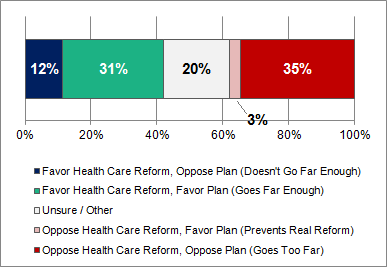
Nate Silver plucks out an interesting nugget from an Ipsos/McClatchy poll:

43 percent of people favor health care reform, whereas 38 percent oppose it (20 percent are undecided). But the actual plan under consideration gets numbers that are more or less the reverse of that — 34 percent in favor, 46 percent opposed — because a significant number of people think the plan doesn't go far enough.