There She Goes Again

A classic moment from the latest Palinpalooza, the Gridiron Dinner:

Yet “on my far left,” as she aptly put it, was the liberal Democrat Mr. Frank. At the other end of the dais, he looked stoic or even pained much of the time. But when Ms. Palin noted how busy she has been — with five kids, a book tour, running a huge state — Mr. Frank suddenly started and looked quizzical, seemingly wondering at her last item since she unexpectedly quit as governor last summer.

"The Desperate Housewives of 133, C Street" is a pretty good one, though, Barney.

“Ruralpolitans”

American-hipster

Gwendolyn Bounds reports on the growing number of urban and suburban dwellers heading for the countryside:

Motivations can vary, but typically there are three groups: young people buying land as an asset or investment, with vague hopes to live on it someday; exurban commuters who have jobs in big towns or cities but want to escape the sprawl; and back-to-the-land types who want to dabble in hobby farming. While the 76 million-strong baby boomers eyeing retirement represent the largest ruralpolitan segment, they're being joined by a growing contingent of 20-to-early-40-somethings freshly imprinted by this recession's pain.

If baby boomers follow typical migration patterns, the rural population age 55-85 will increase by 30% between 2010 and 2020, according to the U.S. Department of Agriculture's Economic Research Service. But other factors, such as widespread Internet access, are giving this current ruralpolitan trend new longevity, particularly among younger generations. Enhanced renewable-energy options and associated tax credits mean homes can be more affordably powered by the sun or wind in areas where utility companies won't service cheaply. […]

Interest in small-scale hobby farming has also bloomed, particularly among the young. When environmental-news Web site Mother Nature Network ran a piece called "40 Farmers Under 40" this year, it garnered nearly 100,000 hits, one of its most popular features since the site's launch. Visitors to the Web site of Living the Country Life magazine increasingly seek info on wood stoves, solar panels and windmills. "It's a little like the pioneer spirit," says Betsy Freese, the magazine's editor.

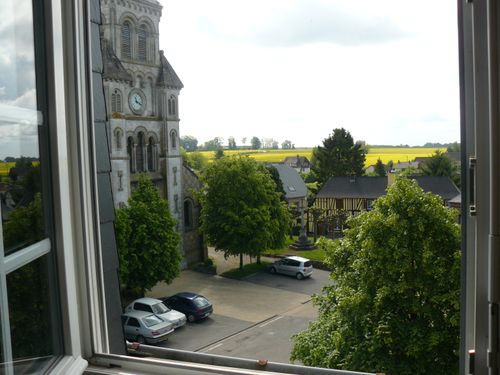
(Photo: Noah Kalina)

Quote For The Day

"I had an interesting conversation with an Alaskan two days ago who had spent time speaking with one of Sarah’s family members. My friend was curious how Sarah’s extended family and small circle of close friends, who know the truth behind many of the mistruths she tells the rest of the nation handle what they know her deceptions to be. “It was so surreal,” my friend recounted. It is as if there is real reality, and then there is “Sarah Reality” and in Sarah Reality whatever Sarah wishes were true at the moment, whatever she wants to be true, then that is what true is for her, and subsequently for those in her inner circle and her fan base. Sarah is not to be questioned. She is to be agreed with and honored. My friend went on to say this particular family member mentioned that Sarah was the “most important person in the world right now” and that Christians needed to get behind her and pray for her.

There seemed to be a total lack of understanding that all Christians may not agree with or support Sarah and Sarah’s viewpoint/s. If she were simply an isolated individual having what sounds to be some sort of delusional experience, it would be kind of interesting and sad. But it disturbs me that so many people across the country have seemingly swallowed hook, line and sinker whatever she tells them. It feels like her fans are more like disciples – not to a doctrine, since she doesn’t seem to have one – but just to her," – commenter on First Things, a Christianist-theocon publication.

Did The Internet Create The New Atheists?

Unreasonable Faith floats a theory:

Atheists have always been a minority. Religious minorities are frequently in an awkward position, particularly when the majority considers their very existence to be a challenge. So atheists have tended to keep quiet, sometime not even realizing that the person they are speaking to is another atheist.

The internet has alleviated some of this problem. First it provides a semi-anonymity, which allows people to speak freely. Second, it’s created a way for people who are geographically spread around the world to meet together and discuss. So the internet provides something of a support group, which makes the atheists stronger and more confident. This also produces a group polarization effect, which makes the stronger atheists more confrontational.

So when folks like Dawkins came along, there was a ready made audience for their work. The success of The God Delusion helped get other atheist works published, creating the wave of “New Atheists” we see today.

Hume ‘N Nature

Beyond

Julian Sanchez, mulling over the existence of the self, quotes Hume:

For my part, when I enter most intimately into what I call myself, I always stumble on some particular perception or other, of heat or cold, light or shade, love or hatred, pain or pleasure. I never can catch myself at any time without a perception, and never can observe any thing but the perception. When my perceptions are remov’d for any time, as by sound sleep; so long am I insensible of myself, and may truly be said not to exist. And were all my perceptions remov’d by death, and cou’d I neither think, nor feel, nor see, nor love, nor hate after the dissolution of my body, I shou’d be entirely annihilated, nor do I conceive what is farther requisite to make me a perfect non-entity. If any one, upon serious and unprejudic’d reflection thinks he has a different notion of himself, I must confess I call reason no longer with him. All I can allow him is, that he may be in the right as well as I, and that we are essentially different in this particular. He may, perhaps, perceive something simple and continu’d, which he calls himself; tho’ I am certain there is no such principle in me.

Sanchez adds:

I see that he too stresses that this is a case where language is the true source of the puzzle, and that quandaries about personal identity “are to be regarded rather as gramatical than as philosophical difficulties.” Moving outside the Western tradition, of course, the “no further fact” view dovetails nicely with Buddhism, which is almost entirely an introspective research program. The illusion of the persistent and unitary self, that tradition teaches, dissolves not in the acid of theory but the light of committed inward contemplation.

And he concludes:

[W]hen people talk about the strong intuitions they have about the nature of the self, I think they’re often really talking about an attachment to a linguistic and social convention rather than an unmediated apprehension of what it’s like to be one’s self.

The Prosperity Gospel And The Subprime Collapse, Ctd

A reader writes:

I teach biblical studies so I am interested in this topic.  You are fundamentally right about the stark contrast between the prosperity gospel of the likes of Joel Osteen and the gospel preached by Jesus, but I take issue with your apolitical reading of Jesus’ proclamation. 

In the ancient world under the rule of the Roman empire (basileus in Geek) where inscriptions read “Divine Augustus Caesar, son of god, imperator of land and sea, the benefactor and savior of the whole world,” running around proclaiming that the “kingdom of God is at hand” has a political resonance.  There is no separation of church and state at this time.  Caesar Augustus was not only the divine son of God and savior, his birth under the sign of a star was “good news” (euangelion in Greek) for the world (a claim that may sound familiar at this time of year). 

When Jesus preached the “good news” (euangelion) of God’s kingdom (basileus) it could not have been heard by the Roman authorities as anything but the assertion that the reign of the God of Israel which was now breaking into the world in Jesus’ preaching, healing, and exorcisms superseded all other claims to kingship and power.  From the Roman side of the equation this message constitutes sedition.  Drawing upon the prophets of Israel, Jesus preached a kingdom that was breaking into this world as the culmination of God’s plan for Israel and the entire world (see Isaiah 40-55).  It was both now and not yet at the same time.  When the time came that God’s kingdom was complete there would be a new heaven and new earth in a mutual embrace where God now dwells with his people here, not up in heaven somewhere (Rev 21:1-4).
 
However, Jesus did not preach that this kingdom manifested itself in the manner to which the world subscribed: the use of power by might and social status.  Rather, the exemplar for life in this kingdom was Jesus on the cross: self-sacrificial love for others that looks foolish to the world.  Thus Paul writes, “we proclaim Christ crucified, a stumbling block to Jews and foolishness to Gentiles” (1 Corinthians 1:23).  Unlike those who grasped for might as power, Jesus “did not regard equality with God as something to be exploited, but emptied himself (in the Greek this phrase literally means “divested himself of status”), taking the form of a slave, being born in human likeness. And being found in human form, he humbled himself and became obedient to the point of death– even death on a cross” (Philippians 2:5-8).

Humility and death on a cross were not virtues in the ancient world, and yet they were to the early Christian movement and because of this “the members of the body that seem to be weaker are indispensable, and those members of the body that we think less honorable we clothe with greater honor, and our less respectable members are treated with greater respect; whereas our more respectable members do not need this. But God has so arranged the body, giving the greater honor to the inferior member, that there may be no dissension within the body, but the members may have the same care for one another.  If one member suffers, all suffer together with it; if one member is honored, all rejoice together with it” (1 Corinthians 12:22-26).  Not easy stuff to preach to a world that craved social status as power then or now.
 
On the matter of “my kingdom is not of this world” (John 18:36).  The “of this world” part of this passage is often mistranslated.  The phrase in Greek “ek tou kosmou toutou” can just as well mean that “my kingdom is not based on this world” (i.e., my kingdom does not function the same way that your kingdom does).  That this is the meaning of this phrase is further supported by Jesus’ follow up, “If my kingdom were from this world, my followers would be fighting to keep me from being handed over.”  If Jesus’ message of the kingdom did not have a bearing on this world, why would he also proclaim “I have conquered the world!” in the same Gospel (16:33)?

My point is that it is not about worldly power as the world understands it. It is the assertion that there is a greater, deeper power: that of love. Jesus' message may have had a political impact, as that is how the Romans understandably heard it. But that is because they misunderstood it.

Malkin Award Nominee

"A biology professor at the University of Minnesota, Morris, known as PZ “Little Paul” Myers, has no claim to fame beyond an infantile expression of bigotry that went viral, much like a flu virus. Though mostly forgotten, Myers is to an Internet hate virus what that pig in Veracruz, Mexico, is to H1N1. He is the original host in an obscure village,"- Wayne Laugesen, Colorado Springs Gazette, in an editorial urging YouTube to remove video of PZ Meyers desecrating a Eucharist.