These three things – core aspects of the classically conservative temperament – are what Rory Stewart sees in Obama's finely callibrated Af-Pak policy. Here's Stewart's must-read response to Obama's Afghanistan speech (which reads better to me now than it did at the time):
I felt as though I had come to hear a fifteenth-century scholastic and found myself suddenly encountering Erasmus: someone not quite free of the peculiarities of the old way, and therefore haunted by its elisions, omissions, and contradictions; but already anticipating a reformation. Obama's central—and revolutionary—claim is that our responsibility, our means, and our interests are finite in Afghanistan. As he says, "we can't simply afford to ignore the price of these wars." Instead of pursuing an Afghan policy for existential reasons—doing "whatever it takes" and "whatever it costs"—we should accept that there is a limit on what we can do. And we don't have a moral obligation to
do what we cannot do…
What would this look like in practice?
Probably a mess. It might involve a tricky coalition of people we refer to, respectively, as Islamists, progressive civil society, terrorists, warlords, learned technocrats, and village chiefs. Under a notionally democratic constitutional structure, it could be a rickety experiment with systems that might, like Afghanistan's neighbors, include strong elements of religious or military rule. There is no way to predict what the Taliban might become or what authority a national government in Kabul could regain. Civil war would remain a possibility.
But an intelligent, long-term, and tolerant partnership with the United States could reduce the likelihood of civil war and increase the likelihood of a political settlement. This is hardly the stuff of sound bites and political slogans. But it would be better for everyone than boom and bust, surge and flight. With the right patient leadership, a political strategy could leave Afghanistan in twenty years' time more prosperous, stable, and humane than it is today. That would be excellent for Afghans and good for the world.
What I admire about Obama is a willingness to embrace such unsatisfying but least worst policy options. I find this sort of muddling through congenitally unpleasant. I tend to gravitate, as thinkers rather than doers can, toward the surge-or-leave mentality. But it may be that some deeply unsatisfying form of muddling through really is the best strategy now in confronting the forever erupting volcano of the evolving Muslim world.
And again: note how this strategy is not utopian. It has not succumbed to the grand sweep of eschatological nirvana that pulsed through some of the more purple of Bush's speeches. Nor has it given in to the high Tory pessimism that animates Stewart or yours truly. It is an embrace of the practical, and a respect for the details of the doing. It's influenced by Bob Gates, I suspect, whose temperament is an almost uncanny match with Obama's.
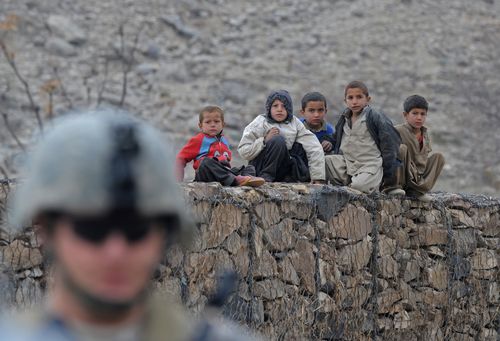
(Photo: A US soldier from the Provincial Reconstruction team (PRT) Steel Warriors is watched by Afghan children during a patrol in Nuristan Province on December 27, 2009. By Tauseef Mustafa/AFP/Getty).
 The Dish