Larison agrees with the Leveretts and defends them against my critique:
As expected, Andrew didn’t like the Leveretts’ op-ed, which he calls part of “their campaign to diminish the significance of the Iranian uprising.” They might say that they are interested in correctly assessing the significance of any uprising in order to make their policy recommendations as realistic as possible. After all, if Western policymakers start banking on domestic political unrest to undermine the Iranian government in a major way, they will pursue policies that would be very different than if they assume that the current Iranian government is not changing and not going anywhere.
Well: sure. I don’t know the future, but the evidence in front of me suggests a huge shift in the distribution of power within the Iranian polity. Of course we shouldn’t anticipate the imminent demise of the regime, but we shouldn’t be in any doubt as to its completely collapsed legitimacy. More to the point, if US policymakers had taken the Leveretts’ analysis as accurate directly after the rigged election, they would have had no idea what was coming over the next several months. It seems to me that when analysts have a proven track record of being wrong, their next statement – in line with their previous demonstrably false take – should be viewed skeptically. Of course, in the MSM, it guarantees them a spot in the NYT. Larison’s bottom line:
The government’s rallies may be fake and the opposition protests may be heartfelt and courageous, but so long as an authoritarian state can limit and divide its opposition and retains the loyalty of its security forces none of that matters.
Really? Well, today we hear that one of the most hated men in the repressive architecture of the Khamenei regime, and one of Ahmadi’s key henchmen, Saeed Mortazavi, has been cited by the Iranian parliament for torture and abuse and murder of prisoners under his authority. That makes Iran’s parliament not only a good deal more active in pursuing torturers in the executive branch than the US Congress, but also another fracture in the junta’s control. Then comes another interesting story today about leaks of unrest and dissent among the … Revolutionary Guards:
“Since June, there has been much anecdotal evidence that suggests deep divisions between the hard-line commanders of the Guards and between the Guards and members of the regular armed forces who are dissatisfied with the election and its aftermath,” said Alireza Nader, an analyst with the RAND Corporation. “The extent of these divisions are hard to gauge, but they have the potential to weaken Khamenei’s grip at a critical juncture.” …
Mr. Milani, for example, pointed to what he said was a credible report based on information from the Military Command for Greater Tehran that the authorities have used criminals and prostitutes to intimidate protesters and fill the ranks of pro-government demonstrations…
On Jan. 2, the Rouydad News Web site said that an opposition supporter within the Guards, or I.R.G.C., provided a detailed account of the funeral for Ali Moussavi, the assassinated nephew of the opposition leader, which was controlled by the Guards’ internal intelligence service.
Who knows what to make of this? I don’t. But after the death of Montazeri, after Ashura, after clear signs that Mousavi feels confident enough to offer the junta a lifeline, is it “realist” to believe that the regime is as secure as ever? Regimes such as Khamenei’s are secure … until they aren’t.
February 11. That should be the next serious data point.
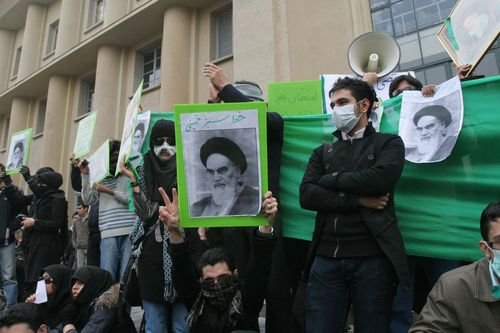
(Photo: Iranian opposition supporters hold pictures of the late founder of the Islamic republic Ayatollah Ruhollah Khomeini as they protest with the green symbolic color of the opposition at Tehran University’s campus on December 13, 2009 to condemn any insults against Khomeini. Iran’s supreme leader Ayatollah Ali Khamenei warned opposition leaders to distance themselves from protesters whom he accused of acting ‘against Islam’ and the late Ayatollah Khomeini. The protests were triggered by state television airing footage of a torn poster of Khomeini, which opposition leaders condemned, rebuking the state television. AFP/Getty Images)
 The Dish