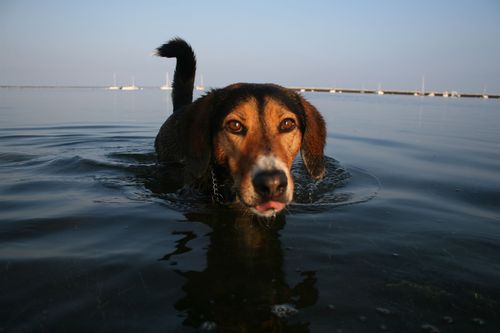
A reader writes:
To see what is in front of one's nose needs a DNA test.
Who's next? Trig? Another writes:
I couldn't help but think that your experience with finding out that your beagle isn't a beagle might be similar to what it's like for a parent to find out that their child isn't a heterosexual. And when that happens, it's the parent's perceptions that have been mistaken, not the child who has been an "imposter." Your dog isn't an imposter – you haven't known what you've thought there was to know, about your dog. Fortunately, your dog is who she is, and just as worthy of your love, and as loyal and perfect as she ever was.
Irony-deficiency anyone? Another:
Maybe the Palins can appreciate you having a sled dog.
Wiki:
The Chinook owes its existence to one man, Arthur Treadwell Walden of Wonalancet, New Hampshire. The breed derives principally from one male ancestor born in 1917, named “Chinook,” who was Walden’s lead dog and stud.
Chinook derived from a crossbreeding of husky stock from the Peary North Pole expedition with a large, tawny Mastiff-like male. Photos of “Chinook” show a drop-eared dog with a broad Mastiff head and muzzle. Walden’s leader was bred to Belgian Sheepdogs, German Shepherd Dogs, Canadian Eskimo Dogs and perhaps other breeds; the progeny were bred back to him to set the desired type and was apparently a strong reproducer of his own traits. Arthur Walden was an experienced dog driver with years of experience in the Yukon; he was lead driver and trainer on the 1929 Byrd antarctic expedition. He is credited with bringing sleddog sport to New England and with founding the New England Sled Dog Club in 1924. The 12-year-old “Chinook” was lost on the Byrd expedition.
Another reader writes:
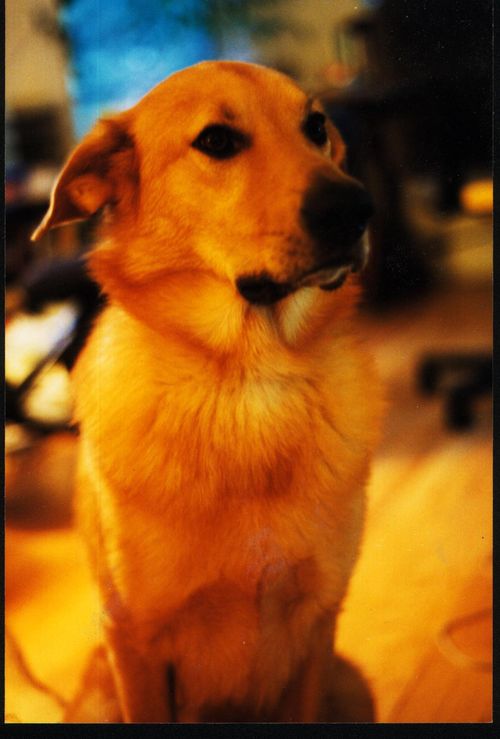
Chinooks! My late and very lamented Vanka was a chinook. He was big, fluffy, friendly, and stuck around in pretty good shape for nearly 16 years. I can't think of a nicer dog. Here he is at about 14. Consider your recent discovery about Eddy a lucky one!
 The Dish