Assuming a huge Brown victory tonight, as I do, I've been trying to sort through the many layers of what it might really mean. The FNC/RNC machine will describe it as a crushing referendum on health insurance reform and Obama, period. The trouble with this analysis is that Scott Brown has actually supported a near carbon copy of the Obama plan on a state level, and his opposition to the Senate bill is primarily that Massachusetts already has universal health insurance, so what's in it for his state? This is not the same as calling Obama a radical, transformational communist, which is the current GOP talking point (well, it's been their talking point since June 2008).
The second explanation is the Brooks/Noonan theory that somehow everything feels wrong to the Independent or conservative-leaning voters. They have an instinctual fear of more government and, even though the Senate bill couldn't be more minimalist within the confines of expanding access and controlling costs, this gnaws at them. I think this is a legitimate feeling (I have it too) – but an illegitimate argument.
Look: the markets conservatives have believed in have failed.
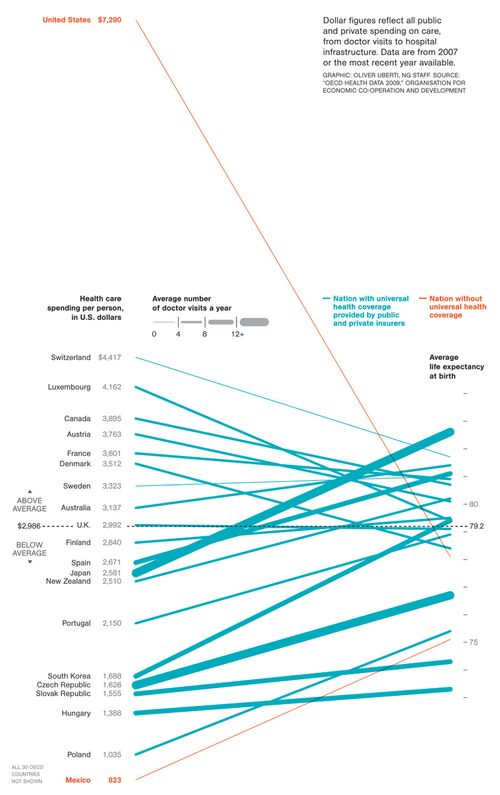
As the more honest conservatives (Greenspan, Posner, Bartlett) have noted, the financial crisis was a clear indicator that we need a more active and vigilant government in regulating the financial sector. And when you look at the results of America's hybrid and dysfunctional healthcare system, it is more than clear that the status quo is unsustainable. Yes, this system has pioneered amazing breakthroughs and a pharmaceutical revolution that has transformed lives. But the cost and inefficiency of this is simply staggering. Look at the graph above. If you think it's great, support the GOP. They don't want to change anything, but a few tweaks.
The current system insures fewer and fewer people and costs more and more. It is crippling other sectors of the economy and will bankrupt the entire Treasury if some painful adjustments are not made. If America cannot grapple with a crisis this big, and cannot accept an imperfect but reformable piece of legislation that makes a start on this, then America is incapable of grappling with its serious problems. And if Republicans are in the forefront of defending every cent going to Medicare and refusing to offer a single credible path to cutting spending and offering even more tax cuts as some kind of panacea, they are much worse than the feckless Democrats. Even the drug and insurance companies know that the current system is broken. At least Obama seems interested in government. The GOP seems interested only in politics and rhetoric that can sustain the bubble of deep denial they live in.
The third explanation is unemployment, a long recession, a sense that things have not turned around, and an economic environment which is a recipe for populist protest.
The fourth is Coakley herself, an awful candidate, who Mass voters know would be stuck in that seat for ever if she gets in today. In contrast, Brown could will almost certainly be ejected by 2012. He's hot, he's tapped into white ethnic class resentment of Democratic party hubris in Massachusetts, and he's run a terrific campaign. You can see why many would vote for him. If you have lived in that one-party state, you will know why there's a frisson in the air today.
What the current FNC/RNC machine wants you to have is total amnesia about the recent past, an iron grip on ideology and abstraction – government always bad, Democrats always socialists – and a tactical delight in playing the political game, even if it means no accountability for their own past, no engagement with reality, no openness to change or constructive reform.
This is the deeper war here. Which means it is essential that Obama find a way to rescue health insurance reform from the Rovian nihilists.
(Graph c/o that socialist/communist rag, National Geographic.)
 The Dish