There’s an HCR metaphor in here somewhere:
(Hat tip: Wooster Collective)
There’s an HCR metaphor in here somewhere:
(Hat tip: Wooster Collective)
Historian Bruce J. Schulman draws on the past:
The architects of the most important social legislation in U.S. history, the Social Security Act of 1935, felt the same ambivalence abut their handiwork — and the same letdown about the final product. But Social Security became the bulwark of American social policy — the foundation of the social safety net to this day. It also proved a political boon for its creators, winning Democrats votes and elections for two generations. Health care reform, however attenuated and compromised, has similar potential.
Austin Frakt advises:
[S]uppose like me you favor the following:
- Federalization of Medicaid,
- Elimination of the preferred tax treatment of employer provided health insurance,
- Severing of the link between employment and health insurance,
- Greater transparency and uniformity of health care prices,
- Less provision of unnecessary care.
None of these will occur with the passage of health reform legislation this year. But all are far more likely to occur in the future if health reform does pass and far less likely if it does not…That’s why I believe it is intellectually consistent to both find the provisions in health reform legislation lacking and still think them worthwhile to implement.
There are many, many aspects of this bill that can be reformed and added to in the coming years – the health insurance exchanges, the cost control pilots schemes, etc. Throwing the whole baby out with the bathwater is madness.
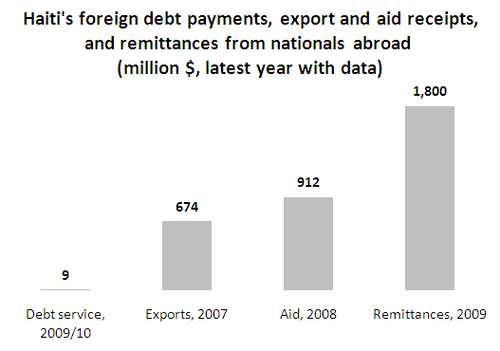
David Roodman furrows his brow:
I fear that calls to cancel Haiti’s debt are the old shoes of political activism. Debt relief will hardly help Haiti recover from the quake. And in a crisis, if you’re not helping, you’re in the way. Let us do the equivalent in the policy realm of sending cash, by advocating reforms that will do far more to alleviate the suffering.
Further thoughts by Roodman here.
(Hat tip: MR)
Greenwald bemoans "how extremist our political consensus has become" against the rule of law:
The express policies of the right-wing Ronald Reagan — “applying the rule of law to terrorists”; delegitimizing Terrorists by treating them as “criminals”; and compelling the criminal prosecution of those who authorize torture — are now considered on the Leftist fringe. Merely advocating what Reagan explicitly adopted as his policy — “to use democracy’s most potent tool, the rule of law against” Terrorists — is now the exclusive province of civil liberties extremists. In those rare cases when Obama does what Reagan’s policy demanded in all instances and what even Bush did at times — namely, trials and due process for accused Terrorists — he is attacked as being “Soft on Terror” by Democrats and Republicans alike. And the mere notion that we should prosecute torturers (as Reagan bound the U.S. to do) — or even hold them accountable in ways short of criminal proceedings — is now the hallmark of a Far Leftist Purist.
And a Reagan-Thatcher pragmatic Christian Tory like me is now a conservative heretic. And a centrist like Obama is a communist. God help us.
A Democratic president who isn't called Clinton makes a difference. So reports Kevin Nix. Serwer sizes up the politics of repeal:
Unlike marriage equality, the American people seem pretty straightforward on DADT: Not allowing gays and lesbians to serve openly is bigotry. They're uncomfortable with that. And the GOP is uncomfortable with cementing the impression that they are homophobes who aren't simply comfortable "maintaining the traditional definition of marriage" but who really want to exclude the LGBT community from as many aspects of public life as possible.
(Hat tip: Smith)
The full budget is here for wonkish masochists to enjoy. Tim Fernholz has highlights. Ezra Klein zooms out:
Commentary on this budget will focus on Obama and "his" deficits, but the reality is that the vast majority of this budget is ours, and the story it tells is only about Obama on the margins.
Reax, mostly from the right, here.
Norm Geras is rounding up reaction to Blair's testimony. He observes:
Opponents of the war complain that the questioning of Tony Blair by the Chilcot panel wasn't very testing. They're right. I could have posed him tougher questions and I'm no lawyer. For example, Blair went back on what he'd said to Fern Britton in December – that he still would have wanted Britain to support a US invasion had he known there were no WMD in Iraq. Others treated this statement as damning of Blair, when it isn't. But the Chilcot panel might have probed, and put him to the trouble of explaining why he'd said it and had now decided to go back on that. But they failed to.
Read the whole thing. Larison is withering:
Going before a toothless inquiry to hold forth and give self-justifying statements is no better and offers no more accountability to the public than issuing defiant statements from the podium at AEI or on the op-ed pages of The Wall Street Journal. Like George Bush, Tony Blair will presumably never hold political office again in his life, but that was already a given. Meanwhile, the damage has been done, and not one of the responsible parties will pay any price for his wrongdoing.

 The Dish