"Team Obama’s anti-anti-missile initiatives are not simply acts of unilateral disarmament of the sort to be expected from an Alinsky acolyte. They seem to fit an increasingly obvious and worrying pattern of official U.S. submission to Islam and the theo-political-legal program the latter’s authorities call Shariah. … [T]he new MDA shield appears ominously to reflect a morphing of the Islamic crescent and star with the Obama campaign logo," – Frank Gaffney, columnist for the Washington Times and a Fox News contributor.
Month: February 2010
Does Obama Have The Votes?
Cohn gets an e-mail from a Democratic strategist:
I don’t believe there is an accurate vote count at this time. It is fluid and many members are trying to digest the policy, process, and outcome of this week’s summit before making a final call. Some of those who are contemplating voting for the bill won’t commit to an aye vote without securing something (policy, political or personal) for it in return.
That is called using your leverage; some will maximize their use of it. The President and his senior staff will have to be aggressively proactive in this effort, something that he and his Administration is not particularly well known for doing. Having said, while the votes are certainly not there now, the odds for a successful outcome is trending in the right direction. Also encouraging is that many in the White House understand it is time for an all hands on deck effort. Regardless, if the Congressional Leadership schedules votes, it will be extremely close–as has been every major Democratic or Republican initiative during the last two decades.
Cohn admits that that this "strategist, and others who echo the sentiment, could be spinning. But I tend to think they are right."
Kate Steadman rounds up pundit predictions.
The Tax Reform Man Cometh, Ctd
Pete Davis also reacts to the Wyden-Gregg bill:
I'd be surprised if Congress got serious about tax reform until at least a year from now. If the Tax Reform Act of 1986 is any example, it will take a strong push from the president to get this going. That effort started with the Bradley-Gephardt proposal of 1978, which I estimated when I was at the Joint Committee on Taxation. It took eight years of debate and political jostling to enact tax reform then. Hopefully, we can proceed more rapidly this time.
If the GOP wins the House or Senate this fall, this seems to me to be a perfect bi-partisan Obama initiative, along with enforcing the conclusions of the debt commission and calling the Republican bluff on cutting spending. Win-win. Or rather: meep-meep.
The Democrats Will Lose Seats
Yglesias highlights Alan Abramowitz's analysis of the midterms:
The current political environment only appears unfavorable for Democrats compared with the extraordinarily favorable environment that the Party enjoyed in both 2006 and 2008. The two structural variables in the model—previous Republican seats and the midterm dummy variable—predict a Republican gain of 38 seats, half due to the small number of Republican seats prior to the election and half due to the fact that 2010 is a Democratic midterm year.
According to this model, the main reasons that Democrats are likely to experience significant losses in 2010 are the normal tendency of voters to turn against the president’s party in midterm elections regardless of the national political environment and the fact that after gaining more than 50 seats in the past two elections, they are defending a large number of seats, many in Republican-leaning districts.
This isn't to say that the political environment doesn't matter at all:
Even under what might be considered a best-case scenario for Democrats, if President Obama’s net approval rating were to improve from a +5 to a +20, and Democrats were to regain a 10 point lead on the generic ballot, Democrats would still be expected to lose about 20 seats in the House. On the other hand, under what might be considered a worst case scenario for Democrats, if President Obama’s net approval rating was to fall from a +5 to a -20 and Republicans were to gain a 10 point lead on the generic ballot, Democratic losses would be expected to reach 54 seats in the House.
Chart Of The Day, Ctd
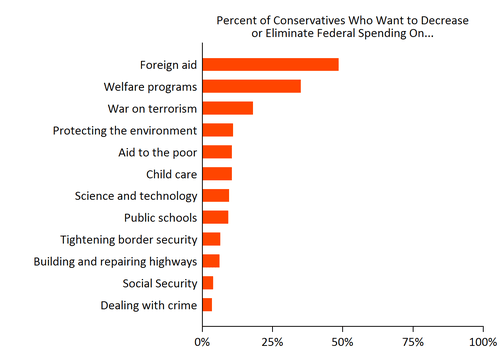
John Sides's chart below used faulty data. The above chart uses the correct numbers. Sides:
The story changes with regard to two programs — welfare and foreign aid — both of which are far less popular than in the original graph. About 49% of conservatives want to cut or eliminate foreign aid; 35% want to cut or eliminate welfare. The other programs, however, are again quite popular. The average percentage of conservatives who want to increase spending is unchanged: about 54%.
This Era’s ‘Hiroshima’ Ctd
A reader notes the role of American psychologists in devising the torture techniques of the last administration. It seems to me essential that the APA discover who these individuals were and enforce baseline professional ethics. From the OPR:
1. P. 40: “The CIA's perception that a more aggressive approach to interrogation was needed accelerated the ongoing development by the CIA of a formal set of EITs [enhanced interrogation techniques] by CIA contractor/psychologists, some of whom had been involved in the United States military's Survival, Evasion, Resistance, and Escape (SERE) training program for military personnel.” (The report goes on to describe the history of the SERE program, which thereby highlights the irony, well-described by David J. Morris, of our employing tactics that we learned from “ . . . German, Japanese, Korean, Chinese, and North Vietnamese military in past conflicts,” causing consternation among U.S. military brass because they were repeatedly resulting in false confession by American GIs.)
2. P.41: “The CIA psychologists eventually proposed the following twelve EITs to be used in the interrogation of Abu Zubaydah . . .” The report then lists torture techniques including “walling”, cramped confinement (with the option of adding an insect to the box), stress positions, sleep deprivation for up to 11 days at a time, waterboarding, and a twelfth technique that is redacted.
3. P.62: “Over the next few days, [REDACTED] sent [REDACTED] additional information relating to the proposed interrogation, including a psychological assessment of Abu Zubaydah and a report from CIA psychologists asserting that the use of harsh interrogation techniques in SERE training had resulted in no adverse long-term effects.”
4. P. 89: [Regarding Abu Zubaydah] “According to the CIA OIG Report, independent contractor psychologists were assigned to lead the interrogation team . . . psychologist/interrogators administered all of the interrogation sessions involving EITs . . .”
5. P.90: [Regarding the waterboarding of Abu Zubaydah] “ . . . unlike the method described in the DOJ memorandum, which involved a damp cloth and small applications of water, the CIA interrogators continuously applied large volumes of water to the subject's mouth and nose. One of the psychologists involved in the interrogation program reportedly told CIA OIG that the technique was different because it was ‘for real’ and was therefore more ‘poignant and convincing.’”
6. P.91: [Regarding Abd Al-Rahim Al-Nashiri] “ . . . psychologist/interrogators immediately began using EITs, and Al-Nashiri reportedly provided lead information about other terrorists during the first day of interrogation. On the twelfth day, the psychologist/interrogators applied the waterboard on two occasions, without achieving any results. Other EITs continued to be used, and the subject eventually become [sic] compliant.”
7. P.94: [Regarding Khalid Sheik Muhammed] “The CIA OIG also reported that on one occasion, one of the CIA psychologist/ interrogators threatened KSM by saying that ‘if anything else happens in the United States, 'We're going to kill your children."'
8. P.133, footnote 99: “The conditions of [Office of Legal Counsel attorney Dan] Levin’s approval [of waterboarding] were: . . . (2) a physician and psychologist would approve the use of the technique before each session, would be present for the session, and would have the authority to stop the session at any time; (3) there would be no material change in the subject’s medical and psychological condition . . . “
Mid-Mortem Summit Reax
[M]ost the time, [watching Obama at the summit] is like watching Lebron James play basketball with a bunch of kids who got cut from the 7th grade basketball team. He's treating them really nice, letting his teammates take shots and allowing the other team to try to score. Nice try on that layup, Timmy, you almost got it on. But after a couple minutes I want him to just grab the ball and dunk on these clowns already.
JPod:
My sense of this summit is that President Obama is exactly as he always is — extremely intelligent, knowledgeable about policy details, so certain of the rightness of his views that he has no compunction about declaring the views of his antagonists to be merely politically convenient rather than substantive, startlingly condescending at moments, and even more startlingly long-winded when he gets going. As a result, he both looks good and bad in these settings — good because he’s serious and doesn’t appear to be a fanatic, and bad because of the condescension.
Lamar Alexander and Barack Obama just had a contentious exchange on this point, so it's worth settling the issue: Yes, the CBO found health-care reform would reduce premiums. The issue gets confused because it also found that access to subsidies would encourage people to buy more comprehensive insurance, which would mean that the value of their insurance would be higher after reform than before it.
Cohn agrees. James Capretta doesn't. Kate Pickert highlights a real philosophical difference:
The Democrats want to set minimum standards for insurance sold to individuals and small businesses in the exchange. This will increase spending because individuals and small businesses often now buy cheap insurance that doesn't provide comprehensive coverage. This insurance tends to have high deductibles, high co-payments and annual and lifetime caps on coverage. Under the Democratic bills, this insurance would essentially get phased out; insurers would only be allowed to sell actual comprehensive insurance in the exchange. This would be better insurance and it would cost more. This insurance would have to cover, at minimum, around 65% of an individual's total health care costs.
The Republicans want to keep the market open without this layer of federal regulation.
The Republicans have not handled THE tough problem. By agreeing that insurance companies should not be able to price based on pre-existing conditions, they have backed themselves into a regulatory corner. Although Obama tends to be dismissive of Joe Biden, and he did it again at about the 12:50 point, Biden nailed it. If we agree, he said, that insurance companies shouldn't be allowed to "discriminate" based on pre-existing conditions, that's not a small agreement, that's a big one.
Whoa! The President just shot himself in foot on the mandated benefit issue — repeatedly! He said the reason that coverage would be more expensive under the bill is because the coverage would offer more benefits. That is true. But then he almost (but not quite) said that people could still choose something else if they wanted too. He stopped mid-sentence probably because he realized what he was about to say wasn’t true. He then pivoted to state that the coverage Congress has includes a minimum benefit package and doesn’t have high-deductible plans. Both of those things are untrue.
Drum:
The Democrats, who should be in better shape because they have a single leader, are insisting on letting every leader speak: Nancy Pelosi, Harry Reid, Steny Hoyer, and Max Baucus so far. These folks are not great speakers. Why are they so lame that they insist on speaking anyway? For once in their preening lives, why don't they just fade into the background and let President Obama orchestrate their side? Obama may yet come out on top in today's session, but the behavior of the Democratic congressional leadership so far constitutes political malpractice.
No Plan B On Health Care
That's Ezra's bottom line. From Jonathan Bernstein's summit primer:
Remember who the audience is here: nervous Democratic Members of the House, who probably already believe that passage of the bill is better for them than failure, but don't want to be the ones who actually have cast the vote for it. What do they want? I wish I knew, but we haven't had very much good reporting…I don't think I've seen a single extensive interview with any of the fifty or so swing Members. I'm not blaming the reporters (well, not too much), because odds are that most of those fifty want the bill to pass without their vote, but realize that they might have to vote for it after all, and how exactly are you supposed to explain that in an interview?
Correction Of The Day
"An earlier version of this post misquoted Mr. Remnick on his comparison between the book [“The Bridge: The Life and Rise of Barack Obama"] and a New Yorker article he had previously written. He said the book would not be a “pumped up” version of the article; he did not say that it would not be a “pimped out” version of the article," – the NYT's "Arts Beat."
Chart Of The Day
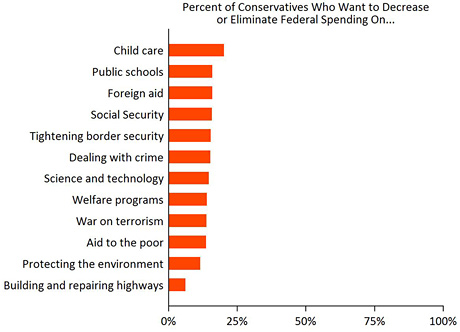
From John Sides:
In 2008, the American National Election Study asked a national sample whether federal spending on 12 different programs should be increased, decreased or kept about the same. As the graph above illustrates, the respondents who identified themselves as "conservative" or "extremely conservative" had little appetite for specific spending cuts.
Drum interjects:
The lesson from this? It turns out that conservative politicians really do represent their base pretty well. They like to yammer endlessly about cutting spending, but when push comes to shove, there's not much they really think we're spending too much on. It's all just venting.
[Correction: See update]
 The Dish