A reader writes:
Exactly whose “triumphalist neoconservative rhetoric over the dead bodies of innocent children” are you referring to? If it is Cheney, et al., please don’t tar Israel or Israel’s supporters with that. Even the farthest right wing in Israel does not celebrate civilian casualties, especially of children. What precisely have you suggested would be the right way for a sovereign country to respond to missile barrages at civilian population centers? Proportionality in international law is measured not by a concept of lex talionis, as you seem to imply, but by the goal of forestalling an enemy attack. The Gaza intervention has produced substantial quiet for Israel’s southern towns; children in Sderot are not sleeping in air raid shelters.
Here is one example of such rhetoric, as first reported in Haaretz: 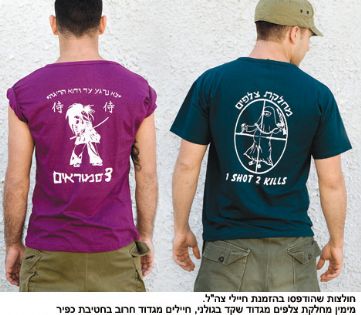
Yes, that’s an unofficial t-shirt, popular among some IDF soldiers, celebrating the notion that by shooting an armed pregnant Palestinian woman, you can also kill her unborn child. They were particularly popular after the Gaza assault. Here is another:
The fight against Islamic radicals always seems to come around to whether or not they can, in fact, be deterred, because it’s not clear that they are rational, at least not like us. But to wipe out a man’s entire family, it’s hard to imagine that doesn’t give his colleagues at least a moment’s pause. Perhaps it will make the leadership of Hamas rethink the wisdom of sparking an open confrontation with Israel under the current conditions. Or maybe not, and the only way to stop Hamas is to eliminate its capacity for violence entirely.
This came from John McCain’s spokesman, Michael Goldfarb, who is currently the online editor of The Weekly Standard. Here’s another from a leading neocon blogger, not Jewish, a month after the Gaza assault:
“Swear to God, if they ever want a Gentile prime minister, my first order would be to deploy the IDF in a north-south line, facing east. My second order would be “forward march” and the order to halt would not be given until it was time for the troops to rinse their bayonets in the Jordan. After a brief rest halt, the order “about face” would be given, and the next halt would be at the Mediterranean coast.”
More detail from the Haaretz story, mentioned above:
Dead babies, mothers weeping on their children’s graves, a gun aimed at a child and bombed-out mosques – these are a few examples of the images Israel Defense Forces soldiers design these days to print on shirts they order to mark the end of training, or of field duty. The slogans accompanying the drawings are not exactly anemic either: A T-shirt for infantry snipers bears the inscription “Better use Durex,” next to a picture of a dead Palestinian baby, with his weeping mother and a teddy bear beside him. A sharpshooter’s T-shirt from the Givati Brigade’s Shaked battalion shows a pregnant Palestinian woman with a bull’s-eye superimposed on her belly, with the slogan, in English, “1 shot, 2 kills.”
More on this in the Israeli press – though, of course, barely in the US – here and here. The head of the IDF condemned the t-shirts here. Money quote:
[P]rinting shirts for IDF soldiers, even if not initiated by the commander, is not a private action. It is an action carried out in the context of military service and should match the values of the IDF.”
I understand why this is shocking to many readers. But so far as I can tell, this controversy, which raged in Israeli press, was never reported by the New York Times or the Washington Post (let me know if I missed it).
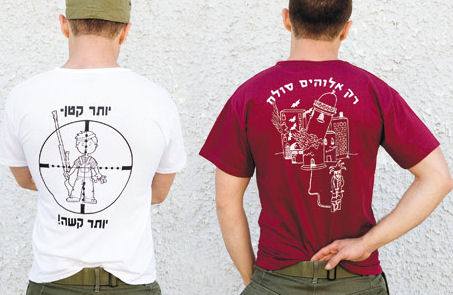
There is considerable controversy over whether the IDF ever condoned or merely overlooked these manifestations of IDF culture. And you’ll notice that the gun targets on children and a pregnant mothers also show the targets armed and thereby combatants. And some of it can be attributed to the usual macho excess and black humor of army snipers. But there is also a relish in the murder of innocents in these incidents. One t-shirt proclaims a simple political statement:
‘Every Arab mother must know that the fate of her son is in my hands’
That is not a sentiment for making peace. It is a statement of total power – and the reveling in it.
(I’m not quite sure what the message is on the t-shirt on the left at the top of this post, or the image on the right of the one immediately above. Maybe some Hebrew readers could help me out.)
 The Dish