Face Of The Day

HaitiChipSomodevillaGettyImages

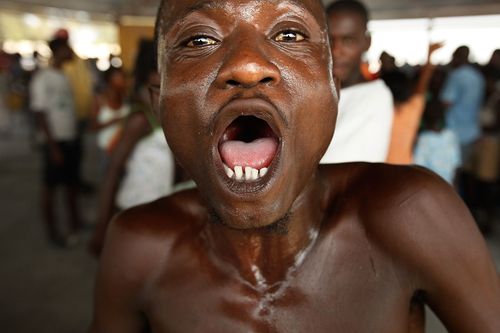
 A Christian man screams, 'Those people are responsible for the aftershocks and we shouldn't let them do this devilish thing,' after a mob attacked a Haitian Voodoo ceremony for earthquake victims in the Ti Ayiti neighborhood February 23, 2010 in Cité Soleil, Haiti. The Voodooists were run out of the central pavilion under a hail of rocks and all the ceremonial items they left behind were destroyed and burned by the mob. Although a multi-million dollar police station was built across the street from the notorious slum, no police appeared to disperse the crowd or protect the worshipers. By Chip Somodevilla/Getty Images.

Tax Reform As Health Care Reform

John Graham wants to let Americans use pre-tax dollars to buy health insurance. He illustrates once again how employer provided health insurance distorts the system:

Suppose you traveled to a parallel USA, where the tax code was malformed such that workers' homes were owned by their employers (using non-taxable dollars). If your employer's HR department changed HMO (Home Maintenance Organization) annually, you'd have to move house every year. If you got a new job, even across the street from your old office, you'd have to switch jobs. Obviously, housing costs would be out of control and there would be huge bureaucracy and lack of responsiveness in the "system."

The Night Of June 14, Ctd

A reader writes:

Couple of points about the new video: The full length version is about 20 minutes long and you can find it here: Part 1 / Part 2

The timing of this leak was really interesting.

On Feb. 20th Tehran's police chief (A. Rajabzadeh) stepped down. He started the job 16 months ago and he is leaving it for a position in the Tehran municipality. During his departing ceremony he said that he was proud of the Police force and that since the election the Police had neither killed anybody or lost any of its servicemen. Moreover, he stated that after the huge rally on June 15th, Tehran was in effect in IRGC control (more specifically the Sar-Allah HQ). Now a couple of days later a high quality video is leaked directly contradicting him. I am thinking this might be a targeted leak. In other words, someone in IRGC was not happy with what Rajabzadeh had said.  One final tidbit: Rajabzadeh's replacement is an IRGC man.

Enduring America adds:

No one in the Islamic Republic accepts responsibility for the actions of the non-uniformed forces. Their actions are usually denied by officials or are attributed to unknown people (and sometimes blamed on foreign intelligence agencies). In the summer the Supreme Leader referred to the attack on the student dorms as crimes, but he added that the attacks were carried out by assailants who had not been identified (see video).

This video proves that either Khamenei, despite being the Supreme Leader, was not given the complete facts about the events or he was lying. … Neither of these two possibilities bode well for the regime.

Joe Stack’s Manifesto, Ctd

Drum isn't so sure that Joe Stack was a terrorist. Matt Steinglass differs:

I think that on definitional grounds, you have to grant that Stack’s suicidal plane attack on the IRS was an act of terrorism. But at the same time, we don’t put it in the same league as attacks by trained agents of Al-Qaeda or the Stern Gang, because it’s not part of an organized campaign of violent intimidation that furthers the aims of a political organization. The Oklahoma City bombing, with its clear links to the militia movement and its explicit (if crazy) ideology, was more like the terrorism we see from Al-Qaeda or the Qassam Brigades. Stack’s act was more like what the Unabomber was up to: the lone act of a disturbed man with no coherent vision of how his desired political change could come about. But, again, we’d all call the Unabomber a terrorist.

My thoughts here.

The Tax That Pays For Expanding Coverage

Brooks doesn't believe that health care bill will cut the deficit:

The odds are high that the excise tax will never actually happen. There is no reason to think that the Congress of 2018 will be any braver than the Congress of today. It will probably get around the pay-go rules or whatever else might apply and it’ll postpone the tax again. The excise tax will turn into another “doc fix.” This is a mythical provision in which doctors are always about to get their reimbursements cut. But somehow they never do because the cuts are always pushed back, year after year…

Douthat agrees. It's a depressing thing, this sausage-making, as David's column very elegantly shows. But I do believe that finding a way to get 40 million Americans some access to healthcare is worth doing more than, say, occupying Iraq and Afghanistan for ever, or paying for tens of thousands of US troops to stay in Germany, or the vast behemoth of corporate welfare that never seems to disappear. Don't you?

Gay Conservatism: Born In The USA

ABBEYDavidMcNew:Getty

My Sunday column reflected on the ironies of British and American conservatism on the gay question:

Since I left the UK a quarter of a century ago as a supporter of Margaret Thatcher and Ronald Reagan, the gulf between American and British conservatism on this question has never been this wide. There is something of an irony in this. Gay conservatism first found its footing in the US in the late 1980s and early 1990s — with the publication of Bruce Bawer’s A Place at the Table and my own Virtually Normal.

The gay left denounced us as “homocons”, but the gay and lesbian group Log Cabin Republicans — named after Abraham Lincoln’s log cabin — thrived. The push to integrate gays into the military — deemed by the largely leftist gay movement of the 1970s to be a violation of the “rainbow coalition” against the military and war — dominated US politics in 1993, long before it came to pass in Britain.

My own New Republic cover story, “A conservative case for gay marriage”, which argued along David Cameron lines that commitment and family should be valued among gays as well as straights, was published in America in 1989.

In 1996, there were two openly gay Republicans in Congress, three years before Michael Portillo’s statement about youthful “homosexual experiences”. One of those congressmen, Jim Kolbe, was re-elected to his seat 10 times and addressed the Republican convention in 2000.

The founder of modern American conservatism, Barry Goldwater, who ran for president in 1964, was a passionate supporter of gay rights in the early 1990s. When Bill Clinton botched the question of gays in the military in 1993, Goldwater quipped: “Everyone knows that gays have served honourably in the military since at least the time of Julius Caesar.” He added: “You don’t have to be straight to be in the military; you just have to be able to shoot straight.”

(Photo: David McNew/Getty)
The Voting Wounded

Steven Lee Myers reports on an Iraqi class teaching political candidates how to run for office. One candidate:

Karim Radhi al-Khafaji lifted his sleeve and unbuttoned his shirt to show the horrific scars he bears from an explosion in a market in 2006. He limps badly. He’s the head of an organization that advocates for those the war has left wounded. “I consider myself the candidate for the disabled and the deprived and those who are marginalized,” he said during a break for tea.

He said 15 percent of Iraqis suffer handicaps – grievous injuries, missing limbs – compared with a world average of 2 percent, and yet they have no elected voice.

“We have not seen anyone pay attention to us, including the prime minister.”

From later in the piece:

The richer candidates hand out cash and blankets, several complained, speaking over each other at times. “The same people harmed by him are voting for him because he’s buying their souls,” Mr. Ahmed said, referring to one of the country’s two vice presidents, though he didn’t specify which. Sabieh Jabur al-Kaabi pointed that campaign posters are being torn down, though not of those of the top candidates — that is, those with influence and power.

Super Adventure Club Update

They have hired three journalists – including one with a Pulitzer – to investigate their long-standing nemesis, the St. Petersburg Times. Money quote:

Weinberg acknowledges that the "unusual situation" gave him pause, saying: "It certainly wouldn't be something just any reporter would do. My role was more limited, and I can certainly use the money these days."