A supercut of mirror scares (just for Aaron):
Month: February 2010
The Enduring Appeal Of Ron Paul
A nice assessment from Robert Costa. For me, the most refreshing thing about Paul is his dogged refusal to exclude the crippling cost of defense and the increasingly nutty attempt at global domination and control by the US. Oh, and habeas corpus – a conservative shibboleth until the Cheney era, which National Review aided and abetted.
“Well, I Don’t Really Want To Shake Your Hand, You’re Intrinsically Evil.”
In case you missed it, the most riveting conversation in the hallways of CPAC – already a viral web sensation – can be read here.
The Great Recession’s Migration
The American checks out US migratory patterns. The places that have weathered the recession the best:
These recession gainers are increasingly, at least in their major metro areas, two-tiered societies, with a highly educated and high-income native-born elite (augmented by high-skill immigrants) combined with an increasing body of relatively uneducated and low-income immigrant masses. Middle education and middle income have been squeezed out, though at a lesser rate in the recession. Politically, these states have voted heavily Democratic, with both tiers casting large Democratic percentages.
And the locations that have done the worst:
They fall into two classes. One is northern New England: the recession seems to have choked off movement to resort and small town areas; New Hampshire’s low-tax advantage seems to have diminished over the years, as neighboring Massachusetts has lowered its tax rates and Democrats who may increase taxes have dominated New Hampshire state government. The other class consists of auto-dependent Michigan and Ohio, which had a dire decade up through 2007 and an even worse one in 2007 to 2009. None of these states has had a significant immigrant inflow, unlike the Recession Gainers, which owe their current population growth to continued immigration.
Meep Meep Watch
Is McConnell getting a little antsy?
Ryan Sorba’s Bizarre Fascination With Homosexuality
The CPAC bruiser who was invited to speak on the ACORN video stunt and suddenly swerved into a diatribe against including GOProud at CPAC and then left the stage, is a familiar type if you ever knew anything about college Republican politics. These people engage in insanely vicious internal feuds and think Jonah Goldberg is a public intellectual. Sorba also fits into a sub-sub-sub-category of those young men, always bristling with somewhat strained masculinity, who are obsessed with the subject of homosexuality and have obviously spent a huge amount of time finding sources and arguments that can back up their feelings on the subject.
Here is a Google video of a recent lecture of his at Cal State. Enjoy a glimpse into the future of Republicanism.
What The GOP Now Is
A few years ago, when I wrote “The Conservative Soul,” the conservative media, insofar as they acknowledged its existence, insisted that its core diagnosis – the the GOP had become a religious, more than a political, organization, was over-wrought. I regarded the fusion of politics and religion – from the world of Islam to the West Bank in Israel to the core of the GOP – as a neurotic and extremely dangerous reacti0n to confusing modernity. I believed and believe that the core conservative mission today is to confront and defeat it. I believe what Barry Goldwater believed in 1994:
When you say “radical right” today, I think of these moneymaking ventures by fellows like Pat Robertson and others who are trying to take the Republican party and make a religious organization out of it. If that ever happens, kiss politics goodbye.
I stand with Goldwater when he declared:
“Every good Christian ought to kick Falwell right in the ass.”
Moreover, I do not believe that Barry Goldwater had become a left-liberal. I believe he remained a conservative to the end, but the Republican Party slowly became a fundamentalist cult, fueled by Nixonian resentment, neoconservative ideology and fiscal recklessness. I mention all this because of Tim Pawlenty’s speech to CPAC this past weekend.
Pawlenty, we have been told, was the moderate alternative to Palin as McCain’s possible veep nominee. He’s from Minnesota, hardly the deep South. He was about fiscal responsibility, not intolerance. He was no Santorum or Barbour or Palin. And yet this is what he said should be the first principle of conservatism in the twenty-first century:
‘God’s in charge.’ ‘God is in charge.’ There are some people who say, ‘Oh, you know, Pawlenty, don’t bring that up. You know, it’s politically incorrect.’ Hogwash.’ These are enshrined in the founding documents and perspective of our country. In the Declaration of Independence, it says we are endowed by our creator with certain unalienable rights. It doesn’t say we’re endowed by Washington, D.C., or endowed by the bureaucrats or endowed by state government; it’s by our creator that we are given these rights.”
And so he manages to turn what was at the time one of the most radical declarations of a constitutional system not reliant on Scripture or on the divine right of monarchs, but on self-government and reason, a revolution against a country where the church and state were fused, a country where the vast majority of the Founders were Deists who believed that God’s control of earthly affairs was extremely remote … into the fundamentalist neurosis that passes for so much religious faith in America today.
And you thought I was exaggerating.
Just The Catholic Church, Ctd
A reader writes:
First a simple 'thank you' for all of your writing. It both challenges and supports me.
I am a gay catholic priest, so often your pieces on how you reconcile being gay and catholic really resonate. For myself, I've always separated the concept of 'institution' from the concept of 'what do we believe', or more accurately 'how we believe'. This is never an exact separation but it at least allows me to serve the people in the church without too much conflict that I'm serving 'the Church'
It's an insane time right now. But many folks in the pews also notice
the insanity.
I sing in our local gay chorus and I've had parishioners at several of our concerts. They see not the slightest conflict in the idea that a man can be both gay and still able to proclaim God's word. It's THEIR faith that sustains me when the institution does not.
Unfortunately as someone who's studied a lot of church history, I'm also aware that the pendulum of the church's attitude swings slowly. We may not get out of this in our lifetime. So that isn't my goal.
My goal is to nudge that pendulum along so that our next generation will have it better.
That, I think, is accomplishable.
Surgery And Spirituality
Nature reports (gated):
Removing part of the brain can induce inner peace, according to researchers from Italy. Their study provides the strongest evidence to date that spiritual thinking arises in, or is limited by, specific brain areas. To investigate the neural basis of spirituality, Cosimo Urgesi, a cognitive neuroscientist at the University of Udine, and his colleagues turned to people with brain tumours to assess the feeling before and after surgery. Three to seven days after the removal of tumours from the posterior part of the brain, in the parietal cortex, patients reported feeling a greater sense of self-transcendence. This was not the case for patients with tumours removed from the frontal regions of the brain.
Sager has a good summary of the study.
(Hat tip: 3QD)
“May The Judgement Not Be Too Heavy Upon Us”
[Re-posted from Ash Wednesday]
To have lived in an America where its former vice-president can boast of supporting the torture of human beings is tragic and terrifying enough. For me and many others, this is not America. As a former president said of the abuse and torture at Abu Ghraib,
“This is not America. America is a country of justice and law and freedom and treating people with respect.”
But it is more than disturbing, especially as we begin Lent, to watch a Catholic cable channel, EWTN, present a self-described Catholic, Marc Thiessen, defending torture on Catholic grounds as compatible with the Magisterium of the Church.
Now I am not one to criticize Catholics who in good conscience dissent from the Magisterium on some topics, because I do so myself. I certainly do not deny that I am in conflict with the Magisterium on the question of homosexuality. This is not true of Marc Thiessen, as he is interviewed in an extremely supportive fashion by Raymond Arroyo, a Catholic media figure prominent enough to have been given the only English language interview with Pope Benedict XVI. Watch for yourself:
As the interview happens, Catholics keep calling in to protest, as Arroyo notices. He never challenges the absurdity that waterboarding isn't torture. He never brings up the Church's own horrifying past with respect to the use of torture, including the stress positions defended by Thiessen today. But the Catechism is very clear about this:
Torture which uses physical or moral violence to extract confessions, punish the guilty, frighten opponents, or satisfy hatred is contrary to respect for the person and for human dignity.
Notice that torture for a Catholic includes "moral violence," in which a human being's body is not even touched – the kind of sleep deprivation, sensory deprivation, or crippling total isolation deployed by the US government for months at a time. Subjecting someone to weeks of sleep deprivation as was done to al-Qhatani, or freezing human beings to states of near-deadly hypothermia, let alone threatening to crush the testicles of a prisoner's child, as John Yoo said was within the president's legal and constitutional authority in the war on terror, is obviously at the very least moral violence. The idea any of it is somehow defensible as a Catholic position is so offensive, so absurd, so outrageous it beggars belief.
Moreover, the US Catholic Bishops have also made their position quite clear. From Dr. Stephen Colecchi, Director, Office of International Justice and Peace, Department of Justice, Peace and Human Development, United States Conference of Catholic Bishops:
"Torture is about the rights of victims, but it is also about who we are as a people. In a statement on Forming Consciences for Faithful Citizenship, issued in preparation for our recent national elections [2008], the bishops reminded Catholics that torture is 'intrinsically evil' and 'can never be justified.' There are some things we must never do. We must never take the lives of innocent people. We must never torture other human beings."
This is not a hedged statement. It is a categorical statement that what Thiessen is defending is, from a Catholic point of view, intrinsically evil and something that cannot be done under any circumstances. Pope John Paul II's Enclyclical, Veritatis Splendor, contains the following passage:
"… 'there exist acts which per se and in themselves, independently of circumstances, are always seriously wrong by reason of their object'. … 'whatever violates the integrity of the human person, such as mutilation, physical and mental torture and attempts to coerce the spirit; whatever is offensive to human dignity' … 'all these and the like are a disgrace, and so long as they infect human civilization they contaminate those who inflict them more than those who suffer injustice, and they are a negation of the honour due to the Creator.'"
The notion of the integrity of the human person, of human dignity, is integral to the Catholic faith. We are all made in the image of God, imago Dei. The central and divine figure in our faith, Jesus of Nazareth, was brutally tortured. He was also robbed of dignity, forced to wear a mocking crown of thorns, sent to carry a crippling cross through the streets of Jerusalem, mocked while in agony, his body exposed naked and twisted in the stress position known as crucifixion – which was often done without nails by Romans so that the death was slow and agonizing in the way stress positions are designed to be. Ask John McCain. That the Catholic church in the Inquisition deployed these techniques reveals the madness and evil that can infect even those institutions purportedly created to oppose all such things.
Human dignity is reflected in the Geneva Conventions which bars outrages on human dignity against prisoners in captivity. Here is an iconic photograph of an individual robbed of all human dignity:
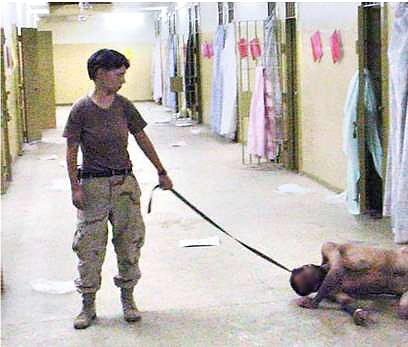
This technique was not invented by Lynndie England. It was also used at Gitmo and directly authorized by the man Thiessen worked for. Forced nudity is another way in which the human being is robbed of dignity:
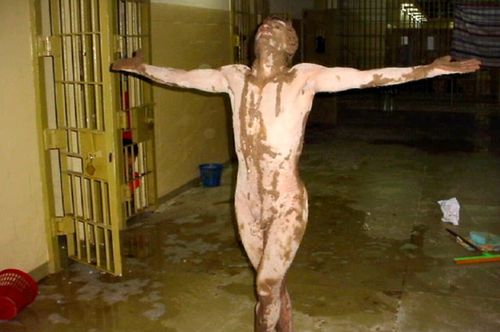
This photograph is particularly striking since it so closely mimics in its form the way in which the Romans exposed Jesus on the cross. Forced nudity of this kind was also directly authorized by Thiessen's bosses. The argument that these techniques were somehow invented by low-level soldiers on the night-shift and had nothing whatsoever to do with the waiving of Geneva or the specific techniques authorized by the last president is simply, flatly, demonstrably untrue. We have the memos and the documents and the Red Cross Report and we have the unanimous conclusion of the Senate Armed Services Committee Report:
"The abuse of detainees at Abu Ghraib in late 2003 was not simply the result of a few soldiers acting on their own. Interrogation techniques such as stripping detainees of their clothes, placing them in stress positions, and using military dogs to intimidate them only appeared in Iraq after they had been approved for use in Afghanistan and GTMO. Secretary of Defense Donald Rumsfeld's December 2, 2002 authorization of aggressive interrogation techniques and subsequent interrogation policies and plans approved by senior military and civilian officers conveyed the message that physical pressures and degradation were appropriate treatment for detainees in IUS military custody."
What was done to human beings under the CIA program that Thiessen's boss, Cheney, has repeatedly and proudly insisted he supported and authorized and that Thiessen is now promoting in his new book, was far worse. Waterboarding, which Thiessen describes as the worst of the tortures, was not, in fact, the worst. Sleep deprivation – another medieval torture technique – can be far more grueling. Alex Massie has a recent post on the subject which I urge you to read. It contains this description from a torture victim subjected to sleep deprivation under the apartheiid regime:
"It is the equivalent of bear-baiting, and we banned that centuries ago. I was kept without sleep for a week in all. I can remember the details of the experience, although it took place 35 years ago. After two nights without sleep, the hallucinations start, and after three nights, people are having dreams while fairly awake, which is a form of psychosis. By the week's end, people lose their orientation in place and time – the people you're speaking to become people from your past; a window might become a view of the sea seen in your younger days. To deprive someone of sleep is to tamper with their equilibrium and their sanity."
It lasts for what seems like for ever. In one case under the direction of Thiessen's boss, Dick Cheney, a prisoner was subjected to 960 hours of it, with a few short breaks. Here is what Marc Thiessen's boss, Dick Cheney, supported, from the Bradbury memo:
“The primary method of sleep deprivation involves the use of shackling to keep the detainee awake,” wrote Bybee’s eventual replacement, Steven Bradbury, on March 10, 2005. “In this method, the detainee is standing and is handcuffed, and the handcuffs are attached by a length of chain to the ceiling.” The detainee’s feet are shackled to a bolt in the floor, giving him a “two-to-three-foot diameter of movement.” His hands “may be raised above the level of his head, but only for a period of up to two hours.” His weight is “borne by his legs and feet during sleep deprivation,” ensuring that he had to keep awake, for if he “los[t] his balance” from exhaustion he would feel “the restraining tension of the shackles.”
[…]According to the memo, the “maximum allowable duration for sleep deprivation” is “180 hours,” or seven and a half days, “after which the detainee must be permitted to sleep without interruption for at least eight hours.”
A footnote to the memo indicated that there was an associated technique of keeping a detainee awake through “horizontal sleep deprivation.” In that technique, “the detainee’s hands are manacled together and the arms placed in an outstretched position — either extended beyond the head or extended to either side of the body — and anchored to a far point on the floor in such a manner that the arms cannot be bent or used for either balance or comfort.” Interrogators would place similar restraints on the detainee’s legs. “The position is sufficiently uncomfortable to detainees to deprive them of unbroken sleep, while allowing their lower limbs to recover from the effects of standing sleep deprivation,” Bradbury wrote.
This is not just torture; it is sadism and cruelty that any Catholic of any kind must find abhorrent. It is so close to crucifixion it chills the soul and shocks the conscience. Here is an FBI description of the treatment of a human being at Guantanamo Bay – an FBI eye-witness description – of what was done to a human being made in the image of God, under the direct authority of Thiessen's boss:
"On a couple of occasions, I entered interview rooms to find a detainee chained hand and foot in a fetal position on the floor, with no chair, food or water. Most times they had urinated or defecated on themselves, and had been left there for 18-24 hours or more.'' The agent also described military police manipulating the temperatures in detainees' cells. One was kept in air conditioning so frigid “the barefooted detainee was shaking with cold.'' ''When I asked the MPs what was going on, I was told that interrogators from the day prior had ordered this treatment,'' the agent wrote. On another occasion, the same agent saw an ''almost unconscious'' prisoner in a room where the temperature was ''probably well over 100 degrees'' — and a pile of his hair on the floor. The detainee “had apparently been literally pulling his hair out throughout the night.''
Again this was at Gitmo, and cannot even be attached to defenseless scapegoats as at Abu Ghraib, because that prison was monitored directly by the government of the United States in a program the former vice-president "strongly supported" and which Thiessen is now defending on a Catholic cable channel.
On the show, Thiessen argues that this kind of treatment of human beings is compatible with Catholic just war theory, because the hundreds of prisoners subjected to these techniques – many of whom were innocent and none of whom had been given fair trials with due process to make even a preliminary assessment of whether they were terrorists at all - knew of impending plots and therefore were still technically fighting the US and metaphorically on the battlefield.
First off, remember that just war theory defends warfare as a last resort act of defense. The Vatican opposed the Iraq war on those grounds. Even on the battlefield, just war theory requires that the force used be minimal to the goal of self-defense and proportional to the force being fought. The idea that a combatant, already taken out of combat, shackled in a cell, defenseless and weaponless, represents a version of a battlefield threat proportional to the use of torture is so outside any understanding of Catholic teaching it really does quite simply shock the conscience.
Secondly, every prisoner captured in war of any kind may have information related to pending attacks. Many may have been briefed about future operations. Leading commanders captured may know a huge amount about what may be coming. In the Cold War, nuclear annihilation of the entire country was at stake. But Geneva explicitly bars such acts of torture under any circumstances, and explicitly makes the case that no impending threat can justify its use, or anything that can remotely be seen as similar to its use. The language is broad and sweeping for a reason. It is not broad and sweeping so that governments can argue that the need to use "severe mental or physical pain or suffering" to extract information legitimately allows them to explore how far they can go. It is broad and sweeping in order to tell such officials that they cannot and should not go anywhere near it under any circumstances.
And before we get the argument that these prisoners are somehow not eligible for such treatment because they are terror suspects not uniformed soldiers, let me repeat yet again the simple fact that the baseline protections against torture and abuse and outrages on human dignity are not just reserved for formal prisoners of war in uniform.
The baseline provisions of Article 3 apply to any prisoner of any kind, including irregulars out of uniform, including terrorists fighting guerrilla wars. In the past the US has actually prosecuted the use of almost identical enhanced interrogation techniques" against irregulars out of uniform as serious war criminals. One defense of such techniques by the deployers of "enhanced interrogations" were that
(c) That the acts of torture in no case resulted in death. Most of the injuries inflicted were slight and did not result in permanent disablement.
The United States executed those responsible for these techniques in 1948, and yet all these decades later, we have a vice-president and his speech writer going on television to brag about them.
More to Thiessen's point that torturing is a legitimate form of self-defense in just war theory, let me again reiterate the US Catholic Bishops' spokesman's statement on the matter:
Torture is 'intrinsically evil' and 'can never be justified.' There are some things we must never do. We must never take the lives of innocent people. We must never torture other human beings.
Then we have the astonishing argument from Thiessen that the torture-victims in the Cheney program he supported were grateful for being tortured, because when they were forced beyond what they could endure – which, of course, is Thiessen's unwitting admission that what he was doing was definitionally torture – they were grateful. They were grateful because their duty to Allah had been fulfilled and they were then free to spill their guts. They had done their religious duty and had been brought to a spiritual epiphany that allowed them to tell us so much.
There is much to say about this but let me on Ash Wednesday simply remember the Catholic church's own shameful history of torture. It was done, according to the Inquisitors, as a way to free the souls of the tortured, to bring them to a religious epiphany in which they abandoned heresy and saved themselves from eternal damnation. It is hard for modern people to understand this, but as a student in college of the years in which my own homeland used torture to procure religious conversion, it is important to remember that the torturers sincerely believed that what they were doing was in the best interests of the tortured. In fact, it was a sacred duty to torture rather than allow the victims to die and live in hell for eternity, a fate even worse than the agonies of stress positions or even burning at the stake. Why? Because the torture they would endure in hell would be eternal, while the torture on earth would not last that long.
This is not an exact parallel to the way in which Thiessen defends torture. But the meme that it somehow relieved the victims, that it liberated them, that it helped them to embrace giving information without conflict with their religious faith is horribly, frighteningly close to this ancient evil. For a Catholic to use this argument on a Catholic television program and to invoke the Magisterium of the Church in its defense is simply breath-taking in its moral obtuseness.
Today is a day for repentance. It is not a day for me to condemn anyone else, given my own failings and sins. And I want to repent today for those many occasions when my anger at what has happened, and my own profound guilt in unwittingly supporting those who made this happen, has gotten the best of me. On a blog, anger can run fast and deep and I will pray today for forgiveness for intemperance. My essays – written over time and in a different rubric – take care not to do this, as evidenced here and here. People do evil most of the time because they think they are doing good. In fact, the greatest evils have been committed in the name of good.
But what has happened in this country, what we have allowed ourselves to do to others, innocent and guilty, is something for which I believe repentance is necessary. As Christians and as Catholics, we are required to follow Our Lord's impossible example and not just love our friends, but to love our enemies. This does not mean pacifism; and I have a long, long record of supporting what I believe were just wars. I mean understanding that war is always evil even when it is necessary, but that some things, like torture, abuse and dehumanizing of others under our total control, are never justified.
And once done, once perpetrated, they damage the souls of the torturers as profoundly as they destroy their victims.
And pray to God to have mercy upon us
And pray that I may forget
These matters that with myself I too much discuss
Too much explain
Because I do not hope to turn again
Let these words answer
For what is done, not to be done again
May the judgement not be too heavy upon us
 The Dish