“May The Judgement Not Be Too Heavy Upon Us” Ctd

Adam Serwer skewers Thiessen for saying that Zubaydah thanked his torturers:

I think it's actually irrelevant whether Zubaydah said it or not. Let's say for a moment it's true: Thiessen's larger argument is that, because of this single dubious anecdote, torturing Muslims we suspect of being terrorists is necessary because that's the only way interrogators can get them to talk. There's a word for the process of drawing broad conclusions about entire religions, cultures, and ethnicities from such minute contact — it's called prejudice.

Cheney vs The Facts

FactCheck.org counters Cheney's claim that the shoe bomber was not put into military custody "primarily because he plead guilty":

But Reid didn’t plead guilty until Oct. 4, 2002 – nearly 11 months after his arrest. Events suggest the guilty plea was a surprise to prosecutors — Reid had been scheduled for trial in November. For nearly a year, then, the Bush administration had the option of transferring Reid into military custody, but didn’t. Then-Attorney General John Ashcroft even discussed the idea with DoD early on, but the decision was made to proceed in the civilian system, according to Ashcroft, who was asked about the possibility at a press conference a little more than a month after Reid’s arrest.

Marijuana Is Medicine

More confirmation:

The Center for Medicinal Cannabis Research (CMCR), based at the University of California, San Diego, published a report [yesterday] summarizing the results of clinical trials studying medical marijuana’s efficacy in treating pain. The studies, funded by CMCR under the mandate of a 1999 legislative action, found that marijuana is particularly helpful in relieving pain associated with nerve damage and in treating the muscle spasticity from multiple sclerosis.

Chart Of The Day

Trust 

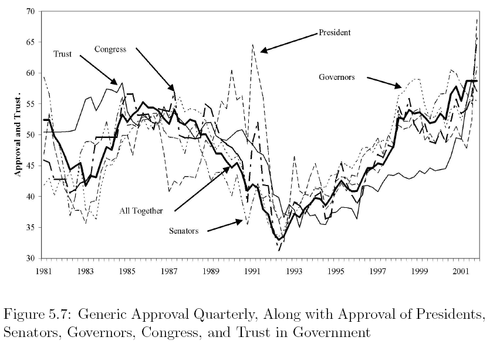
John Sides posts a graph from Jim Stimson showing the correlation between trust in government and the approval ratings of in various public officials. Stimson concludes:

So what does it mean that citizens approve or trust? It appears to mean mainly that things are going well in the country. What is important about this pattern, and unexpected, is that the approval and trust are granted to those who have had no role in producing the outcomes. We have known for some time that presidents seemed to get more credit or blame than they deserved. With the pattern now extended to those who have had no conceivable role, we need to reassess what it means to approve.

Where Is The iPhone Of Cars? Ctd

Megan and one of her readers criticize Ryan Avent's recent postings on automotive innovation. James Joyner is also skeptical. Avent continues the thread:

Better personal vehicles will ultimately be good for urbanism. It’s not too difficult to imagine a few reasons why. For one thing, small vehicles will require less space for parking, and autonomous vehicles may not require any parking at all. Parking lots and decks are the bane of walkability. Smaller vehicles, particularly ones which weigh just a few hundred pounds, will be much more pedestrian and cyclist friendly than standard automobiles. They’ll take up less precious road space. They’ll block less of other travelers’ field of vision. And in the event of a collision with a non-driver, they’ll do much less damage.

The Jobs Debate

Yglesias is optimistic:

It’s just difficult, as a writer or an advocate, to convince people that ARRA is creating jobs when everyone knows that there’s no net job growth. If there’s no job growth, then what jobs are being created? Then you get into counterfactuals and nobody is persuaded. But we’ll be into positive territory very soon. Which means you won’t be able to ask “where are the jobs?” The answer will be “the jobs are right here!” And when the jobs are right here, suddenly the data—which makes it perfectly clear that ARRA is playing a large role in supporting employment—will start to get the place they deserve in the narrative.

Drum isn't so sure. Nor is Derek Thompson.

“May The Judgement Not Be Too Heavy Upon Us” Ctd

Michael Scherer counters Thiessen:

According to Thiessen's unnamed sources, Zubaydah thanked his interrogators for forcing him to the edge of what he could physically and mentally endure, thereby freeing him of his religious obligation to not talk. The logic of this argumentation, as they say in the business, shocks my conscience.

Does it also follow that a victims of domestic violence who forgives her attacker's violence (or argues that it was justified) can also effectively erases the moral culpability of their abuser? Is Thiessen unfamiliar with the reams of research about the effects of Stockholm syndrome, which drives victims to identify with their attackers and behave in ways contrary to their own rational physical and emotional interests? Should confessions made under threat of physical and emotional harm now suddenly be considered credible, or germane to a discussion of the morality of that harm?