Pass and Patch

by Jonathan Bernstein

It's really good that Sheryl Gay Stolberg and Robert Pear have figured out that the important unknowns for health care reform are swing voting Democrats in the House of Representatives, not Senators (and not Republicans).  There's some excellent reporting in their story, which is headed I guess to the front page of the Sunday Times.  This is a hard story to report, I would think. The odds are that the margin of difference is eventually going to be Democratic Members of the House who want the bill to pass, but want to vote against it.   The trick for Nancy Pelosi and Barack Obama is to get enough of those reluctant Dems to actually vote yes.  Given that situation, it's highly unlikely that any reporter could really get much out of the swing voters, but Stolberg and Pear do a good job of attaching some names and stories to the uncertainty.

However, it would be nice if they got the basic facts of the parliamentary situation right.  As Steve Benen has taken to shouting, it's not true that the Democrats are passing health care reform through reconciliation; they're actually planning to pass two separate bills, the main body of health care reform that passed the Senate on Christmas Eve Day, and a second reconciliation "patch" with relatively small modifications in the first bill. 

This isn't just semantic; the procedure, which I think everyone agrees is the only viable path, imposes a variety of constraints on the Democrats, and NYT readers deserve to have this explained to them properly.  So, for example, it is not really accurate to say that "the new version being pushed by Mr. Obama would strip out the House bill’s abortion restrictions in favor of Senate language that many of them consider unacceptable."  What's actually happening is that the House is passing the Senate bill (with the Senate abortion provision), and that changes in the abortion language wouldn't work as part of the second, "patch" legislation because of technical details of how reconciliation works.  The same thing is true about the structure of the national exchanges, and other some other provisions — if it can't be done through reconciliation (because of the way that reconciliation works) then the Democrats are stuck with the Senate version, like it or not.  Provisions which can be dealt with in the patch, such as how the bill will be financed, will be changed to a House/Senate compromise.

Perhaps the Times doesn't want to confuse its readers with overly technical descriptions of parliamentary procedure, and I can understand that impulse, but in this case it's impossible to understand why some things are negotiable and some aren't without at least some reference to the rules that are shaping the Democrats' actions. 

Moreover, and to return to one of my larger themes over the last six weeks, the Times should let its readers know that if this moves forward the Senate will only be voting on the reconciliation fix, which is basically all ice cream and no spinach.  Which is why the remaining action is all on the House side.

(Update: The Times has revised earlier versions of the story, and now does a better job of describing the process.)
Face Of The Day

Bramblitt

by Patrick Appel

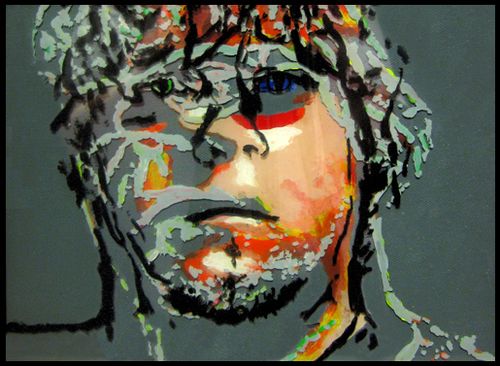
John Bramblitt is a blind painter:

For color, Bramblitt uses oil paint, which has proven critical to the process. While oil paint is messier, more pungent, and dries much slower than acrylics, it offers something that no other paint can: idiosyncratic viscosity. According to Bramblitt, “White feels thicker on my fingers, almost like toothpaste, and black feels slicker and thinner. To mix a gray, I’ll try to get the paint to have a feel of medium viscosity”. In fact, he has learned to recognize and mix all the colors he uses by his sense of touch. And the colors are the first thing one notices about Bramblitt’s work (www.Bramblitt.net). While the subjects of his paintings are immediately recognizable, proportioned, and smartly stylized, the colors are supremely vibrant, and nearly psychedelic in their rendering.

(Image: Bramblitt's website. Hat tip: Mind Hacks)

Free-Lunchism

by Patrick Appel

Reihan calls Charlie Crist " one of the worst governors in the United States, if not the absolute worst":

Rather than see federal stimulus funds as a one-time injection that could spare the state pro-cyclical cuts while creating room for a long-term plan to reduce the size of state government in line with revenues, he seemed to think that it gave him an opportunity to permanently ratchet up spending while also cutting taxes. No wonder he embraced the president.

The Decentralizing Power Of Rivers

by Chris Bodenner

Lauren Goodrich and Peter Zeihan compare the vast, interconnected river system of the US to the large but sparse and isolated rivers of Russia:

So while geography handed the United States the perfect transport network free of charge, Russia has had to use every available kopek to link its country together with an expensive road, rail and canal network. One of the many side effects of this geography situation is that the United States had extra capital that it could dedicate to finance in a relatively democratic manner, while Russia's chronic capital deficit prompted it to concentrate what little capital resources it had into a single set of hands – Moscow's hands. So while the United States became the poster child for the free market, Russia (whether the Russian Empire, Soviet Union or Russian Federation) has always tended toward central planning.

The New Print Houses

by Patrick Appel

Jason Epstein on the future of books:

Digitization will encourage an unprecedented diversity of new specialized content in many languages. The more adaptable of today's general publishers will survive the redundancy of their traditional infrastructure but digitization has already begun to spawn specialized publishers occupying a variety of niches staffed by small groups of like-minded editors, perhaps not in the same office or even the same country, much as software firms themselves are decentralized with staff in California collaborating online with colleagues in Bangalore and Barcelona.

Alan Jacobs questions Epstein's understanding of literary fragility.

Escape from Kandahar

by Graeme Wood

In 1995, the Taliban used their MiG fighter jet to force a Russian IL-76 cargo plane to land at Kandahar Air Field. After nearly a year of captivity, the crew supposedly tricked the Taliban into letting them perform routine maintenance on the plane, and then flew away, under fire, to the United Arab Emirates.  English Russia has photographs of the crew in Taliban custody.

If the crew had been American, Bruckheimer would have made a movie about this long ago.  Here's the trailer for Kandahar: Survive and Return, which hit theaters in Russia this month:

Victor Bout, the arms dealer and logistics entrepreneur implicated in this caper, is still in a Thai jail waiting for extradition to US on charges of trying to sell surface-to-air-missiles to FARC.

The Evolution Of A Search Engine

by Patrick Appel

Steven Levy explains Google’s algorithm:

Google's synonym system understood that a dog was similar to a puppy and that boiling water was hot. But it also concluded that a hot dog was the same as a boiling puppy. The problem was fixed in late 2002 by a breakthrough based on philosopher Ludwig Wittgenstein's theories about how words are defined by context. As Google crawled and archived billions of documents and Web pages, it analyzed what words were close to each other. "Hot dog" would be found in searches that also contained "bread" and "mustard" and "baseball games" — not poached pooches. That helped the algorithm understand what "hot dog" — and millions of other terms — meant. "Today, if you type 'Gandhi bio,' we know that bio means biography," Singhal says. "And if you type 'bio warfare,' it means biological."

(Hat tip: Kottke)

The Making Of K-Thug

KrugmanPaulRichardsAFPGetty

by Patrick Appel

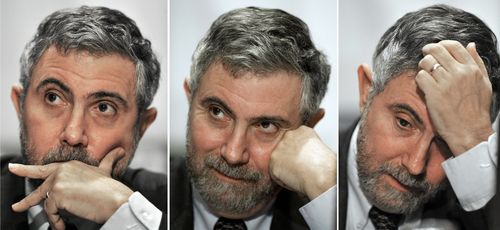
Larissa MacFarquhar's excellent profile of Paul Krugman and his wife Robin Wells has been pinging around the blogs all week, but I just found time to sit down with it. A taste:

If he is writing his column, he will start it on the morning of the day it’s due, and, if the spirit is with him, he will be done soon after lunch. When he has a draft, he gives it to Wells to edit. Early on, she edited a lot—she had, they felt, a better sense than he did of how to communicate economics to the layperson. (She is also an economist—they met when she was a postdoc at M.I.T. and he was teaching there.) But he’s much better at that now, and these days she focusses on making him less dry, less abstract, angrier.

Recently, he gave her a draft of an article he’d done for Rolling Stone. He had written, “As Obama tries to deal with the crisis, he will get no help from Republican leaders,” and after this she inserted the sentence “Worse yet, he’ll get obstruction and lies.” Where he had written that the stimulus bill would at best “mitigate the slump, not cure it,” she crossed out that phrase and substituted “somewhat soften the economic hardship that we face for the next few years.” Here and there, she suggested things for him to add. “This would be a good place to flesh out the vehement objections from the G.O.P. and bankers to nationalization,” she wrote on page 9. “Show us all their huffing and puffing before you dismiss it as nonsense in the following graf.”

(Image: Paul J. Richards/AFP/Getty Images)

A 12,300-Pound Animal

by Patrick Appel

In wake of this week's tragedy, Susan Orlean argues that killer whales should be set free:

[E]ven though I was convinced that whales should be wild and that we should instead just take fabulous videos of them and project them on gigantic high-definition screens, I simply couldn’t resist. I begged one of the trainers to take me to the dock where Keiko was lolling around and let me pet him. I will never forget the soft spongy feel of Keiko’s rubbery skin or the sensation, when he lifted his huge blocky head just above the water, that we exchanged a real look, eye to eye, full of primal meaning and connection. That’s exactly why it’s so hard to do what is right with regards to wild animals, because having such a creature that close really is magical.