Energy Miracles

Bradford Plumer looks at the chances of innovation solving our energy problem:

Expecting that a game-changing technology can be invented, perfected, and prepared for mass deployment in just 20 years is a real gamble. This isn't a task akin to the Apollo program or Manhattan Project, because the end project has to be cheap and widely accessible.

What's more, some of the best innovation comes from broadly implementing already available technology—your humdrum wind turbines or efficiency measures. (The policy mechanisms for doing so would likely involve a carbon price and some government support.) As those power sources get deployed, prices start tumbling and incremental tweaks get made. The technology improves over time. Indeed, as Joe Romm notes, that's how PCs became so ubiquitou…Given the need to start cutting emissions quickly, that sort of innovation will be far more important in the short-term—and far more likely to make a surprisingly large impact. So, yes, a miracle or two would be terrific, but that can't be the only plan.

What Should Obama Do On Iran?

National Journal experts debate. Here's Paul Pillar:

The consequences of a military strike against Iran would be widespread, very costly, and highly damaging to U.S. interests. A sample of what to expect can be gleaned from a recent simulation organized by the Saban Center at the Brookings Institution, which began with an Israeli strike against Iranian nuclear facilities. Before long there were Iranian missiles fired against Saudi Arabia as well as Israel, a skyrocketing of oil prices after closure of the Strait of Hormuz, and a worldwide Iranian terrorist campaign against the United States, amid other chaos and mayhem.

Larison moderates.

Swift-Boating Climate Change?

Walter Russell Mead is upset that the NYT hasn't reported on the IPCC pseudogates:

Let me say this again one last time:  the story here is that the movement to stop climate change is being swift-boated right before our eyes.  And just as Senator Kerry and the journalistic establishment failed to see the importance of the swift boat attacks and develop a counter strategy early, so the Times along with the climate change establishment is, yet again, missing the boat on a major piece of news.

Blake Hounshell sheds some light on the Times coverage.

Stimulus, Pro And Con

David Leonhard defends the stimulus bill in today's NYT. Reihan returns fire:

If Leonhardt intends to knock down a straw-man argument — ARRA has had no impact and the economy would be in the same shape without any fiscal stimulus program — he succeeds. But of course economists like Michael Boskin, who is also affiliated with Hoover, argued that there were cheaper alternatives that would yield better overall employment outcomes.

Boskin could be wrong. Yet his argument is one that deserves to be taken seriously. Note that Boskin's argument does not "revolve around the idea that the economy would be no worse off without" the stimulus. Rather, he suggests that it had less impact than the business cycle, the Fed's zero interest rate policy, and the automatic stabilizers in the tax code. That there is an important different between this argument and the argument that the economy would be no worse off without the stimulus should be obvious. 

Leonhardt admits that "program has had its flaws" and that "many of the criticisms are valid." He is addressing the perception that the stimulus did nothing – a view shared by a huge percentage of the population. Yglesias also reads the column:

Douglas Holtz-Eakin not only thinks the stimulus is working, but he’s in denial about the conservative movement’s view on this and says that “no one” thinks “stimulus has done nothing” even though it’s become mainstream on the right to make this view. Heck, even though Tim Pawlenty is relying on ARRA to fund one-third of his budget for Minnesota he’s out there pretending that it’s not making a difference.

Obama Cave-In Watch, Ctd

The point here isn’t that Obama loves medical marijuana, or that the DEA can now be counted on to behave itself. Politicians and drug war soldiers don't change overnight, but the mere expectation that the raids have ended can easily become a self-fulfilling prophecy when the media and the public generally believe such activity is now illegal in addition to being unpopular. Imagine trying to convict a medical marijuana defendant in federal court in the current political climate. If you lose, the Dept. of Justice will look impotent during a period of surging marijuana entrepreneurship, and if you win, Obama will get skewered in the press.

So if rogue DEA officials still feel compelled to go around making angry threats in the newspaper, I say bring it on. The war on medical marijuana gets less popular every time they open their mouths.

Jacob Sullum has further thoughts on the case.

How Many Die For Lack Of Insurance? Ctd

Tyler Cowen favors Medicaid expansion over the health care mandate:

It’s one thing to count up “lives saved from insurance” but a lot of those lives are, in ex ante terms, actually made worse off from the mandate.  Some recent research indicates that an economic downturn saves the lives of a lot of lower-middle class individuals by limiting their consumption of cigarettes.  Surely the first question is whether the downturn makes those individuals better off — doubtful — and not whether it saves some of their lives.

Stan Dorn, who authored an Urban Institute study on health insurance and mortality, has weighted in at Ezra Klein’s place, and Megan goes another round over first-dollar coverage.

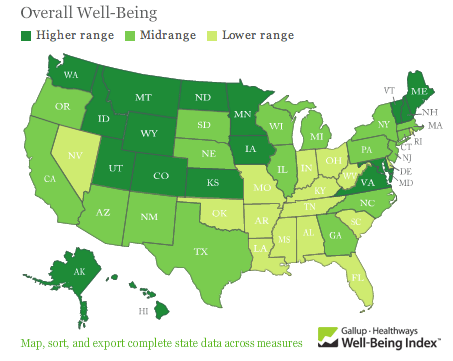
Map Of The Day

StateOfStates
Gallup has an interactive graphs on all 50 states' well being, economic outlook, and politics. From their write-up on state well being:

In addition to having the highest overall Well-Being Index score, Hawaii was best in the nation on three of the six well-being sub-indexes, Life Evaluation, Emotional Health, and Physical Health. At the opposite end of the spectrum is West Virginia, which performed the worst on the same three sub-indexes. Utah does the best on the Work Environment Index, with a score more than 10 points higher than that of the worst state on this measure, Delaware. As in 2008, Mississippi is at the bottom on the Basic Access Index, and Kentucky scores the worst on the Healthy Behavior Index.