They removed the graffiti before the media could get there. Maybe I'm being sentimental, or maybe the rawness of last week has me a little emotionally chafed, but this little incident moved me deeply in these polarized times.
Month: February 2010
How Credible Is The Paul Ryan Budget?
My view is that Ryan is far preferable to the total fraudulence of phony fiscal conservatives like Glenn Reynolds or Sarah Palin or the Tea Party “Government Out Of Medicare!” Movement. At least it opens up a more honest debate in a way the propagandists and opportunists on the right fail to do. Bruce Bartlett explains why, even though he sympathizes with the goals of Ryan’s plan, he finds it inherently unserious:
The Ryan plan is, of course, politically ludicrous. It would be impossible to get Congress to even implement one of its major provisions, let alone all of them simultaneously. And I say this as someone who in principle supports many of the ideas in his plan. For example, I believe we must raise the retirement age, and it’s hard to see how we can meaningfully reform the health system to reduce cost inflation as long as health insurance is free of taxation. But I don’t delude myself that it is possible to implement such changes absent a major transformation in political attitudes or conditions that do not now exist.
…That is why I think tax increases will be the default position when a Greece-like fiscal nightmare hits, which is inevitable if current tax and spending trends continue. Those that are adamantly opposed to any tax increase to deal with this inevitability must–I repeat, must–be willing to support cuts in Social Security and Medicare of the magnitude proposed by Rep. Ryan, and they must begin working to implement those cuts today.
In other Paul Ryan news: he says Jonah Goldberg’s Liberal Fascism helped convince him to vote for the TARP bailout and Ryan’s budget is too optimistic about revenues.
Slowly, The English Language Returns
A reader writes:
A few moments ago I heard an NPR reporter, with respect to the Biden/Cheney dust up, say that Dick Cheney opposed the dropping of the use of torture. I don't know the exact way he phrased it, but my jaw dropped when I heard him use the word torture.
Yes, one's jaw drops when plain English is used in the US media on this topic.
Creepy Ad Watch
A reader writes:
Bonjour from France! I thought you might enjoy this ad (in English) released by Puma for this Valentine's day. It features Sébastien Chabal, the most famous bearded rugby player of France (also famous in the UK since he played for the Sale Sharks for years). He is often nicknamed Caveman, aka The Animal, aka Attila, aka The Anaesthetist because of his look and of tries like this one or tackles like this one. He likes to make fun of his "caveman" image (he's actually known for being a very gentle guy when not on a rugby field) and I thought Puma found a very funny and creative way of playing with it too.
Two Cartoons That Say It All
The Trinity

A reader writes:
Wieseltier's response — especially on the question of his ridiculous assertions about the Trinity – is unbelievable. I'm still shaking at how terrifyingly rude he is. Just because he's had "many years of study in philosophy and religion" he is entitled to state that the Trinitarian Conception of the Unified Godhead is "polytheism?" Really? Really? And this is justified because some people (I'm assuming Arians, though they were hardly the only group to oppose the Trinity) thought differently, so their opinion of the matter is to be taken as the last word on the subject? And because "they are hardly just my opinions?"
This is like a modern-day Christian saying that it's okay to say anti-Semitic things because "These aren't my opinions, this is just what Gregory of Nyssa and Justin Martyr said about Jews!"
It's downright evil to excuse saying terrible things about other people's faiths, especially when the things you are saying misconstrue what those people themselves believe about their own religion. It would be one thing if Leon Wieseltier laid out the doctrine of the Trinity fairly and charitably and then argued against it. But that is simply something he has not done.
Look. I may just be a graduate student, but at least I'm a graduate student in the academic study of religion at the University of Chicago, and not a critic and a literary editor. Wieseltier may be thirty years my senior, but even I know a specious argument when I see it. The fact that some Arians thought some things about the divinity of Christ and the unity of God is hardly grounds for an argument that the Christian tradition is a "regression to polytheism" simply for deciding it disagreed in ecumenical council after ecumenical council.
And all polytheism is "crude?" In one stroke Leon Wieseltier condemns entire continents to backwardness, sacrificing their lives and their faiths on the wagon wheel of his notion of what constitutes religious progress. I've spent my entire life as a Christian trying to find and quarantine aspects of the Christian tradition that have held up Christianity as a progressive religion that renders "backward" peoples only to have Leon Wieseltier come along and decide it's high time Judaism's conception of monotheism started taking up the slack.
And it's okay to derogate this as crude because his objections are somehow "thoughtful," and acting as if he would respect similar ridicule from another provided that ridicule was "thoughtful?" Would he acknowledge any such assault on Judaism as "thoughtful?" If he says yes, here's a hint: even he knows he's lying.
Wieseltier wants to say both yes and no at the same time, and thinks that somehow it's blogging that embodies the postmodern glorification of self as discontinuous and promiscuous. I am at a loss for words.
You're not the only one.
(Painting: Luca Rossetti da Orta, The Holy Trinity', fresco, 1738-9, St. Gaudenzio Church at Ivrea, Turin.)
Mental Health Break
"A 2100 page-long flipbook by art student Jamie Bell containing a brief history of pretty much everything."
Antibodies In The Culture
Jessa Crispin defends Elizabeth Gilbert:
Committed is kind of boring and just rehashes a lot of Stephanie Coontz's vastly superior Marriage, A History: From Obedience to Intimacy, or How Love Conquered Marriage. It's value lies in that it's about how we get married despite all the bad news, and how, if we go into it really knowing what we're up against, we can create new types of marriages. Marriages where one partner is not unconsciously lifted at the expense of the other.
Like a lot of people who care about books and writing and sentence structure, I was initially horrified at the success at Dan Brown's The Da Vinci Code. Then I realized what it meant: 80 million people read a book about the removal of femininity from the Catholic Church, about how Jesus liked women and prostitutes and screw-ups and freaks, about how the Bible was edited by men in power, about how Jesus' divinity was not universally accepted. They read the book, and now it's in their brains, like a vaccination against patriarchal monotheism, even if they don't do anything with the information. Even if the people who read Elizabeth Gilbert's books now only toss them away and grumble ''How dare she?,'' Gilbert's sincerity about figuring out a new way to be in the world are now out there.
Don’t Hate Them Because They’re Thin
Lisa Hilton debates male and female thinness. Elizabeth Nolan Brown comments:
I had “disordered eating” habits once. I frequented eating disorder chat rooms and livejournal groups (oh, yes). I’ve talked to a lot of girls with eating disorders. And as cliched as it sounds, it’s almost always about control, or making up for perceived inadequacies in other parts of life, not about looking like ladies in magazines. Or, not just about that. When it is about looks, it’s tied up in deeper things, deeper symbolism imbued in extreme thinness; it’s signaling on a deep psychological scale.
Happy Valenguys Day
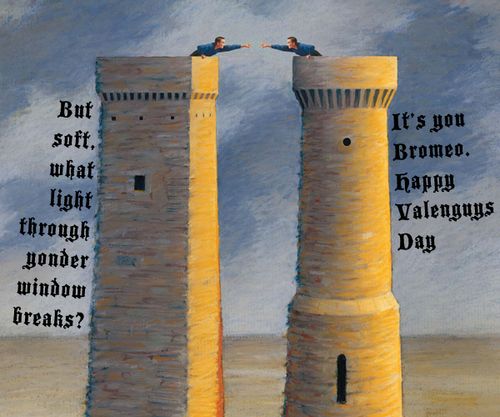
Buzzfeed provides some bromantic e-cards for the occasion.
 The Dish