Too Grey

Sager highlights a study that had partisans of the Arab-Israel debate watch a news report on the subject:

[T]hese groups watched the same news and came to opposite conclusions as to which way it was biased. And each side thought it was biased against their side.

PsyBlog explains the phenomenon:

There were two mechanisms at work here:

  1. The truth is black and white: partisans generally thought that the truth about the Arab-Israeli debate was black and white. Any hint of shades of grey in the news reports was interpreted by partisans as bias towards the other side. In other words: any balanced report will seem biased to partisan viewers.
  2. The news report was too grey: as well as thinking the Arab-Israeli issue was either black or white, partisans also perceived that the specific news report they watched was too grey.
Voodoo Histories

David Aaronovitch discusses his new book Voodoo Histories: The Role of the Conspiracy Theory in Shaping Modern History:

We want to believe theories that contradict the idea that young, iconic people died senselessly. If a story takes away the accidental from their death, it gives them agency. After the JFK assassination, it was unbearable to many people that they could live in a country where a lone gunman could kill a president. In those circumstances, it’s not surprising that an overarching conspiracy theory emerges. It suggests that somebody is in control, rather than that we’re at the mercy of our neighbors and to some extent of ourselves (as was the case with Marilyn Monroe and Princess Diana). It’s the urge to make sense of a particularly traumatic moment.

Why We Laugh

New Scientist studies the brain's comedy circuit:

[H]umour is a far more complex process than primeval pleasures like sex or food. In addition to the two core processes of getting the joke and feeling good about it, jokes also activate regions of the frontal and cingulate cortex, which are linked with association formation, learning and decision-making … The team also found heightened activity in the anterior cingulate cortex and the frontoinsular cortex – regions that are only present in humans and, in a less developed form, great apes.

Indeed, the fact that these regions are involved suggests that humour is an advanced ability which may have only evolved in early humans…

There is something of the divine in it.

Knowing Your Talents

Scott Adams values knowledge of self:

I wonder if the most valuable knowledge you can have is the knowledge of what you're good at. For example, I doubt you are working at the very best job for your aptitude. We tend to drift into our careers. It's more luck than plan. But imagine if you were born knowing you had the natural aptitude to be the world's best brain surgeon, or guitar player, or graphic designer. On the flip side, maybe you thought you had more talent in some field than you do, and wasted a lot of time preparing for the wrong profession.

Up From The Abyss, Ctd

Ryan Avent on the consequences of the latest downturn:

Another Nobelist, James Heckman, has warned of deterioration in the educational levels of successive generations and pointed out (PDF) that the high school graduation rate in America actually peaked in the late 1960s and has since declined. One doesn't have to look very hard to find other potential limiting factors: rapid growth in congestion on transportation systems, poor broadband coverage relative to other developed nations, and so on.What seems clear is that at no time in the living memory of working Americans has the economy gone through a recession like this—deep, and with a jobless recovery. It will influence society and culture for a generation.

Face Of The Day

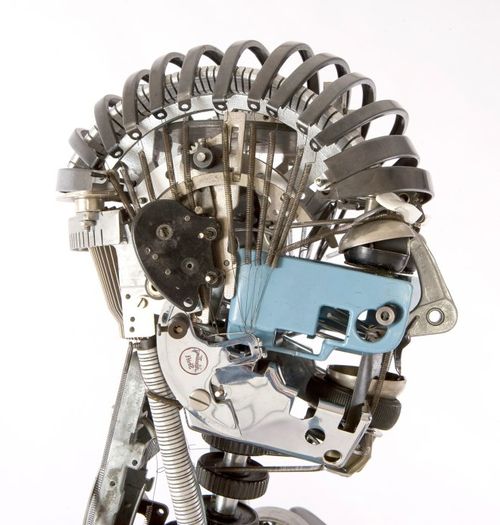
Nudeivsidehead

Wired interviews sculptor Jeremy Mayer:

It took a little over a year (1,400 hours) to make Delilah. I have a couple of rules about my process: I have to use only connections and parts indigenous to the typewriter — no soldering, welding, gluing or wire-wrapping is allowed. Second, I try to bend, drill or cut the typewriter components as little as possible. I do cheat a little, but only serious typewriter buffs would be able to tell which parts I’ve modified from their original form. I don’t tap new threads at all.

Israel Could Be Headed Toward “An Apartheid State”

Who said those words, echoing what this blog has been trying to express in the last year and a a half? The full quote is

If, and as long as between the Jordan and the sea, there is only one political entity, named Israel, it will end up being either non-Jewish or non-democratic … If the Palestinians vote in elections, it is a binational state, and if they don't, it is an apartheid state.

Nah: another emotional blogger with a problem.

Chart Of The Day

Lifeeval

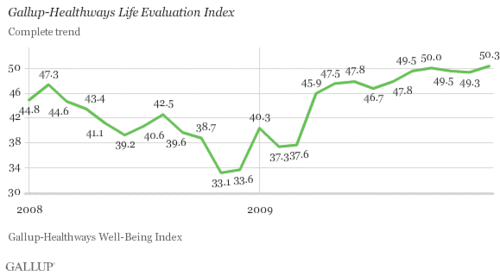
Americans are more positive about their lives:

Here are the exact questions we ask, based on the Cantril Self-Anchoring Striving Scale:

Please imagine a ladder with steps numbered from zero at the bottom to 10 at the top. The top of the ladder represents the best possible life for you and the bottom of the ladder represents the worst possible life for you. On which step of the ladder would you say you personally feel you stand at this time? On which step do you think you will stand about five years from now?

Do you have an explanation for this increase in life evaluation, despite all of the challenges facing the U.S. today? How would you answer this question?

One Size Fits Some

Jerome Groopman is skeptical  of “comparative effectiveness research”:

What may account for the repeated failures of expert panels to identify and validate “best practices”? In large part, the panels made a conceptual error. They did not distinguish between medical practices that can be standardized and not significantly altered by the condition of the individual patient, and those that must be adapted to a particular person. For instance, inserting an intravenous catheter into a blood vessel involves essentially the same set of procedures for everyone in order to assure that the catheter does not cause infection. Here is an example of how studies of comparative effectiveness can readily prove the value of an approach by which “one size fits all.” Moreover, there is no violation of autonomy in adopting “aggressive” measures of this kind to assure patient safety. But once we depart from such mechanical procedures and impose a single “best practice” on a complex malady, our treatment is too often inadequate.

Read the whole piece. I found it eye-opening and as always with Jerry, as fair as it is profoundly and deeply humane.