From Froomkin To Thiessen

There was only one regular opinion writer at the Washington Post who strongly and consistently opposed and exposed the torture policies and war crimes of the Bush-Cheney administration, Dan Froomkin. He was not on the op-ed page, which prominently features Charles Krauthammer, the intellectual architect of the descent of the US into the torture methods of the Gestapo, Khmer Rouge and Inquisition.

But now, Fred Hiatt has gone one step further.

He has hired as a columnist Marc Thiessen, a proud defender of torture, one of Cheney's chief propagandists, who is now promoting his book claiming that everything was kosher under Bush and Cheney and that nothing even remotely illegal or unethical took place. Thiessen's new book's subtitle is "How Barack Obama Is Inviting the Next Attack," because he is not continuing the torture program of his predecessor.

If you ever believed for a minute that Dan was fired for anything but challenging the Krauthammer line on torture, think again.
Meep Meep Watch

Hmmm:

House Republican leaders on Friday demanded that House and Senate Democrats halt their ongoing efforts to resolve differences between the versions of major health care legislation adopted by each chamber late last year…

By raising questions about the Democrats’ motives, Republicans seem to be anticipating that Mr. Obama will move quickly after the summit to win passage of a revised health care bill, and they seem to wish to blunt any effort by the president to suggest that Republicans offered few workable alternatives.

Even as they have criticized the Democrats and cast doubts on the summit, Republicans have not put forward any new, comprehensive health care proposal that would meet the president’s goal of extending coverage to most of the nation’s uninsured. Republicans say that doing so would be too costly and that they do not share the president’s goal of a broad expansion in coverage, but instead want more modest efforts to help control costs.

I think it's critical for the president to point out that the GOP, in a time of great anxiety, have no plans to extend health insurance to 30 million uninsured, and have no way to reform the cruelties of the pre-existing condition Catch-22 that so many beleaguered Americans face. Not only does this expose the real non-solutions offered by the Republicans – but it is especially significant for Hispanic voters. Hispanics put healthcare at the top of their priorities this year and a whopping 86 percent want reform passed this year.

Facebookistan

Facebook

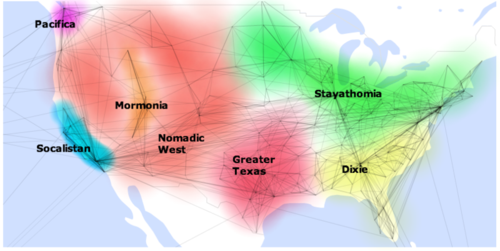
Sager flags an interesting chart on Facebook's social clusters (above) while Katja Grace considers Facebook social conventions:

People who talk about themselves a lot are generally disliked. A likable person will instead subtly direct conversation to where others request the information they want to reveal. Revealing good news about yourself is a good sign, but wanting to reveal good news about yourself is a bad sign. Best to do it without wanting to.

This appears true of most human interaction, but apparently not of that on Facebook.

Joanne McNeil bashes the website:

Facebook epitomizes filter failure for me. Yes, there are ways to segment information and keep groups, but there aren’t very good ways to keep worlds from overlapping. Facebook isn’t a more neutral LinkedIn and Myspace. It is the collapse of LinkedIn, Myspace, and a bunch of other networks, while many people want these worlds compartmentalized. I mostly avoid Facebook the same way that I’ll get drinks on a Monday night with colleagues, but not on a Friday or Saturday night.

One of Fallows' readers gives the site a second look:

I'm more selective [with Facebook friends] now, and am comfortable with it as a gratifying reminder of my own history.  It now includes people I was (and am) very fond of, but whom it wouldn't make any sense for me to be emailing – we've reasserted our goodwill towards each other; I am glad to know tidbits of their present lives, some of which I pursue independently, and to occasionally hail each other over some entry.  It's a cushion against loneliness, and against investing too much in some particular, immediate relationship.  It makes me feel part of a carefully crafted whole, sustainable since its give-and-take is very lightweight.  Its usefulness is just different from other approaches to socializing, in an unexpected but pleasant way – like an interactive, ever-updated scrapbook.

Bonus Facebook chart porn here.

If The Web Gets A Medal

Evgeny Morozov doesn't want the internet to be given a Nobel Peace Prize:

If the Internet gets the Nobel, it would further advance techno-utopian babble about the "hive mind" and ultimate peace that already occupies so many of the pages of Wired magazine (not to mention blog posts and tweets!).  The debate about the democratizing potential of the Internet – both in authoritarian and democratic contexts – is far from over, and while I tolerate the possibility, however abysmal,  that the Wired school of thought may be right, I think we've got good 20 or 30 years of debate ahead of us before we can say anything conclusively.

The dangerous rise of direct democracy, the paralysis of the political process under the pressure of over-empowered grassroots movement, the polarization of public debate, the end of the national conversation, not to mention new opportunities for surveillance and control – the Internet may be directly or indirectly responsible for all of these activities (the original assumption of Wired Italy – that the Internet will "destroy hate and conflict and to propagate peace and democracy" – is even more contentious). We don't know for sure – but this is no reason to stop the inchoate debate. If anything, we are not spending enough time talking about these issues in an intelligent manner; chances are we'd be talking about them even less if the Nobel goes to the Internet.

Up From The Abyss

Don Peck's cover story illuminates the extent of the jobs crisis and how it will shape America:

Strong evidence suggests that people who don’t find solid roots in the job market within a year or two have a particularly hard time righting themselves. In part, that’s because many of them become different—and damaged—people. Krysia Mossakowski, a sociologist at the University of Miami, has found that in young adults, long bouts of unemployment provoke long-lasting changes in behavior and mental health. “Some people say, ‘Oh, well, they’re young, they’re in and out of the workforce, so unemployment shouldn’t matter much psychologically,’” Mossakowski told me. “But that isn’t true.”

The Daily Wrap

Today on the Dish, Andrew wondered what the Obama administration should do about Bush torture. He also addressed the broader context of the Weiseltier flap, a reader responded, DiA defended political generalizations, a reader touched up a double standard involving Cuba, and we highlighted a real act of anti-semitism.

Post-mortems on 22 Bahman from Juan Cole and Marc Lynch. Nuke discussion from Fred Kaplan and Matthew Kroenig. Stunning images from Iran here and here.

Palin wants to be Esther. More speculation about her presidential chances from Weigel, Sargent, Frum, David Boas, Michael Savage, and a reader. Politico tackled her relationship with the MSM and McCain sounded like her on climate change.

In other commentary, Megan and others grappled with the deadly implications of health insurance, Volokh discussed DADT and lesbians, Dreher got grossed out with Grindr, and a reader jumped in the debate over obesity. Gay couples gained ground and made a powerful statement about inequality. This ad was creepy.

— C.B.

The Israel Lobby And Cuba’s

A reader writes:

Thanks so much for this post. Having been born in Cuba and grown up in Miami and seeing how exiles there twist U.S. foreign policy into whatever way they want it to be, it was very easy for me to accept the idea of an "Israel lobby". Of course, serious people can debate the extent of the influence of the lobby but to deny it exists is crazy.

Luckily, it looks like things are changing in Miami. It looks as though lobbies from within the Cuban-American population are springing up that challenge the traditional exile prerogatives. I hope the same is true of Israel because while Cuba has not really been important to US interests since at least the fall of the Soviet Union Israel's relationships with its neighbors is the most pressing concern to US interests at the moment.

I would also like to note that the idea of a Cuban Exile lobby is widely accepted by people inside and outside the Cuban-American community and I have not yet witnessed one instance of racism being charged when it's pointed out (I've heard other pretty vile stuff but never that).

Rigging The Vote

Alberto Simpser has a theory about extreme vote manipulation:

Why do politicians manipulate elections excessively? The conventional wisdom associates electoral manipulation with close elections and small margins of victory. In fact, however, many manipulated elections are won by overwhelming margins of victory, and some elections are manipulated even though the result is scarcely in doubt. I present a theory about the incentives that shape electoral manipulation under conditions that often characterize developing countries. The central idea is that in such settings, electoral manipulation, in addition to directly affecting vote totals, can influence expectations and consequently impact patterns of political participation. This simple idea goes a long way toward explaining observed patterns: When large-scale manipulation can help to deter opponents in the future, politicians may purposefully use it beyond the point necessary for victory. Evidence from a variety of regions and time periods suggests that large-scale manipulation and overwhelming margins of victory have often had such an effect.

How Many Die For Lack Of Insurance?

McArdle pours through the data in the latest Atlantic:

The possibility that no one risks death by going without health insurance may be startling, but some research supports it. Richard Kronick of the University of California at San Diego’s Department of Family and Preventive Medicine, an adviser to the Clinton administration, recently published the results of what may be the largest and most comprehensive analysis yet done of the effect of insurance on mortality. He used a sample of more than 600,000, and controlled not only for the standard factors, but for how long the subjects went without insurance, whether their disease was particularly amenable to early intervention, and even whether they lived in a mobile home. In test after test, he found no significantly elevated risk of death among the uninsured.

Follow ups at her blog (one, two) and at Tyler Cowen's place. Austin Frakt counters by pointing to literature on the subject:

I assume she (and any reasonable minded individual) would agree that death can be caused by lack of sufficiently good health. It is, therefore, only a trivial bit of logic to conclude that if insurance promotes health it can also be life preserving. Or, turning it around, if uninsurance leads to bad health outcomes it can also increase mortality…The evidence that insurance and the access to care it facilitates improves health, particularly for vulnerable populations (due to age or chronic illness, or both) is as close to an incontrovertible truth as one can find in social science.

Megan replies to Frakt. Yglesias responds to Cowen.