The 8.8 Earthquake In Chile

ChileTsunami

by Patrick Appel

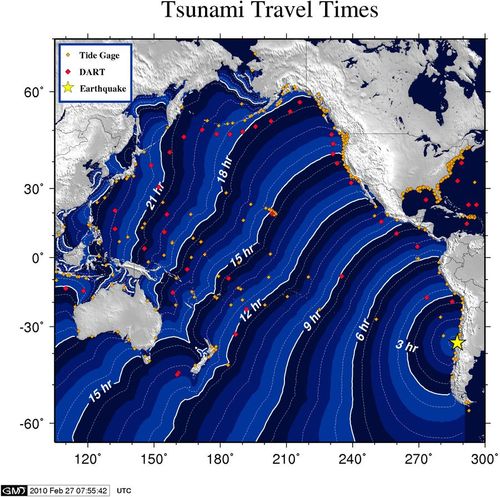
Robert Mackey is live-blogging. A tsunami is expected to hit Hawaii at 11:19 am local time, 4.19 pm EST (via Insta). Blake Hounshell's analysis:

[O]ne thing is already clear: Chile was well prepared for this disaster, having been struck by 13 large earthquakes since 1973. The biggest seismic event in recorded history was in Chile, a 9.5-magnitude quake in 1960. While the death toll will inevitably go up, and hundreds of millions of dollars in property damage are likely, the country seems very resilient.

Comparisons to Haiti, whose earthquake was much smaller but several orders of magnitude more deadly, are inevitable. But not only was Chile far better prepared, it is also a vastly more developed country, one that just joined the OECD and has a highly competent government, so it's no surprise that it would be able to weather this disaster.
Start Hoarding Wonder Bread

by Graeme Wood

The world's wheat is defenseless against a new fungus that causes stem rot.  Brendan Koerner says a billion people could die:

The pathogen has already been detected in Iran and may now be headed for South Asia’s most important breadbasket, the Punjab, which nourishes hundreds of millions of Indians and Pakistanis. What’s more, Ug99 could easily make the transoceanic leap to the United States. All it would take is for a single spore, barely bigger than a red blood cell, to latch onto the shirt of an oblivious traveler. The toll from that would be ruinous; the US Department of Agriculture estimates that more than 40 million acres of wheat would be at serious risk if Ug99 came to these shores, where the grain is the third most valuable crop, trailing only corn and soybeans. The economic loss might easily exceed $10 billion; a simple loaf of bread could become a luxury.

The fungus, called Ug99 (sounds a bit like Ice 9, and acts a bit like it too), is a new strain of the same stuff that the late Norman Borlaug won the Nobel for defeating, and thereby possibly saving more lives than anyone has ever lived.

The War On Youtube

by Chris Bodenner

Nicholas Sautin theorizes over amateur videos from the Iraq war:

In their democratic lack of artifice and ornamentation, they suggest the closest approximation we have to reality; this makes them intolerable. In this, such video has played a role in the upheaval of traditional journalism. How can a reporter with even total access compete with a soldier attaching a camera to his helmet during a firefight?

This immediacy fuels journalism’s increased obsolescence; despite the American media’s remarkably successful attempts to shield its viewers from gruesome images of the wars in Iraq and Afghanistan, the ease with which digital photos and videos can be recorded and disseminated has largely antiquated traditional military censorship. While mainstream networks were still fretting over whether to show flag-draped coffins on the nightly news, wrestling internally over the complicated ethics of embedded journalism, and creating ever more extravagant banners and catchphrases, camera phones quietly and permanently altered the journalistic landscape.

The Contrarians, Ctd

by Patrick Appel

Kevin Sullivan defends the Leveretts:

Analysts and experts – clearly wearing their green hearts on their sleeves – have been repeatedly proven wrong about the size and capabilities of the Green Movement, yet no one suspects these well-intentioned partisans of nefarious, or even treasonous ties to agents or officials inside Iran (and if you think the Green Movement is somehow operating outside of Iran's inner-circle you simply haven't been paying attention). While I reserve my own criticisms of the Leveretts, I find the very personal and often malicious attacks on them to be really uncalled for, not to mention a distraction from the debate at hand.

Larison seconds Sullivan. My main problem with the Leveretts is, like certain hawks, they project a false sense of certainty about the situation in Iran. No one knows exactly how the opposition movement will manifest. The Leveretts assert arguable claims as fact without explaining how they are reaching their conclusions.

The Small Condom Trade

TinyCondoms

by Patrick Appel

Menachem Kaiser investigates:

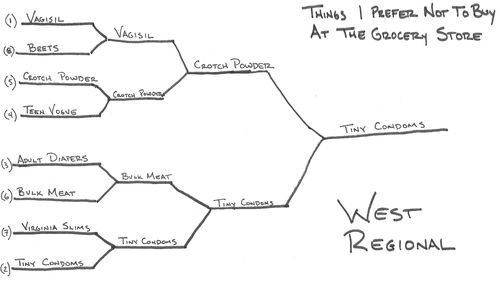
According to the medical journal Sexually Transmitted Infections, 45 percent of men reported that they had experienced an ill-fitting condom within the last three months.  The misfits were significantly more likely to report breakage and slippage, along with difficulty reaching orgasm, both for their partners and for themselves, and a host of other sexual mishaps. Not surprisingly, men with ill-fitting condoms were more likely to take them off before sex was even over — all of which adds up to a massive failure for the one job a condom exists to fulfill.

Image by Ted McCagg (click to enlarge).

How Should We Reform Taxes?

by Patrick Appel

Bruce Bartlett has some ideas. He points out practical problems with the flat tax, which Andrew has long favored:

[T]he flat tax always required a trade off between the exemption level and the rate. The higher the exemption, the greater the number of people paying no income taxes at all, which broadened support. But that required a higher rate to bring in enough revenue, which reduced support. Experience showed that the rate could not be much above 20% or support for the flat tax simply evaporated…Finding a rate and an exemption that fully satisfied every political requirement proved to be impossible if the flat tax were to be implemented in a revenue-neutral manner–neither raising nor lowering the overall tax burden.

Bartlett is enticed by the Wyden-Gregg plan:

[It] would be highly desirable to clean up the tax code, eliminate special tax provisions, and try to establish more uniform effective tax rates across income classes. That is what Sens. Wyden and Gregg propose. Here is a list of the credits, deductions, exclusions and other tax preferences they would abolish. A key benefit would be abolition of the Alternative Minimum tax in return.

It's too soon to say whether the Wyden-Gregg proposal is a viable vehicle for tax reform, but it's a good start.

A Quarter The Cost, Ctd

 by Patrick Appel

Douthat continues to make his pitch for a smaller health care bill:

[P]art of the reason this kind of targeting would costs less than the bigger bill is because children are relatively cheap to insure. But I don’t see what’s wrong with targeting a population that’s vulnerable and inexpensive to cover, rather than first mandating and then subsidizing (to the tune of hundreds of billions of dollars, in the long run) comprehensive plans for adults who would be better off buying catastrophic coverage instead.

Porn In Church

Ssempa

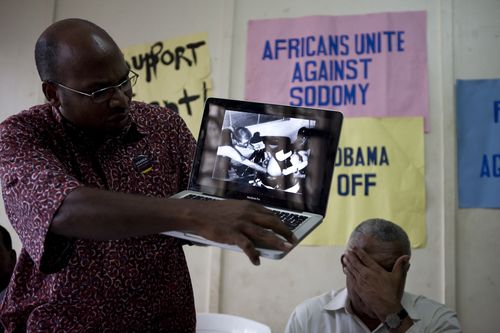
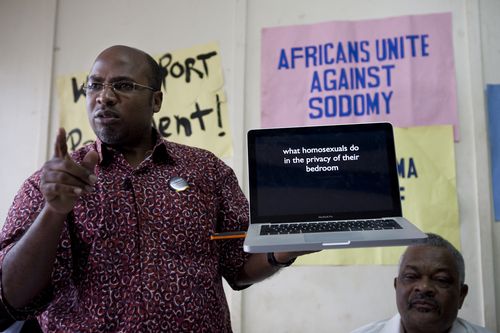
Box Turtle Bulletin noted awhile ago that Ugandan pastor Martin Ssempa is showing graphic gay pornography in Church to shock his congregation and rile up support for Uganda's kill-the-gays bill. Box Turtle follows up by linking to a Ugandan writer who mocks the church:

This makes Makerere Community Church the only place in Uganda where watching pornography is “legal”. According to Uganda’s laws, even mere possession of pornographic material is a crime. It would appear that Makerere Community Church has got a special license to show porn. Moreover, perhaps following Jesus Christ’s example of welcoming children, even kids can watch porn at Makerere Community Church.

Photograph from Warren Throckmorton. He says that  the photos "were provided anonymously by someone who attended one of the presentations over the past few weeks…Suffice to say they are troubling but not in the way Pastor Ssempa hopes. This is leather S&M which of course is unrepresentative of the population he hopes to demonize." The NSFW image Throckmorton describes after the jump:

SsempaII