Is Palin a top 2012 prospect if she runs? Sure, and it’s not clear whether an announcement would push her numbers up or not. But she’s clearly closer to the place that eventual losers Joe Lieberman and John Edwards were — boosted by name recognition — than to the frontrunner status of candidates like [Hillary] Clinton [in 2008] or Gore [in 2004]. Yes, neither of them won the nomination, but it’s still amazing that Palin, with roughly a third or a half the support among her own base that Clinton and Gore had, is uniquely treated as their standard-bearer.
Matthew Kroenig argues that Russia and China won't stop Iran from acquiring the bomb:
[An Iranian bomb] won’t disadvantage China or Russia. In fact, it might even help them. Neither country has hidden its desire to hem in America’s unilateral ability to project power, and a nuclear-armed Iran would certainly mean a more constrained U.S. military in the Middle East.
Indeed, at times during the 1980s and 1990s, Beijing and Moscow aided Tehran with important aspects of its nuclear program. While we don’t have detailed information on the motives behind the assistance, we do know that governments don’t export sensitive nuclear technologies for economic reasons alone. Rather, as I show in my forthcoming book, they generally do so in an attempt to hinder their enemies. For example, France helped Israel acquire the bomb in the late 1950s and early 1960s in order to balance against Nasser’s Egypt, and China provided nuclear aid to Pakistan in the 1980s to impose strategic costs on its longtime rival India.It is likely that China and Russia’s nuclear assistance to Iran waspartly intended as a counterweight to American power in the Middle East. Although these countries no longer actively aid Iran’s nuclear program, they may still secretly welcome its development.
Bagehot watches tempers flare in the run up to the British election:
Look at their respective platforms. As both [Cameron and Brown] re-calibrate their positions on tackling the deficit—by all accounts, the key issue of the campaign—the gap between them, in policy terms, is shrinking. Could all the bile possibly be a distraction from the fact that, where it matters, Mr Cameron and Mr Brown increasingly agree with each other?
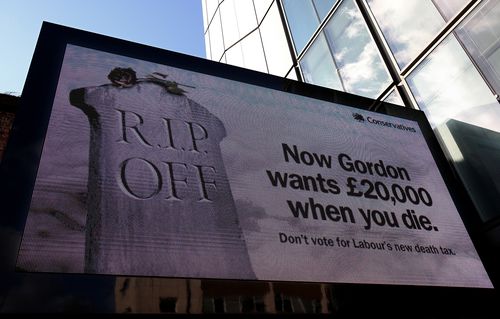
Daniel Finkelstein doesn't approve of the misleading poster above.
(Image: One of the Conservative party's new nationwide poster campaigns is displayed on February 10, 2010 in London, United Kingdom. By Dan Kitwood/Getty Images.)
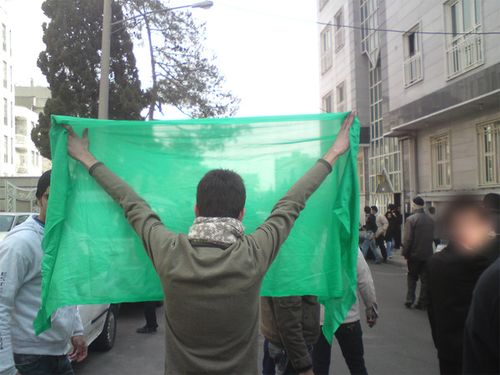
Today on the Dish we tracked the events of 22 Bahman. Extensive summary of our night-shift here. Accounts of the junta's lockdown here, here, and here. Analysis here and here. Glimpses of violence here, here, here, and here. Various doubts of Ahmadi's "20 percent" claim here and a critique of the speech here. Stories of press manipulation here and here. Andrew's impression of the day here and Scott Lucas' here.
In other coverage, the Dish brought fresh evidence to the torture debate here, here, and here. Andrew again addressed the Wieseltier controversy (with backup here). Palin appeared not as popular as many fear, though she did seem to have critics in the palm of her hand. That San Francisco gay-couple story was apparently bunk. And we recorded a blockbuster quote from Choi.
Scott Lucas doesn't like to "make artificial sense out of the complex and messy politics of events" but does his best to understand today's events in Iran:
If the opposition had truly been “crushed” today, that might have been sufficient to ensure Ahmadinejad’s longer-term survival, even in the absence of any positive measures. But the Green movement and figures like Mousavi and Karroubi were not crushed. They were bashed about, dispersed, and, most importantly, exposed as tactically naïve with today’s loudly-declared plan to march from Sadeghiyeh Square to the Government’s lair in Azadi. Their ranks have been thinned by the detentions, and their communications have to fight new ways to deal with regime restrictions.
But they are not crushed. They also live for other battles. A Mousavi or Karroubi declaration could come tomorrow or Saturday or later in the work. The Green websites, with new ones emerging as others are closed, will be trying to find the front foot in stories of defiance and justice. And the planning will be moving beyond the tactic of trying to “hijack” the regime’s highlight days.
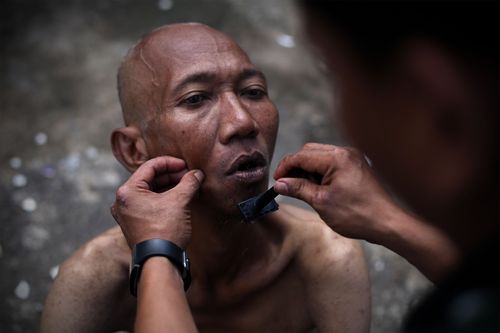
Head nurse Suharyono shaves a patient named Yoyo at the Galuh foundation for mental patients in East Bekasi near Jakarta on February 11, 2010 in Bekasi, Indonesia. Belief in black magic is commonplace in Indonesia, where there is limited education about mental health issues, with traditional healers instead consulted for apparent sufferers. 2007 figures suggest that 4.6% of the nation suffers from serious mental disorders. The country’s population now stands at around 230 million, with only around 700 psychiatrists at 48 psychiatric hospitals available to help treat those affected. With such limited care, sufferers instead usually turn to black magic and are taken to ‘dukuns’ or healers who are believed to have magical powers. By Ulet Ifansasti/Getty Images.
I’m heartened to see so many bloggers defending Andrew Sullivan against the insinuation that he is anti-Semitic. It is an impressive feat to levy a charge so wrongheaded that Daniel Larison, David Frum, Matthew Yglesias, James Joyner, Brad DeLong, Alex Pareene, and Robert Stacy McCain all agree with one another in finding it ridiculous. Is there any other instance of those folks all writing on the same side of a single issue?
For your readers who were bothered by inaccuracies in The Hurt Locker, I'd recommend Restrepo, a documentary set in the Korengal Valley in Afghanistan, which just won the Grand Jury Prize at Sundance. It's an entirely experiential, soldier's-eye view of war, set in one of the deadliest combat postings in the US military. I saw it recently, and was blown away.
Werner Herzog has a phrase about the "voodoo of location" in movies, and Restrepo demonstrates that in spades – the awareness that the bullets whizzing past the soldiers and filmmakers are real makes it far more heart-stopping than anything in The Hurt Locker. More than any war movie I've seen since The Battle of Algiers, in fact. It's a directorial debut from author Sebastian Junger and photographer Tim Hetherington, and deserves wider attention (I believe they are looking for distribution).
Another reader also recommends the film:
You really get to know the soldiers and you are right there with all the confusion, real courage, fear, the ugly and the tender through their whole deployment. The filmmakers deliberately never interviewed commanding officers, so you never get the sort of scripted high-level mission description you are used to seeing. I watched a National Geographic TV documentary on Afghanistan the night after watching Restrepo at Sundance, and I felt like I was watching a propaganda film by comparison.
Jason Rezaian renders a dispatch from Ahmadi's propaganda show:
For the first time in months, several members of the foreign press were allowed to cover a public event in Tehran. We all gathered at the foreign-media office of the Ministry of Islamic Culture and Guidance early this morning to receive credentials for the day, neon-colored vests marking us as press, and chocolate milk. We then boarded three buses and made our way to Freedom Square. I kept my eyes glued to the window waiting to catch signs of protests, but there was nothing.
 The Dish