The World-Changing Promise Of A Democratic Iran

I don't think that Reuel Marc Gerecht is overstating this:

A democratic revolution in Tehran could well prove the most momentous Mideastern event since the fall of the Ottoman Empire. A politically freer Iran would bring front and center the great Islamic debate of our times: How can one be both a good Muslim and a democrat? How does one pay homage to Islamic law but give ultimate authority to the people’s elected representatives? How can a Muslim import the best of the West without suffering debilitating guilt?

I am, of course, distressed at the rank show of force in the streets of Iran today, the brutal intimidation of peaceful protestors. But this strength is as brittle as all raw force without legitimacy, and something very profound has occurred in the Iranian soul this past year.

How we cope with this, try to leverage this, try to help the people of Iran is a delicate matter.

I think Obama has handled it with great skill, making sure he does not take the regime's bait, and patiently revealing to the entire world that he is not the obstacle to Iran's peaceful nuclear power aspirations, that he is not belligerent, that his open hand remains open as a way to expose and thereby isolate the junta in Tehran.

The case for targeted sanctions against the junta, not the people – and the support for them – is stronger now than it was a year ago, and it is stronger in large part because of the skill with which Obama has played his hand. There remain the huge problem of China's UN veto, and Israel's potential for a pre-emptive attack. But there is also great reason for hope, resilience and patience.
Where Will Iran Be Five Years From Now?

Kevin Sullivan interviews Ali Alfoneh, an AEI research fellow:

Any student of political science and history knows that prediction of political revolutions is almost impossible, while social revolutions are more easily detectable. Iran has been going through a social revolution for the past one hundred years, which on two occasions led to political revolutions: The constitutional revolution of 1906 and the revolution of 1979. The ability of the Islamic Republic to suppress the democratic opposition in times of weakness in order to fend off regime collapse – and reversely to give considerable concessions such as political liberalization in more stable periods – could secure survival of the Islamic Republic. Unfortunately, the Iranian leadership does not seem to have learned many lessons from the past, it commits mistakes of His late Imperial Majesty the Shah and will therefore sooner or later suffer the destiny of the imperial regime.

The Day’s Events

Scott Lucas posts a reader's take:

The big points won are 1) the brutal treatment of (Zahra) Rahnavard and (Mehdi) Karroubi gives them more revolutionary stature and 2) the regime did not succeed in outshining the demonstrators because once again it had to resort to violence and not just outnumbering the protesters. The news of the brutality will ruin the image of a populist government that the regime wants to display.

This is a regime that prides itself in its ability to rally masses on these occasions. Today it has lost more credibility. If no further developments or revelations occur, the opposition needs to rethink its strategy of demonstrating on official and permitted days when the regime has time to plan and clamp down on its moves. Also it will become more apparent that in the face of such regime tactics and brutality more organization and leadership is needed.

Bipolar Measurements

Kevin Sullivan:

One of the pitfalls in analyzing the ebb and flow of a reform movement by crowd size and exuberance is that you end up with rather bipolar measurements for success and failure…Whatever happens today will not change the fact that Iran is changing. But how it's changing, and at what pace, is where people in-the-know must fill in the gaps.

(Video via the Guardian)

Total Sensory Deprivation, Confined Spaces, And The Inquisition

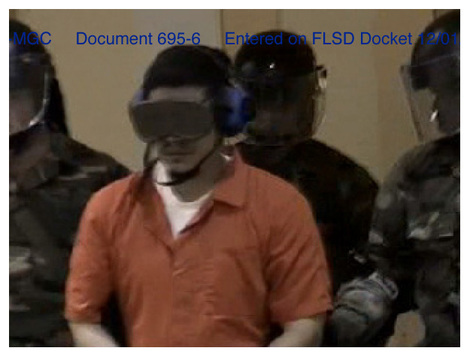
Another detail we discovered about then torture techniques adopted by Bush and Cheney was confinement in tiny boxes and total sensory deprivation. This was done to Jose Padilla, an American citizen, for years. with permanent shackles, ear-muffs and goggles to blind him.

We also know that the Cheney regime put individuals in upright coffins, as well as using the stress positions Padillagoggles

Here's a victim of the Peruvian Inquisition:

Stressposition

There is simply no dispute that the US, under Bush and Cheney, authorized classic torture techniques from the Inquisition to the Gestapo and to the Khmer Rouge. I'm sorry, Mr president, but I refuse to move on until these war criminals are held accountable and brought to justice.

Confirmed Protests

From Josh Shahryar’s live-blog summary:

I can so far confirm green protests in Tehran, Isfahan, Shiraz, Mashhad and Ahvaz. I can partially confirm a protest in Tabriz. I cannot say anything about numbers, but violence broke out in every city where I can confirm a protest. Dozens were arrested in Tehran – possibly hundreds. 100 people were arrested in Mashhad and about two dozen were arrested in Shiraz and Isfahan respectively.

Oppostion leaders:

Mousavi: Attended, but forced to leave.

Rahnavard: Was attacked, forced to leave.

Karroubi: Attacked, forced to leave.

Khatami: Attacked, forced to leave.

Stress Positions And The Inquisition

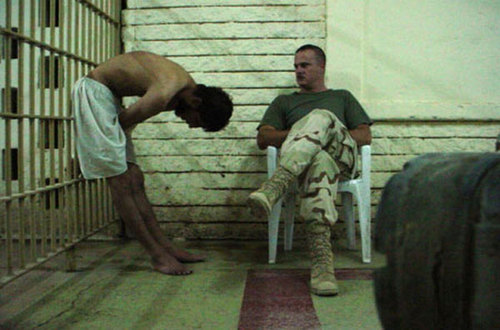
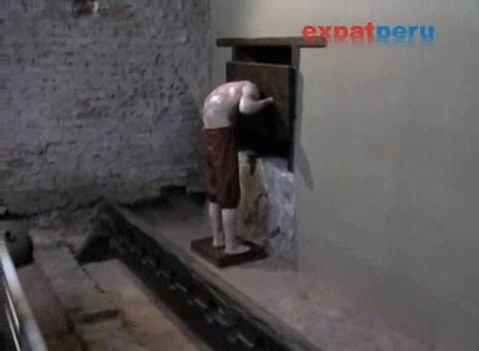
Here's another Inquisition torture technique authorized by Bush and Cheney and defended by Yoo and Thiessen, as found in the same museum in Lima, Peru: stress positions. Here is the Cheney method:

Abu-ghraib-torture-05

Another version:

Abu-ghraib-torture-02

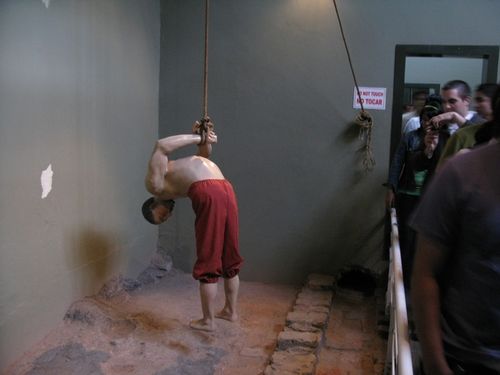
Here is an almost identical version of the Inquisition's, as recreated in the Lima, Peru, Museum of the Inquisition:

Museum0004

 You will notice that the torture victim is standing on the ground, not hanging. The point is to create such awful pain in his joints, especially during long-standing, that he can bear it no longer. It leaves no permanent marks, but it is a brutal form of torture, and those in the United States government who authorized this, implemented it, and twisted the law to make it "legal" must be held accountable.

Time To Prepare

NIAC:

Many commenters are calling the presence of governmental security forces “stifling,” using violence and intimidation to prevent demonstrations from growing beyond relatively small numbers.  With over a month to prepare, the government’s security forces were out in full force today, immediately reacting when opposition leaders like Karroubi, Khatami, and Mousavi appeared among the people.  For much of this week, Internet service was spotty and Gmail has been taken down completely, all in preparation for today’s expected events.  (Compare this to Ashura, when the government had hardly any time at all to prepare, and the reaction by Basij and police was much more careless and led to more bloodshed).

From the same live-blog:

According to the source, the biggest difference between today’s events and previous demonstrations was the amount of undercover police among the crowd.  The moment anyone indicated an opposition or “green” point of view, plainclothes militiamen would come out of nowhere and take that person away.  One gentleman remarked about all the buses funneling people in from out of town, only to be whisked away by three undercover agents.

Waterboarding And The Inquisition

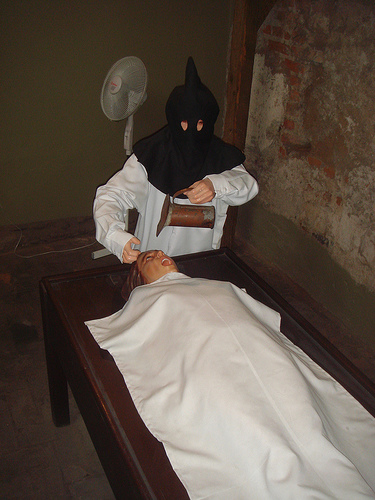
Marc Thiessen rightly points out that one Spanish Inquisition water-torture method in which water was funneled down a victim's throat until his or her body was bursting with liquid is not what the CIA did to prisoners. The CIA technique is the Khmer Rouge's in every single respect, as you can see clearly depicted here. But he is wrong in thinking that the Inquisition didn't use the same basic method of using smaller amounts to bring victims to near-drowning and then relent, before subjecting them to it again and again until they told the torturers what they wanted to hear. He is wrong that they didn't strap people to a board to do it.

A reader notes the following diorama in the Museum of the Inquisition in Lima, Peru, re-enacting the technique in the Peruvian Inquisition. Before Thiessen tries yet another semantic dodge, the reader reminds us:

Some folks would argue that the Peruvian Inquisition was separate from the Spanish Inquisition, and it did have its own tribunal.  However, that's more of a procedural detail of running an inquisition in a far-off colony; the Peruvian branch of the Inquisition was authorized by the Spanish king and got its authority and tactics from the Spanish branch.

Now look at the diorama representation of it in the museum:

2207579073_d290633417

Notice that there is no pumping of water into the body until it swells into great pain; notice that the amount of water applied at any one time is not enough to drown someone entirely, just enough to bring the person to the brink of drowning, with all the involuntary terror that creates.These photos are from here and here.

What Thiessen is doing is justifying torture. And he is a Catholic. The hierarchy supports barring pro-choice Catholic public officials from receiving communion. But public officials who helped set up and defend the absolute evil of torture? The hierarchy is silent. It tells you something about the corruption at the top of the Vatican and the shameful abdication of the American bishops, whose opposition to torture has been present but remarkably subdued.

Basij Everywhere

The Guardian captions: “This seems to be why the protests were snuffed out. The video below shows hundreds of police and basij militia in riot gear lining the streets.”

Tehran Bureau interviewed Hossein Karroubi, the son of opposition leader Mehdi Karroubi:

[The government] bussed in as many people as they possibly could from many towns and locations and depositing them at Azadi Square, surrounded by and escorted by thousands of officers. I have even seen them rounding up people myself. This is while they started beating the others (opposition) starting at 8 am. Of what value is such a pro-government turnout? If they allowed this side (opposition) to gather, they would see how the masses really turn out. For example, at Sadeghi Square, where we were, folks told us they started beating up on them since they started arriving at 8 am. They kept gathering and they kept dispersing them. What value was their [the government’s] turnout under these circumstances?