
Philadelphia, Pennsylvania, 7.30 pm, tonight.
Philadelphia, Pennsylvania, 7.30 pm, tonight.
First, on the Daily Show last night, he said that unlike the undie-bomber, Richard Reid was a US citizen. Wrong! He was a foreign citizen treated by Bush exactly as the undie-bomber was treated by Obama. Then Gingrich tweeted to say he meant Jose Padilla, who was tortured for years in a brig, proving the effectiveness of torture. Wrong again.
A breakthrough in Britain in the Binyam Mohammed case – and a blow against the Obama administration's attempts to stop investigation of torture claims by invoking state secrets, and threatening to withhold intelligence-sharing from Britain if the courts published classified documents detailing the treatment of detainees. The British have confirmed that the treatment of Mohamed by the US
could readily be contended to be at the very least cruel, inhuman and degrading treatment.
Ambers has the goods. The UK court has concluded that the treatment violated international law.
(Correction: the torture was inflicted in May 2002, not 2001, as I originally reported via Ambers.)
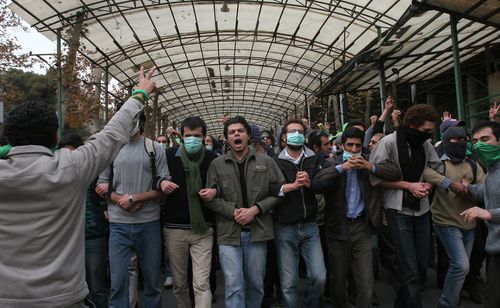
Alireza Nader and Trita Parsi outline the approach the US should take towards Iran. Their bottom line:
Iran's people, not outsiders, will be the ones to achieve sustainable democracy. The Iranian opposition is not merely concerned about the June election, nor is it a simple creature of Iran's factional politics. Rather, it represents a historic struggle for democracy and human rights. Between the all or nothing approaches, the United States can best help by providing Iran's democrats with breathing room.
(Photo: Iranian opposition supporters march during an anti-government demonstration at Tehran University in the Iranian capital on December 7, 2009. Iranian police firing tear gas clashed with crowds of protesters in central Tehran as opposition supporters used Students Day commemorations to stage fresh anti-government demonstrations. AFP/Getty Images)
A reader writes:
To the extent Mr. Wieseltier's argument supposes that you have some unexpressed opinions, I think that the vast weight of empirical evidence is to the contrary.
Robert Wright notes that even the reformers in Iran are in favor of a nuclear energy program:
Why don’t we offer Iran something its public cherishes — the acknowledged right to enrich uranium — in exchange for radically more intrusive inspections, along with ratification of the additional protocol? A version of this idea has been advanced by a group of experts that was convened by the American Foreign Policy Project and co-chaired by former Ambassador Thomas Pickering and the aforementioned Gary Sick. It’s worth checking out.
I’m not betting that Iran would accept this deal, but I don’t see the downside of finding out, and that’s something we’ve never done; no comparable deal has ever been put on the table. The closest such overture was a 2008 offer that would have imposed tougher inspections but denied Iran the right to enrich uranium as allowed under the N.P.T. until “the confidence of the international community in the exclusively peaceful nature of your nuclear program is restored” — which to the average Iranian means, “not until America says so.”
Yglesias agrees:
It’s worth emphasizing that it’s not unusual for a country to possess a full-spectrum of scientific and technical aspects of nuclear technology without building nuclear weapons. Germany, Japan, South Korea, Sweden, and I believe some other smaller European countries are in that boat. What’s more, Iranians seem committed to enrichment even if it means sanctions…
Tehran Bureau spells it out:
A) a complex logistical scheme is to be implemented whereby the two sides of the Azadi Square from North and East (where the protesters always emerge) will be blocked for several kilometers in each direction. Those on these two sides will be diverted away from the eyes of the international press confined to designated areas within the square. At the same time, supporters will be marshaled en masse from the West and South ends of the square.
B) Two days prior to the ceremonies, the famous inner ring of Azadi Square has been sealed off by special partitions. On the early hours of Thursday morning, the plan is to fill the space with die-hard supporters while checking the bags and pockets of the others wanting to gain entry to the protected zone to make sure they don't carry any Green paraphernalia.
C) Dozens of Basij contingents from the provinces have started arriving in Tehran with each group assigned to one part of the northeast quadrant of the city, using Azadi Square as the reference point.

Masoud explains:
Rashid Ghaleh Shahini, a renown Iranian body-builder, entered the Fajr body building championship (in the Western Islamabad province of Iran) with his body painted entirely in green, in solidarity with Iran's Green opposition. His bold action earned him an expulsion from the competition, despite the fact he was the favorite to win.
For most observers, Leon Wieseltier’s latest attack on me as an anti-Semite, without even the candor to say so (since that would contradict his previous categorical refutation of the idea), may seem somewhat over the top. And, as many have already noted, there is a long history here, which it is unseemly to disinter and tedious to recount. But I do want to note that it is a history of deep love and friendship and mentorship, for which I shall always be deeply grateful, as well as of eventually profound animosity. The day I sero-converted to HIV, a fact I couldn’t tell anyone (even my mother who was hospitalized with severe depression at the time), he took me into his home and cared for me like a brother. He is a man capable of immense kindness, of brilliant humor, and is probably the funniest single person I have ever come across. I also deeply respect his quite remarkable legacy as editor of the literary section of the New Republic which I was honored to edit for a while under his guidance. In the good old days, I took him to gay bars (he has not a shred of homophobia); as a Jew and a Catholic, we read Buddhist scriptures together. We were, in fact, somewhat painfully alike in many ways: religious traditionalists whose reverence for our faiths was also marked by our rebellion within them. We share a commitment to secularism and religion, these days a very rare combination. His mentor was Isaiah Berlin; mine Michael Oakeshott. Their differences are fascinating but minor – and they too, sadly, came to despise each other. Although the collapse of our friendship was among the most hurtful of my life, and for which I take my own share of responsibility, I remain an admirer of his intellect. I have tried to move on, and although I have occasionally thrown a tease about his sometimes impenetrable prose, or got him to make a factual correction, I also posted this quite recently of a review he wrote for the NYTBR:
This is a very pithy summary of a view of politics and religion that I share and that Leon helped me appreciate and understand. The quote is an hors d’oeuvre before the main course, however, which is this essay: clear, stringent, restrained where necessary, vicious when warranted … and, well, humane. It’s an important essay because within it, there pulsates a whole slew of vital issues where some level of contradiction and tension is far more defensible than their opposites: being a Jew and an American, being a conservative who can see the role of liberalism in the West (and vice-versa), and being a secular citizen with profound respect for and engagement with religious truth. I think it’s the best thing Wieseltier has written in memory – and reminds me of what an immense and powerful talent he remains.
People have referred to this contretemps as the continuation of a tit for tat. More tit than tat, I’d say. But his newest charge deserves treatment beyond this personal history, because it is a very grave one. His accusation of anti-Semitism is wounding because from my teenage years, the Holocaust has remained in my mind and soul as a defining event in human history, and, as a Catholic, I have struggled mightily to hold my own faith fully accountable for its historical contribution to it. I have also an extremely long record of calling out genuine anti-Semitism on this blog – not as a way to score points against my critics, or to police the domestic discourse – but because I think it is an eternal toxin for which my own Church bears a huge amount of responsibility and which needs to be confronted wherever it appears. I despise the Iranian regime in part for its murderous and disgusting anti-Semitism, as I do Hamas and Hezbollah. Maybe other non-Jewish writers have a stronger or deeper record of this than I, but I did my best. It is demeaning to point to the many instances, as if I were in a dock and presumed guilty before having to prove myself innocent. But the record is plainly there (just search this blog or google it); it is voluminous; it is deep; and it is quite patently sincere. There is also some irony here since my political position on Israel remains, so far as I can tell, extremely close to Leon’s. I favor a two-state solution along the 1967 lines (give or take a few adjustments to reality on the ground), a partition of Jerusalem, and guarantees for both Israel’s security and that of the Palestinians, whose suffering and constant humiliation is indisputable. I cannot see a full right of return being viable, and I would like to save the idea of a specifically Jewish state from demographic suicide, and because I see the Jewish faith as the foundation of my own and my Jewish friends as more than just my friends, but part of a spiritual brotherhood.
Even on the Gaza war, which was, for me, a turning point in my view of the Israel that is emerging with ever more danger to itself and the entire world, Leon and I have very similar positions, so far as I can tell. He has a long record of calling out the racist religious right in Israel, although much less so now than in the past. Again, I posted on this blog his very elegant description of the situation a year ago:
“I have a sickened feeling about the recent campaign in Gaza. No sovereign state can accept regular aggressions across its border, but Operation Cast Lead seems to have accomplished nothing. Hamas is again firing its rockets, Israel is again retaliating against them, and Israeli politicians are again making virile promises to finish the job. The suffering of the people of Gaza during the war was partly the responsibility of their own astoundingly callous leaders, but not entirely. Israel’s choice of tactics and strategies was its own; and when it chose blunt instruments, it guaranteed harsh consequences.”
Now Leon used those words weeks after the onslaught, and I am a blogger writing in real time, reacting to the horrifying scenes of suffering, of the heads of children buried in rubble. Whatever the context, watching largely defenseless, densely packed urban areas being pummeled with missiles is traumatizing. I don’t see how a human being can watch it and not feel for those innocents trapped in terror below. I have Irish blood and a Catholic conscience. Seeing this happen in real time was as vivid for me as it was watching the people of Iran last June. There will be times in which the emotion of the moment overwhelms me. Leon despises blogging, but I see its merits as long as it is seen in proper context as provisional truth, not considered analysis. Read my Sunday Times columns or Atlantic essays to see the difference. So maybe my reaction was over-wrought. But it was certainly not over-wrought because of some kind of anti-Semitism. To be honest, I was also shocked. This was not the Israel I thought I knew.
To address the substantive points:
As evidence of my anti-Semitism, Wieseltier first cites a post in which I distinguish between “Most American Jews [who] retain a respect for learning, compassion for the other, and support for minorities (Jews, for example, are the ethnic group most sympathetic to gay rights)” and those who celebrated the Gaza attack and defend the torture of terror suspects. (I must say I’m relieved that even Leon cannot defend Michael Goldfarb!) This, apparently, to Leon, is dividing Jews between “good” and “bad” which, I am informed, has a “sordid history.”
I’m sorry if Leon immediately saw my distinction between some neocons and many non-neocons as some kind of reference to ancient persecution. But what am I to do if I am trying to describe my support for J-Street over AIPAC on these matters, or for the younger generation of American-Jewish writers as opposed to their elders? Is this analysis something no non-Jew is allowed to even discuss, for fear of offending? How am I able as a writer to make occasional distinctions between American Jewish factions whose views I have come to support and those I don’t? To give a counter-example, in my writing about homosexuals for the past twenty years, I have often distinguished between the gay left and the gay right, between strategies and arguments I support and those I oppose. Are we supposed to think that this is some kind of dark reference to the ways in which totalitarian countries persecute openly gay or effeminate gays and leave the closeted macho types alone? Please. This is searching for animus that simply isn’t there.
In defense of Charles Krauthammer’s support for torture – yes Leon Wieseltier is defending Charles Krauthammer, as Washington freezes over – Leon writes:
Krauthammer argues for his views; the premises of his analysis are coldly clear, and may be engaged analytically, and when necessary refuted. Unlike Sullivan, he does not present feelings as ideas.
Actually, I responded to Krauthammer’s first, formative and reasoned essay not with mere “feelings as ideas” but with careful and respectful arguments. And the essay, “The Abolition Of Torture“, appeared in The New Republic! Leon appears not to have read it. All I ask is that someone read that essay and see if they think that my case is a hunt “for motives, not reasons; for conspiracies, which is the surest sign of a mind’s bankruptcy.” It is an impassioned case for the American idea. My blogging on this subject has also been packed with fact, argument, research, logic and debate. To give one example, this pivotal post about the Nazi origins of “enhanced interrogations.”
Then we come to the question of “The Israel Lobby”. Leon argues that I am of “the party of Mearesheimer and the clique of Walt”. He has long since demonized them as the modern equivalent of der Sturmer. I have, in fact, criticized the book in some respects. Shortly after it was published, I wrote:
I haven’t written much about the Walt-Mearesheimer book because it’s long and I haven’t had time to read it. (There’s a concept: a blogger not posting about something he knows nothing about.) But it is interesting, it seems to me, that the debate about the Middle East does indeed feel freer in Israel than in the US, where some American Jews have a defensiveness and anger that makes calm debate very difficult. (I guess I should add that my impression of the Walt-Mearesheimer book – I did read the original article – is that it’s shoddy enough to merit Jewish defensiveness and anger. Sigh.)
But I do respect professors John Mearesheimer and Stephen Walt. I am not going to be a party to their demonization and attempted ostracism because they dared open a necessary discussion that so many tried to shut down before it even began. At TNR, I ran a cover-story by Mearesheimer, a realist case for the partition of Bosnia. I studied Walt’s work in the Government Department at Harvard and I don’t recall it being outrageous, even if it was a little dull for my taste.
My own views on foreign policy have shifted back and forth over the years – which does not make me a “Buchanan of the left”, as Leon ludicrously claims. It makes me a conservative of the kind I tried to explain in my most recent book, and is perhaps best explained in this post. I think one should adjust to events and times, even though deep down, my own preference is a kind of warm-hearted realism. I did have a neocon phase, especially after 9/11, when neoconservatism’s analysis of the world seemed to me in my anger and fear the most coherent on offer. But as I have surveyed the catastrophes and countless deaths visited upon the world by neoconservatism since, and wrestled with my own misjudgments and errors, I have come to appreciate more deeply the wisdom of foreign policy realists (and look back more fondly on Reagan’s later years and the first president Bush).
Most of the neocons, with some exceptions, such as Frank Fukuyama, seem incapable of self-reflection, of conceding error, of feeling any moral responsibility for the horrors they have inflicted – perhaps with the best of intentions – on the world. Although there can be a heartlessness in the soul of realism which I find personally hard to embrace, it sure has the recent evidence on its side.
Then this assertion that I subscribe to some dark conspiracy theory that “the Jews control Washington.” I’m sorry but this really is a vile lie, a stark accusation of anti-Semitism, unsupported by any evidence. The only people I have ever heard refer continuously and emphatically to “the Jews” as a single global entity wrote for The New Republic. This was often humorous and self-mocking, of course, until it wasn’t. But I might as well state clearly what I do believe – and know almost no-one in Washington who isn’t a fanatic who doesn’t – that AIPAC’s perfectly legal, perfectly open, brilliantly conducted lobbying operation has massive influence in the Congress. Really, any dissenters?
I have also noted that many, many other powerful lobbies exist. At TNR, I ran a major story on the malign influence of the Cuban lobby, for example, which exerted disproportionate power and distorted US foreign policy in ways that I came to believe hurt Cubans and Americans. I don’t remember being accused of being bigoted about Cubans for it. But somehow criticizing AIPAC is something forbidden for non-Jews – for fear of being labeled an anti-Semite or, if you are Jewish, a “self-hating Jew”. I refuse to be cowed by such bullying tactics. And thanks to the fact that the blogosphere now exists, such bullying is far less effective than it once was in the past.
Wieseltier then makes some wild whiffs that “[Sullivan] prefers not to dive deep into the substance of anything.” Let’s take just one example he cites:
“Does he believe that the Israeli war against Hamas was an unjust war, or that Israel should have continued to absorb Hamas’s rocket attacks–which were indisputably criminal–and not acted with force against them? His answers may be inferred from his various ejaculations–“the pulverization of Gazans,” for example, is a phrase that is calculatedly indifferent to the wrenching moral and strategic perplexities that are contained in the awful reality of asymmetrical warfare–but they are not so much answers as bar-room retorts; moody explosions of verbal violence; more invective from another American crank.”
Well let us look at the actual record (thank God for Google). This blog conducted one of its longer threads on the questions of just war and proportionality during and after the Gaza onslaught. I urge fair-minded readers to read them sequentially and see if all I did was utter “bar-room retorts” or “moody explosions of verbal violence.” The thread starts here and includes all angles and runs to thousands and thousands of words. From the beginning, the posts are here, here, here, here, here, here, and here. I may have missed some, but you browse the archives in January 2009 and see just how deep, various and open the debate was. On this, as on so much else, Wieseltier accuses someone of something he hasn’t bothered to do even the faintest due diligence on. He should try getting an editor.
Leon then drags out some of my more hysterical and emotional posts during and immediately after the 9/11 attack. He does not refer to my considered takes on what it all meant in the NYT Magazine here or my essay, “This Is A Religious War.” Yes, I confess and have often apologized for the excess of some of my rhetoric at the time. It was a traumatizing time and I was horrified and my emotions got the better of me at times. I wasn’t the only one, of course, in a country still polarized by the 2000 recount, but it’s still no excuse. He even brings up my infamous sentence in a 6,000 word piece in the days after 9/11 about a “a fifth column” among some far leftists. He omits to note that I regretted that phrase – and its misleading implications – days thereafter, and pledged never to use it or anything like it again. More recently, I wrote
In the emotional days after the destruction of the World Trade Center, there was at least as much heat as light. I myself wrote a sloppy throwaway sentence effectively accusing such “enclaves” on the far left of being a virtual and potential “fifth column” in the coming war. I regret that ugly coinage and said so days later.
This is odd because these sentences appeared in a review I wrote for the New Republic’s literary section, edited by Leon Wieseltier. And what on earth has this to do with my alleged anti-Semitism? Seriously, is he this intent on throwing everything but the kitchen sink at me?
As for Hamas, I have never, ever done anything but condemn their vile anti-Semitism. As for their rocket attacks against Israeli citizens, I have consistently referred to them as war crimes. My Face of the Day on May 16, 2007, was of a young Ethiopian Jewish immigrant boy shedding a tear as he took refuge in a bomb shelter in Sderot, Israel. I reported that “at least 30 Israelis have been injured from more than 25 Qassam rockets that have fallen in the area in the past 24 hours.”
Then there are his semantics over fundamentalism. My point is an obvious one: many of the West Bank settlers, especially the more extreme ones, are religious fanatics. There is no political settlement to be had with those who base their views on divine sanction. Then Wieseltier asks the following unhinged question:
And does Sullivan have any notion of the magnitude and the virulence of Muslim contempt for the Jewish world? Muslim contempt for Jews does not justify Jewish contempt for Muslims, of course; but nothing justifies Sullivan’s refusal to give the whole picture.
How can anyone who has ever read anything of mine over the last few years not know of my insistent, repeated, analysis and condemnation of Muslim anti-Semitism. I have “refused” to give the whole picture? This is an unforgivable lie that requires a factual retraction and apology from TNR. My exposure of Islamism from 9/11 on has been relentless. But let me give a simple, lone example in a review I wrote for TNR, again edited by Wieseltier, in which I criticized the book because
There is no mention in the book of the pathological anti-Semitism that currently accompanies these traditional Islamic societies. But D’Souza goes out of his way to draw a distinction between Islamist terrorism undertaken purely in the name of jihad — September 11, the Bali bombing, the London and Madrid massacres — and terrorism that he regards as legitimate self-defense. He puts “the conflicts in Palestine, Chechnya and Kashmir” in the latter category: “No one can deny the horror of Palestinian and Chechen attacks upon civilians, but these have to be measured against the state-sponsored terror on the other side: the bulldozing of Palestinian homes, the shooting of stone-throwing teenagers, the obliteration of the Chechen capital of Grozny…by Russian troops.”
Again I wrote this for Wieseltier. And yet he asserts that “nothing justifies Sullivan’s refusal to give the whole picture.” Refusal implies I knew better and decided to withhold the evidence to single out Jewish prejudice. This is truly unforgivable.
There is then a legitimate argument about the role that America’s support for Israel plays in advancing America’s global interests. Here there is a good faith disagreement – but it is not a major one. I long subscribed to the view that the fundamental problem with the Middle East was the refusal of many Arab states to recognize the state of Israel. At some point, I should explain how and why the events of the last decade have educated me and complicated my view. This response is long enough not to go into all that now.
But I do believe that it is vital for the US to appeal to moderate Muslims across the world in order to isolate Islamist extremists, and I do believe that some kind of effort to jump-start the peace process in Israel-Palestine is critical to that. After watching how neoconservatism has actually – if unwittingly – empowered Islamism, I have come to see the wisdom of realism and calm in this matter. This was one central reason for my support of Obama.
I do not think it was unreasonable for the new president, with a unique chance to reset relations with the Muslim world, to ask an ally to make a gesture to freeze all settlement construction in order to bring credibility back to the US as an honest broker in the Middle East. I also believe for good measure that this is in the interests of Israel, if I am allowed to offer an opinion on the matter without being called out as a false friend of “the Jews”. I do believe that what Wieseltier himself delicately concedes were “blunt tactics” in Gaza, followed by a humiliation of president Obama in his first year of office were not the acts of a truly helpful ally of the US, especially when suspension of the settlement construction would have had zero effect on Israel’s security. And I strongly disagree that when a struggle between a foreign country’s government and the newly elected president of the United States cripples the peace process, it is somehow the president of the United States’ fault.
Look at this sentence from Wieseltier:
If “the Netanyahu government has all but declared war on the Obama administration,” it was after the Obama administration had all but declared war on the Netanyahu government. Obama may have been right about Netanyahu – the skepticism about the latter’s willingness to surrender land for a peace that will bring Palestine into being is not exactly fanciful – but Obama failed miserably, and set everything back.
To ask that Israel freeze all its settlement construction as a way to help facilitate peace is not declaring war on Netanyahu’s government. It is simply assuming the US is capable of determining its own foreign policy in the region without a foreign government’s advance permission. And notice that Wieseltier, in a convoluted fashion, does not exactly disagree on Netanyahu’s intransigence. But all of this is always Obama’s failure because it can never be Israel’s fault because to say that anything is Israel’s fault is anti-Semitic. Lovely piece of circular logic there, innit? Unless and until the president of the US recognizes that policy toward the Middle East must always be subject to Israel’s interests and sensitivities before anything else, it is the American president’s failure. Israel can never be blamed. I’m sorry but I disagree. I think Israel can be blamed and its intransigence should be exposed and criticized forthrightly – or, of course, defended – in Washington without this looming threat of the anti-Semite card being hauled out.
And this, it seems to me, must be the occasion for this rather sad attempt at character assassination. All those who dissent one iota from whatever excruciatingly arcane position Wieseltier carves out for himself at any given moment must be set up for character assassination. The first card to be used is the anti-Semitic card. It is, apparently, the responsibility of every non-Jewish or even Jewish writer who is not Leon Wieseltier to tread an extremely careful linguistic path, to walk delicately through a minefield of traps, to remain permanently fearful of being tarred as a bigot if he or she dares question the line that alone Wieseltier polices.
Look, I am not one to dismiss any notion of anti-Semitism in me or anyone else. I believe it is such a toxic theme in human history and such a grave strain in the human soul that no one should be sublimely confident that he or she is free of it entirely. I take the moral demand to guard against it very seriously. And I have indeed searched my conscience these past few years to take stock if anything like this is unconsciously entering my soul, as I try to guard against my many other sins. I certainly think I have written and thought some things about Muslims and Arabs over the years that are not always carefully parsed, conditioned or measured. I’m not immune to homophobia either. Our psyches are complex. As I said, Irish blood and a Catholic conscience are not easy bedfellows. And I can parry a little hard in the cut and thrust of debate sometimes.
At his most generous, Wieseltier accuses me of moronic insensitivity. Well, I do not think Leon thinks I am a moron. Am I insensitive? At times, I’m sure I am. I’m a writer who doesn’t much care for political correctness, of policing discourse for every single possible trope or code that someone somewhere will pounce on as evidence of bigotry. I’ve gone out of my way as an editor and writer to stir things up – on race and gender and culture and sex – and I have never been one to worry excessively about the sensitivity of others. I think I have offended and enraged far far more gay men and evangelicals than I ever have Jewish-Americans, for example. I’m a South Park devotee, for Pete’s sake.
But you will note that Wieseltier himself peppers his own prose with statements about “the Jews” as if they are some collective, monolithic mass. You will note how he interchangeably refers to Israelis, liberal Jewish-Americans, conservative Jewish-Americans, orthodox and reform, Democratic and Republican, settlers and non-settlers, Likudniks and peaceniks and Lord knows who else as “the Jews.” It is a sleight of hand reserved for him alone, and a statement that no one else can enter this debate on the same terms without obeying his rules of discourse or face some kind of ostracism or vilification.
But I will note one sentence Wieseltier writes at the beginning of this unedited rant. It refers to the Holy Trinity and the Incarnation, a profound mystery to Christians, and at the heart of our faith. He writes this:
“The idea of plurality in the deity, like the idea of corporeality in the deity (Auden would not have had an easier time with the Incarnation!), represents nothing less than a retraction of the monotheistic revolution in thinking about God, a reversal of God’s sublimity, a regress to polytheistic crudity.”
Leon is describing the central tenets of the Christian faith – the divinity of Jesus and the Triune God – as a step backward for religious thinking. He is dismissing as stupid and backward the Incarnation. He goes so far as to insult it by decrying it as a regress to polytheism. And not just polytheism but crude polytheism.
I am not one to take offense at such things. My own faith can withstand the cheap pot-shots of others. But can you imagine if Wieseltier came across a Muslim or a Christian making similar derogatory and condescending and cheap remarks about Judaism? As crude? A form of religious regression?
Yes, of course, you can.
Keith Hennessey responds to Chait:
Three things can be done with a dollar of surplus: return it to the taxpayers, use it to pay down debt, or increase spending on a government program. Team Obama and its allies suggest that if we had not cut taxes and the surpluses had remained in Washington, then all these surplus revenues would have been used to pay down debt. I think it’s far more likely that Congress would have figured out ways to increase government spending (yes, sadly even with Republican Congressional majorities). For me tax cuts vs. debt reduction is a tough call. Tax cuts vs. (an uncertain mix of debt reduction and government spending increases) is a much easier choice.
Chait fires back:
While Democrats pushed for reserving the surplus to reduce the national debt, Bush always insisted there were just "two choices": leave the money in Washington, or return it to the taxpayers. This was a rhetorical trick designed to define out of existence the option of paying down the debt. It's nice to see Hennessey admit there are actually three choices. But he recycles Bush's old dodge that somehow the debt wouldn't have been paid down and that spending would rise. This is nonsense. Debt reduction was the default policy in the absence of Congressional action. If Bush wanted to pay down the debt, he could have vetoed any spending bill above his desired amount. The decision not to pay down debt was not taken away by Congress. It was removed by Bush because Bush preferred tax cuts.
 The Dish