The Latest From Leon, Ctd

Larison also comes to my defense:

It is quite easy to see everything Wieseltier cites from Andrew’s writings as the product of a pro-Obama advocate who has been frustrated by the false start of Obama’s handling of Israel and Palestine and as nothing more than that. As denunciations go, Wieseltier’s is probably the most intellectually sloppy, shabby one I have seen since the days before the invasion of Iraq.

Greenwald notes:

If perfectly mainstream writers, expressing perfectly appropriate and reasonable arguments about Israel, are routinely condemned for "anti-semitism," then it must not be a particularly bad thing to be, so this reasoning goes.  If The Atlantic's Andrew Sullivan, and Time's Joe Klein, and Foreign Policy's Stephen Walt, and the University of Chicago's John Mearsheimer, and Gen. Wes Clark (a TNR target), and Howard Dean, and former President Jimmy Carter, and a whole slew of others like them are "anti-semites," then how terrible of an insult is it?  By tossing around the term cynically and to advance personal vendettas, neoconservatives are the authors not only of their own irrelevance but also, more significantly, of the growing irrelevance of the "anti-semtiism" charge.

I hope to post my response today.

On The Eve Of 22 Bahman

Scott Lucas previews the protests in Iran:

[T]here is a significant difference on the eve of this event compared to the political environment before Ashura (27 December). On that occasion, the only prominent opposition figure who made a move was former President Mohammad Khatami, and his memorial speech for Grand Ayatollah Montazeri was rudely broken up by pro-Government protesters.

Mousavi, Karroubi, and other senior clerics were all muted about the demonstrations to come. And, after those protests, “conservative” figures such as Ali Larijani were unstinting in their criticism of the “violent” and “foreign-backed” Green movement.

Now all these figures are in play. Mousavi, Karroubi, Khatami have put down their political markers for a big opposition show on Thursday and promised more to come. Rafsanjani, for the first time since early December, may have made his manoeuvre to challenge the Government. And Larijani, joined by others within the establishment, is now targeting Ahmadinejad as much as any Green protester.

Books, Twitter, Word Count

Chait takes George Packer's side in the ongoing debate. Pivoting off the original thread, Henry Farrell thinks even good books are too long:

I would estimate that about 80% of the non-academic non-fiction books that I do not find a complete waste of time (i.e. good books in politics, economics etc – I can’t speak to genres that I don’t know) are at least twice as long as they should be. They make an interesting point, and then they make it again, and again, padding it out with some quasi-relevant examples, and tacking on a conclusion about What It All Means which the author clearly doesn’t believe herself. The length of the average book reflects the economics of the print trade and educated guesses as to what book-buyers will actually pay for, much more than it does the actual intellectual content of the book itself.

Yglesias agrees. Jim Henley follows up.

Tomorrow Belongs To Her, Ctd

A reader writes:

I was born, raised, and educated in Coeur d'Alene, Idaho, an exemplary Whitopia. I grew up listening to Rush Limbaugh, watching Fox News and had a "Proud Member of the Vast Right Wing Conspiracy" bumper sticker on my debate tub. I was lucky though. I did well enough in school to be eligible to attend one of those evil elite East Cost universities on scholarship. I defended Bush, idiotically, all the way until my senior year, when I studied abroad in both China and England. I was forced, over and over, by classmates and those I met in other countries to confront the grotesque neo-con mindset I had thought was so obviously right.

It took crossing both oceans, a comprehensive study of the history of religion and government, and four years of college to change my perspective. As someone who moved from one extreme to the other, I can tell you the one thing that saved me was the conservative impulse to be self critical, to avoid hubris and arrogance. The other was my parents teaching me to love science. My first break with Whitopia doctrine was when I argued with my church's youth group leader over the reality of evolution. That someone could deny something so obvious baffled me. It has been a slow and painful process since then, testing and retesting my beliefs.

I am now everything I grew up thinking I should hate:

I live in New York, go to NYU, and I study feminist and queer theory. I am horrified by the insane ramblings of Palin and the small government ideas she mutilates on a daily basis. I have lots of friends back in CDA, and lots of friends from high school who "got out." Those of use who escaped treat our home town as a place we love filled with people we don't understand or relate too. Most of us who "got out" are liberal or libertarian (I'm the latter). Most of us are deeply ashamed of how we used to view the world and, in many cases, how our friends and families still do.

If you really want know fear, all I can tell you is that Coeur d'Alene was downright progressive compared to the surrounding towns.

Keep hammering Palin. Those of use who grew up in Whitopia know her kind and understand how seductive her anti-logic can be. Thank you thank you thank you for exposing her.

The Social Contract

Matt Steinglass is open to tort reform, with a big caveat:

I'm instinctively sympathetic to this idea in part because I come from a family of doctors and have heard complaints about crazy malpractice suits since I was 12, and in part because I've lived in Europe, where people think American tort law is insane. But part of the reason why Europeans accept restrictions on their ability to sue doctors for malpractice is that they have guaranteed health insurance. It's part of the social contract: doctors accept limited salaries in exchange for limited liability; patients accept that they cannot sue doctors for millions of dollars in exchange for a guarantee of access to decent health care.

How Palin Could Win

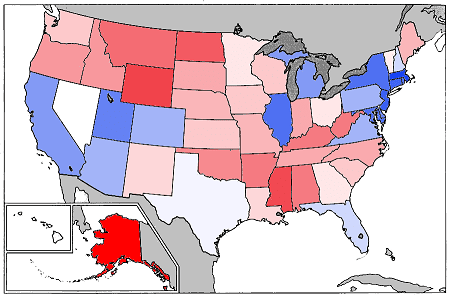
PalinMap
Silver studies Palin's path through the 2012 GOP primaries. The red states above are more favorable to her, the blue ones less so:

Among the first four states to vote, both Iowa and South Carolina should be winnable for Palin. Although Iowa is not a perfect match for her — not quite as many no-college voters as she'd like — it holds a caucus rather than a primary, which tends to bring out a more conservative electorate. The most obvious concern for Palin in Iowa, if he runs, is Mike Huckabee, who won there in 2008. She could also conceivably lose a war of attrition if a candidate like Santorum eats away some of her evangelical vote, or if her organization and infrastructure is not up to par. The inclusion of a regional candidate like John Thune or Mike Pence could cut either way for Palin; they are not yet terribly well defined and it's unclear whether they'll run to the right-center (in which case they could cause more problems for someone like Romney) or further to the right (trouble for Palin).

Christianist Watch II

"I am convinced in my heart and in my mind that if the United States fails to stand with Israel, that is the end of the United States . . . [W]e have to show that we are inextricably entwined, that as a nation we have been blessed because of our relationship with Israel, and if we reject Israel, then there is a curse that comes into play. And my husband and I are both Christians, and we believe very strongly the verse from Genesis [Genesis 12:3], we believe very strongly that nations also receive blessings as they bless Israel," – Michele Bachmann.

Christianist Watch

The AP:

[Palin] said it was "providential" that President Barack Obama did not return from Denmark with a clear victory after questions arose about figures used in the scientific studies to promote conservation.

Although she ran on a national ticket that took climate change seriously, with a raft of proposals by McCain to tackle dependence on foreign oil and carbon energy, she now blithely rejects the premise of such a policy as "snake-oil science."