Slate imagines if Tarantino, Lynch, Anderson, Godard, and Herzog directed the Super Bowl.
Month: February 2010
Palin Last Night: “I Will Live And Die For The People Of America!”
For The Record
"But as long as the nation is obsessed with historic milestones, is no one going to remark on what a great country it is where a mentally retarded woman can become speaker of the house?" – Ann Coulter, in a February 2009 column.
(Hat tip: Dusty Rhoades)
Attention: Politics And Football Nerds
A blog devoted to matching up all 44 presidents with all 44 Super Bowls.
Malkin Award Nominee
"The Obama administration is no longer interrogating terrorists, no longer capturing them, and trying to get them," – Marc Thiessen.
Totten On “The Hurt Locker”
I've mentioned this remarkable movie before and found it by far the best film on our current war – the "Deer Hunter" for the Iraq war. Now, Michael Totten gives it his endorsement, and his opinion is worth much more than mine, because he's been there and seen that. It's now available on Blu-Ray.
While you're at his site, if you can spare some dough in these straitened times, show him some money love. (Hat tip: Jeff.)
Sin As An Evasion Of Time
"The commonplace that no civilization can last forever contains an essential truth: time is the enemy of civilization. And in the last analysis we humans are on the side of time, not of civilization. Time must finally be allowed to have its way with civilization. Hope is willingness to entrust our lives to time…
Sin is evasion of time. In giving way to nostalgia, for example, we flee from time into the past. Evading time is accomplished mainly, however, by constructing worlds — orders of life in which everything has its assigned place, and all events are foreknown if not willed. There are personal worlds, occupied perhaps by only a single individual; and there is also 'the world,' the surrounding order of society, treated as objectively knowable, humanly controllable, and morally final. A world is always a kind of fortress against time.
Sin, as I have tried to show, is in essence worldliness, whether in proud mastery of a world, in distracted abandonment of oneself to someone else's world, or, as is almost always the case, a subtle mixture of these. To entrust your life to time, however, is to acknowledge the impermanence and imperfection of all worlds.
It is to dwell within the situation in which time has placed you, suffering and doing what you must, in the faith that by submitting to the demands of time you are submitting to the demands of God, the Lord of time," – Glenn Tinder, The Fabric of Hope: An Essay
Mental Health Break
Grains Of War
Rob Lyons reviews Tom Standage’s An Edible History of Humanity. Standage's description of his own work:
The use of food as a weapon or war is timeless, but the large-scale military conflicts of the 18th and 19th centuries elevated it a new level. Food played an important role in determining the outcome of the two wars that defined the United States of America: the Revolutionary War of the 1770-80s and the Civil War of the 1860s.
In Europe, meanwhile, Napoleon’s rise and fall was intimately connected with his ability to feed his vast armies. The mechanisation of warfare in the 20th century meant that for the first time in history, feeding machines with fuel and ammunition became a more important consideration than feeding soldiers. But food then took on a new role, as an ideological weapon, during the Cold War between capitalism and communism, and ultimately helped to determine the outcome of the conflict. And in modern times food has become a battlefield for other issues, including trade, development and globalisation.
Friendship, Family And Christianity
A reader writes:
Reading Montaigne also changed my life. Picking up his Essais was what I consider the first step in my growing up. It was the first step in becoming secure in my failings, asking questions about myself that most people shy away from, embracing my curious nature, overcoming anxiety and genuinely embracing life.
It has become one of my guidebooks to living in a fulfilling way (and it pointed me to some great classics, which have also turned into guidebooks). When it comes to the religion debate, you and I would most likely be on opposite ends; however, what has always interested me is what both sides have in common. The rest is just an engaging and riveting debate.
And, I would say, Montaigne's essay on friendship is a prime example of that which the religious and the nonreligious have in common (at least both sides should recognize that is what brings us together).
Please update us if How to Live is ever published in the US.
Will do. On friendship,  the topic of debate for centuries and add the great gay twelfth century Christian monk, Aelred of Rievaulx, whose classic on spiritual friendship is tragically overlooked, and on to Emerson.
As a Christian, it's the Gospels that, to me, represent the greatest celebration of friendship as well as some of the most brutal attacks on the family ever written. It's always staggered me how the church has managed to ignore this for so long in favor of a cult of the family that Jesus clearly violated in almost everything he did.
Remember: Jesus rebuked his parents in public, told his disciples to abandon their wives and children without so much as a buh-bye, continually violated the cultural gender norms of his day (unlike the current Catholic church hierarchy, who insist on much more rigid gender subjugation than the culture in which they exist), and whose closest female disciple was unmarried. His fundamental relationship – the way he expressed the love that defined him as divine – was friendship.
In this, his deepest human relationship was clearly with John, the beloved disciple. Meditating on their love for one another – not sexual, much, much deeper than sexual – helped me overcome the loss of my dearest friend in the plague years. The Gospels tell us that John rested his head on Jesus' bosom at the Last Supper and was the only disciple to have attended Jesus' crucifixion. He was the one to whom Jesus entrusted his own mother as he died.
When was the last time you heard a Christian leader speak of friendship as a supreme virtue, as the ancients understood it? When was the last time you heard a homily about the profound relationship between Jesus and John. Of its essential freedom and self-giving. And note too one of the most memorable things Jesus said;
Greater love hath no man than this: that he lay down his life for his friends.
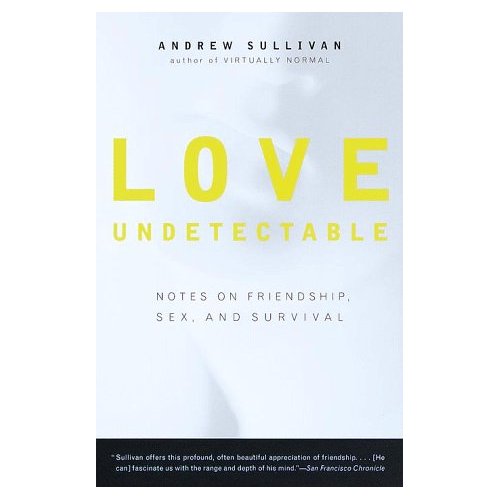
What word in that sentence is the one thing we never hear about in our churches? The last section of my book is devoted to the relationship of Jesus and John, the disciple whom Jesus loved.
(Image: a classic depiction of the relationship between Jesus and John.)
 The Dish