Tossing The Child Clear

Jon Lee Anderson reports on Haiti:

When the quake hit, Nadia had tried to run out of the ravine. She was halfway up the crude concrete steps that led to the street when she heard screaming from near her house. She ran back, and saw her neighbor lying dead under the pile of cinder blocks. The neighbor had a seven-month-old boy. “I said, ‘Where’s the baby, where’s the baby?’ and we saw him lying there on the ground.” She had managed to toss the child clear just as she was buried by the blocks. “A woman picked him up and gave him to me,” Nadia said. “He was covered with blood, and there was also blood on his socks. One arm looked dislocated, and one of his legs, too, and he had a swelling on his head. I was scared he would die in my hands. He kept trying to go to sleep, and I was trying to wake him up.” Nadia went looking for his relatives and found his aunt, who lived in Ravine 75, a few blocks away from Fidel.

Why We Tip

A study:

[P]erceived service quality was associated with both the likelihood of giving a tip and the amount tipped, thus suggesting that participants were using tipping as a form of reward. Similarly, those who said they thought it was important to help others in need tended to tip more (although they weren't any more likely to tip), suggesting altruism was another motive. Finally, social norms were a key factor – participants who said their friends and relatives thought it was important to tip were more likely to tip themselves, especially if there were more people with them at the time of questioning. Size of tip was not associated with this factor, perhaps because it's only the act of tipping that's visible to others, rather than the amount tipped.

Analysis from Sager here.

The Old Shall Inherit The Blogs

Nick Carr breaks the news:

Did you see that new Pew study that came out [this week]? It put a big fat exclamation point on what a lot of us have come to realize recently: blogging is now the uncoolest thing you can do on the Internet. It's even uncooler than editing Wikipedia articles or having a Second Life avatar. In 2006, 28% of teens were blogging. Now, just three years later, the percentage has tumbled to 14%. Among twentysomethings, the percentage who write blogs has fallen from 24% to 15%. Writing comments on blogs is also down sharply among the young. It's only geezers – those over 30 – who are doing more blogging than they used to.

How To Survive A 35,000 Foot Fall

Popular Mechanics has a tips:

Keeping your wits about you, you take aim. But at what?

Magee’s landing on the stone floor of that French train station was softened by the skylight he crashed through a moment earlier. Glass hurts, but it gives. So does grass. Haystacks and bushes have cushioned surprised-to-be-alive free-fallers. Trees aren’t bad, though they tend to skewer. Snow? Absolutely. Swamps? With their mucky, plant-covered surface, even more awesome. Hamilton documents one case of a sky diver who, upon total parachute failure, was saved by bouncing off high-tension wires. Contrary to popular belief, water is an awful choice. Like concrete, liquid doesn’t compress. Hitting the ocean is essentially the same as colliding with a sidewalk, Hamilton explains, except that pavement (perhaps unfortunately) won’t “open up and swallow your shattered body.”

Map Of The Day

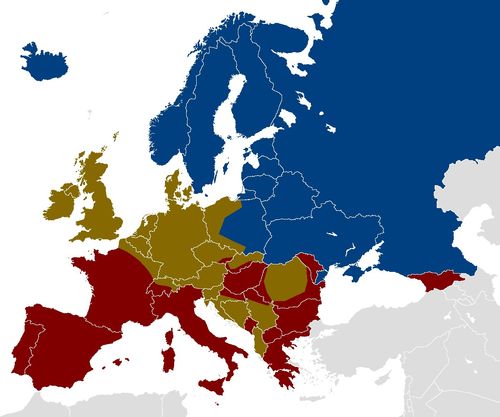
Alcoholbelt

From Strange Maps:

This map shows Europe dominated by three so-called ‘alcohol belts’, the northernmost one for distilled spirits, a middle one for beer and the southernmost one for wine. Each one’s existence and extension is determined by a mix of culture and agriculture.

Scotland seems to me to be miscategorized. And Russia surely should be colored black.

What We Don’t Know About Our Health Care System

Salon talks with Dr. Atul Gawande:

We have that data on maternal and infant mortality, but that’s about it. The fact that we have no idea about how our health systems are doing now versus, say, two years ago — that flabbergasts me. [W]e’re obsessed with components in medicine: Do I have the best medicine, do I have the best doctor? The reality is that a doctor embedded in one system may get different results than if he or she were embedded in a different one. Some studies have started to show doctors getting different results when they work in more than one hospital. I think it’s much more critical for patients to see how good a system can be. Because care requires a whole chain of events.

The Daily Wrap

Today on the Dish we saw an Alabama senator jump the shark. In Palin coverage, she tried to take back the Rush retaliation, new controversial emails surfaced, and tea-partiers started to get agitated. That Brown phone call was resolved here and here.

In other news, another small protest popped up in Iran. Daniel Indiviglio and others tried to make sense of the newest economic numbers. Uganda update here. Updates on HCR politics here and here, and more debate here, here, here, and here. Frum tried to rally moderate Republicans.

A Dish reader added to the copyright discussion, another sounded off on the Edwards story, and another argued for an Enquirer Pulitzer. Beard-blogging updates here and here. Very entertaining vids here, here, and here.

— C.B.