I loves me the Internet:
(Hat tip: BuzzFeed. The original here. Notice that only the soundtrack was added.)
Andrew Sprung on the extraordinary self-restraint and patience of this president, which is enough to drive mere mortals to distraction:
It's Obama playing a long game again — driving supporters of HCR insane with anxiety and frustration. While most of us fret that as the clock ticks wavering Democrats will panic more and "run for the hills," as Obama enjoined them not to in the SOTU, he seems to be betting on the opposite: that as time passes, the suicidal logic of running away from monumental legislation they already voted for is what will sink in. Jonathan Chait has made this argument repeatedly — originally last summer, when HCR was dying its first apparent death.
Sargent has more on yet another truly baffling, frustrating, nerve-working Obama statement last night:
So there’s a lot of information out there that people understandably are concerned about. And that’s why I think it’s very important for us to have a methodical, open process over the next several weeks, and then let’s go ahead and make a decision. And it may be that — you know, if Congress decides — if Congress decides we’re not going to do it, even after all the facts are laid out, all the options are clear, then the American people can make a judgment as to whether this Congress has done the right thing for them or not. And that’s how democracy works. There will be elections coming up and they’ll be able to make a determination and register their concerns one way or the other during election time.
Jesus, Mr president. Are you trying to give Cohn a nervous breakdown?
Macroeconomic Advisers (via email):
Less aggressively negative assumptions for monthly GDP in December would imply fourth-quarter GDP growth between 6% and 7%. Even higher quarterly growth rates are possible. Thus, we believe the risks are strongly on the side of an upward revision to Q4 GDP growth, and growth of 7% or higher in the fourth quarter is a distinct possibility.
Meanwhile, the unemployment rate drops while job losses rise. I'll leave it to one of the best econo-bloggers out there, Daniel Indiviglio, to explain:
I think you should look at this confusing report today in two ways.
Seasonality is useful for recognizing trends. As a result, the trend is clearly positive. But unadjusted unemployment shows total worker suffering. And that's quite awful, as the broader rate including marginally attached unemployed who can't find full time work is up to a whopping 18% — the highest we've seen since the beginning of the recession. So while the economy is beginning to make a turn, things are still very, very bad on the actual employment front.
.
An Iranian source writes:
The city of Lar is a small town in the Farsi Province (the capital of the province is Shiraz (where the wine came from) ) …The back-story is that the government suddenly decided it wanted to separate the city from its county and attach it to another county. That precipitated a riot … there are reports of direct shooting into protesters by the guards and the city’s electricity has been caught off. Nevertheless this video made it out, and tellingly, the slogans are very similar to those chanted in Tehran, “Down with this cabinet! I will kill those who killed my brother!…etc.
More here, where the back-story is described thus:
The clashes were a result of the people’s discontent over the decision to make Gerash, one of the nearby villages into a city. Some windows were smashed and people were arrested and injured. Anti-riot police used tear gas and fired shots to disperse [the crowd]. The people reacted by fighting back.
This could be just a regional flare-up. But the slogans are what make this interesting. The regime is deeply unpopular in many places other than Tehran.

I suspected this could get some readers going:
A word to the wise… With beards, as with writing, one must embrace the Claus.
Another:
Look, now that gays can see an end to DADT, and can realistically anticipate full acceptance of their justly equal position in society, it's time gays started realizing that as fashion trend-setters they have a responsibility to men as a whole, not just to their gay brothers.
To put the matter squarely: my beard looks like hell. So stop with the pro-beard propaganda.
Seriously. It's patchy, dude. I look like a rabbinical student with a skin condition. It's not a good look.
Another:
I had a full beard from the time I was a sophomore in college until about 45. Over that time it got grayer and shorter, in keeping with the rest of my hair, of course. The final straw was when I chanced upon a newspaper article with an accompanying photo of seven entrants in a Kenny Rogers lookalike contest in Bransom, MO. I shaved the next day.
Be careful with "Just for Men" as it can stain ones skin if left on even a fraction too long resulting in the dreaded Fred Flintstone syndrome. The advice to use a light shade is good. I find it turns the gray to blond.
Another:
Andrew, Andrew, Andrew… We ARE "that age" (I'm 50). Quite the opposite of discreetly "covering up" the visible signs of aging, we should be reveling in them, celebrating them to the world: shouting to the hilltops and thanking heaven we're ALIVE to actually GET old. You know far better than I that was not always such a foregone conclusion…
Another:
I've dabbled in beards – mine have never grown as long or full as I'd like – and I mean to tell you, I cannot wait for the day that my beard grows just a tiny bit of grey, like yours, so it can graduate from a hipster-doofus beard to a wise-sage beard.
Jonathan Bernstein counters Suderman:
Really, it comes down to this: if Democrats truly believe that their plan will be deservedly unpopular if passed — that people will hate the individual mandate more than they like the benefits it brings — then they should back off. Not because of how it will be portrayed, but because of what the program actually does. If, however, Democrats believe that once passed health care reform will rapidly become part of the scenery, the way that Social Security and Medicare have become, then it's not even a close case; the best political course for them is to pass the bill.
Julian Sanchez doesn't understand the response to Citizens United:
On the one hand, maybe for all our folly we’re basically engaged enough—or the people who decide to vote are engaged enough—that we can sift through the media maelstrom and figure out, on average, whose principles, character, and record best represent our community. On the other hand, maybe we’re a bunch of chimps who will vote for the shiny thing. I incline toward the latter, but I’ve never been all that big on the intrinsic virtues of democracy. I just have trouble wrapping my head around the view that combines these two beliefs: (1) The wisdom of the people, on the whole, justifies not just the installation of Candidate A over Candidate B, but a whole array of coercive state policies, and also (2) We’re really easily led, and will sell our firstborn to Altria if a slick ad says to. It seems strange for both those things to be true.
A reader writes:
It's good John Edwards the monster has been exposed for what he is, but it's also the case that – despite Elizabeth's suffering and her facing death, and bless her for all that – she was party to what could have been almost as (or perhaps even more) deadly as Palin becoming President after a McCain death. In both cases, all parties knew full well the long term implications of their choices, and yet chose the short view – and low road – anyway.
As for the Enquirer and any Pulitzer talk, I simply cannot go there at all, for both the reasons you mention about the sanctity of people's sex lives, but also because their reporters were not going after this story for any concerns about our republic or protecting our electorate or presenting the truth as a responsibility of the fifth column or anything patriotic or noble such as that. They went after it to sell copy and make a buck, and it's simple and prurient as that. Period. Rewarding that intention – no matter the outcome – with a Pulitzer induces nausea that makes my reaction to what the Edwards's did evaporate by comparison.
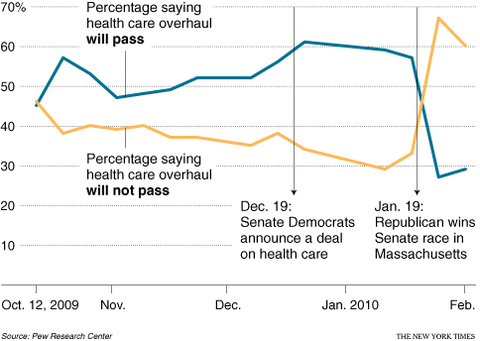
From the NYT health care blog. Interesting little bounce. The whole thing looks like my general mood these past few months.
A reader writes:
Yglesias and Bunch are each correct in different ways, but Yglesias has the better argument here. Bunch, willfully or not, ignores the fact that while the intellectual property laws — and this goes beyond music and even beyond copyright into patent law — were intended to protect the creation of intellectual property, they have come to be used largely to protect the distribution of intellectual property. At some point in the life of a creation — and we can have a legitimate argument about when that point is reached — the distribution of a work becomes divorced from its creation.
The record companies' problem is that technology — the internet on the distribution side and the laptop and other personal recording technologies on the creation side — has made the record company's traditional role as financer and distributor of works increasingly irrelevant. They are using the intellectual property laws to protect a distribution model that is largely outdated.
But to the issue of an artist's profits: Bunch argues, correctly, that "artists . . . have a right to profit from their labors." But here, too, he cuts his analysis off at a point that is convenient for his argument. What "profit" is reasonable for an artist? He, and certainly the record companies and the artists, seem to base their arguments on the assumption that artists, and in many cases their successors, have a right to live exclusively off their works.
This assumption needs to be examined because it treats the intellectual property laws solely as an incentive to lay one golden egg. If as an artist I can garner outsized profit from one work, how does that provide an incentive to create additional works? If my successors can live exclusively off the profit of my work, what incentive is there for them to create ANY artistic work? Why does an artist need to be so well compensated that as a society we ask that he does no other productive work? One can name many, many artists — Wallace Stevens comes immediately to mind, but there are countless others – who created great art while making a living doing other things. Contrast Stevens's life with, well I won't name anybody, but the artist who creates one good, maybe great, work and then spends his time living off royalties and sleeping with starlets. This is defensible on moral or economic grounds?
Another writes:
I just wanted to weigh in on the budding IP debate to say that anyone who takes a firm stand on the specific meaning of IP law doesn't really understand IP law. Copyright, patent, and trademark law all serve different purposes, and have different statutory regimes precisely because the issue is multifaceted, complex, and must meet various and sometimes opposing interests. Conflating three separate legal regimes as "IP law" can make arguing about it's purpose inherently impossible.
For instance, Yglesias points to the Constitutional requirement that the protection be for a "limited time." Well, over the last 200 years as IP laws have evolved, we've decided that "limited time" means something very different in patent law and copyright law. Patents generally last for 25 years, copyrights last for the life of the author plus 75 years (this is a gross simplification, but good enough for our purposes). Patents cover inventions that increase our standard of living and move society forward. The inventors of those things should be protected, but only for a short time; after that society as a whole should be allowed to benefit from the increased utility of the technology's wide dissemination.
More to the point, copyright law protects expression — the words or notes an artist uses in creating his work. Though I agree with him on many things, Yglesias is wrong here. Copyright law is very much in the business of protecting the rights of the author. That's why a copyright term lasts so long (copyright terms have been increasing steadily over time, indicating that we are becoming more and more concerned with protecting authors as time goes forward). That's also why copyright protects such a wide range of expressions and has so few formal requirements for securing one. Our copyright scheme is actually quite expansive in its protection of producers' interests.
One could say, as Yglesias does, that copyright protects consumers, but only with very roundabout logic: copyright incents producers to produce copyrightable works, and that allows consumers to consume those works, thus protecting their interest in listening to music, etc. It's much more logically satisfying to accept the basic truth and say "copyright law protects an author's interest in his copyrightable works," and then derive whatever ancillary benefits you want from there.
 The Dish