Blair’s Journey

by Alex Massie

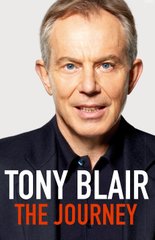
S320x240I know you're not supposed to judge a book by its cover but since we don't know what's actually in Tony Blair's memoirs the cover and title is all we have.

And, geez, it looks like the kind of autobiography normally written for American Idol contestants or B-list celebrities publicising their confessions on daytime television. I mean, "The Journey", really? 

Well, you know, I'd just like to thank you Simon, and the other judges, for being able to share this journey with you. It's been an incredible ride! I think we've all, like, grown during this process and I'm just so excited to have been a part of it. You guys are the best! And, you know, thanks too to God for making it all possible. You're always in my heart big guy. Couldn't do it without you.

Somehow I doubt that's how Blair sees it but, since there's always been something of the showman about Blair, who knows?

Incidentally, the book is being published in September; right around the time when Labour may be enduring a leadership election.

Quote For The Day

by Chris Bodenner

"The ethos of the bar is built on the idea that lawyers will represent both the popular and the unpopular, so that everyone has access to justice. Despite the horrible Sept. 11, 2001, attacks, this is still proudly held as a basic tenet of our profession. … Patriotism is believing that the American system, not whim and insult, will reach the right results," – Ted Olson, former solicitor general under Bush and Cheney, writing in the January 2007 issue of Legal Times.

Polling Health Care

by Patrick Appel

Frank Newport compares current polling on health care reform to 1960s polling on Medicare:

Although support for Medicare fluctuated, it appears to have engendered at least a plurality margin of approval in contemporaneous Gallup polls. Most current polls measuring new healthcare legislation find at least a plurality opposed.

Awhile back Seth Masket argued that polls are not a very good way to judge this issue:

Health reform is tremendously complex and the media don't do a great job reporting on it substantively.  Opinion polls on the subject are highly sensitive to issues of question wording and ordering.  If you want to know whether people approve of the job Obama is doing or for whom they intend to vote in the next election, polls are pretty reliable.  But for this subject, it's just not terribly revealing.

Looking Back II

by Jonathan Bernstein

Marc Ambinder — and by the way, I think he's a terrific reporter, and I'm enjoying being down the virtual hall from him even though I'm taking issue with this particular post — also says that the revival of health care reform is a "perfect storm," and in particular points to the Bunning filibuster and (in what he considers "perhaps the largest single current") the massive premium increases proposed by insurers this winter.  Ezra Klein responded with a tweet:

I think when we write the stories, Bunning and Wellpoint will figure in. But I don't think they were truly important.

Which is correct?  The reason this interests me is because of the relationship between causal analysis and storytelling.  For the former, the structural analysis is the "right" answer in this case.  Here's Jonathan Chait, the day after the Massachusetts Senate election:

Here is what I think will happen. The shock and panic will play itself out over a few days. Then the Democrats will assess the situation and realize that letting health care die represents their worst possible option. And then they will make a deal to pass the Senate bill through the House. I am not positive this will happen, but it's my bet, because elected officials at the national level, dim though they can be, are usually shrewd enough to recognize their political self-interest.

In the meantime, the display of hysteria is actually disgusting.

And lo and behold, that's pretty much what's happened.  They may not pass the bill, but they're pretty much where they were on New Year's Day, with the only significant difference being the structural issue that they need to use a "pass and patch" procedure instead of just agreeing to a bill and getting a majority in the House and 60 in the Senate.  The underlying situation, and not the emotions of the moment, are what matters.

But it's also true that, whatever the underlying structure that can push people in certain directions, those who are actually living through it don't feel as if they are being irrational one day, and then rational the next.  The events and experiences along the way feel as if they're influencing us.  What's really happening, however, is that we interpret those events and experiences in ways that are consistent with, in the case of politicians, their political interests.  So Democrats who have a (collective) electoral incentive to pass a health care bill, and in many or most cases also have a personal preference for action on one of the core issues of the Democratic Party for decades, are apt to interpret something like the premium increases as a signal to refocus on health care reform.  Democrats who have been frustrated by Republican tactics in the Senate were ready to pounce on the Bunning filibuster as another sign that it's okay to act in a partisan way.*  I don't quite want to say that if those events hadn't happened along that others would have automatically substituted for them (although it's clear that there are no shortage of either insurance company problems or Republican partisan actions), but the odds were pretty good that something would serve that role.  At the same time, anyone who wants to tell the story as the participants lived it should certainly include these details…the trick, as far as I'm concerned is to be careful about causal claims.

So: yes, the basic structure of the situation was very likely to drive Democrats to try to pass the bill even after the Massachusetts Senate results, but the way that it happened will involve these sorts of stories.

*One caveat: as far the particular stories, I'm not sure I see Ambinder's point on Bunning, which came after the summit and took place in the Senate, while the action here is in the House.  If, however, he thinks that Bunning is part of the story of marginal Democratic Members of the House getting to yes (as opposed to the choice by Pelosi, Obama, and others to move forward at all), then he may well be correct.
Palin In Cedar Rapids

by Chris Bodenner

While Palin's second book is already underway, her first one is still getting fact-checked. From the Iowa Independent:

In her book, “Going Rogue,” Palin briefly discusses the visit to Cedar Rapids as follows: “… Jason, Jeannie and Bexie were there at one of our first campaign stops after the convention, a stop I’ll never forget. It was at a rally in Cedar Rapids, Iowa. The town was a slice of Americana, with its quaint town square with mom-and-pop stores; red, white and blue bunting; moms and dads; kids in strollers; seniors; and people of every color. …”

Except that "slice of America" was still recovering from the most devastating natural disaster in the state's history. The Independent concludes:

Sarah Palin's description … can only be described as fiction. The campaign event was held at the airport, and there was no quaint town square with patriotic bunting in the wake of massive 2008 floods.

Cameron Receives an Endorsement

by Alex Massie

It's poor form for foreign leaders to intervene in other countries' elections. Nevertheless, this doesn't stop them from doing so. In other circumstances David Cameron might be pleased by this verdict from a veteran statesman:

We have always related better with the British through the Conservatives than Labour. Conservatives are bold, (Tony) Blair and (Gordon) Brown run away when they see me, but not these fools, they know how to relate to others. We have a better chance with David Cameron than with Brown.

Apart from the unfortunate, less than wholly-diplomatic "fools" bit that sounds good! Except, alas, that all this means is that Dave has secured the vital Robert Mugabe endorsement.

Then again, there are plenty of people in these islands who might agree that even an old brute can be right sometimes:

Blair is a downright liar, utterly dishonest, hypocritical.

Next week: Labour are endorsed by Kim Jong-Il…

Von Hoffman Award Nominee

"Visionaries see a future of telecommuting workers, interactive libraries and multimedia classrooms. They speak of electronic town meetings and virtual communities. Commerce and business will shift from offices and malls to networks and modems. And the freedom of digital networks will make government more democratic. Baloney. Do our computer pundits lack all common sense? The truth in no online database will replace your daily newspaper, no CD-ROM can take the place of a competent teacher and no computer network will change the way government works," technology writer Clifford Stoll, in a 1995 Newsweek piece entitled, "The Internet? Bah!"

(Awards glossary here.  Hat tip: GovExec)

Against School Choice

by Patrick Appel

Diane Ravitch, formerly a major proponent of school choice, has changed her mind. Her new book is The Death and Life of the Great American School System. The argument:

I realized that I am too "conservative" to embrace an agenda whose end result is entirely speculative and uncertain.  The effort to upend American public education and replace it with something market-based began to feel too radical for me.

Tyler Cowen's review:

Overall it is a serious book worth reading and it has some good arguments to establish the view — as I interpret it — that both vouchers and school accountability are overrated ideas by their proponents.  (Short of turning the world upside down, some school districts will only get so good; conversely many public schools around the world are excellent.)  But are they bad ideas outright?  Ravitch doesn't do much to contest the quantitative evidence in their favor.  There are many studies on vouchers, some surveyed here.  Charter schools also seem like a good idea.