The Man Who Broke Into Auschwitz

by Alex Massie

Sometimes it's useful to be reminded that our generation has it pretty damned lucky. A remarkable story, even by the standards of a war full of remarkable stories. From the Times today:

Denis Avey, even at the age of 91, cuts a formidable figure. More than 6ft tall, with a severe short back and sides and a piercing glare, he combines the panache of Errol Flynn with the dignity of age. This is the former Desert Rat, who, in 1944, broke into — yes, into — Auschwitz, and he looks exactly as I expected. He removes his monocle for the camera, and one of his pupils slips sideways before realigning. It is a glass eye. I ask him about it. He tells me that in 1944, he cursed an SS officer who was beating a Jew in the camp. He received a blow with a pistol butt and his eye was knocked in.

[Having been captured in North Africa,] Avey was a troublesome prisoner. In the summer of 1943 he was deported to Auschwitz, in Poland, and interned in a small PoW camp on the periphery of the IG Farben factory. The main Jewish camps were several miles to the west. “I’d lost my liberty, but none of my spirit,” he says. “I was still determined to give as good as I got.”

But he knew immediately that this was a different order of prison. “The Stripeys — that’s what we called the Jewish prisoners — were in a terrible state. Within months they were reduced to waifs and then they disappeared. The stench from the crematoria was appalling, civilians from as far away as Katowice were complaining. Everybody knew what was going on. Everybody knew.”

Remarkably, Avey was able to think beyond the war. “I knew in my gut that these swine would eventually be held to account,” he says. “Evidence would be vital. Of course, sneaking into the Jewish camp was a ludicrous idea. It was like breaking into Hell. But that’s the sort of chap I was. Reckless.”

[…] Avey shaved his head and blackened his face. At the allocated time, he and the Dutch Jew sneaked into a disused shed. There they swapped uniforms and exchanged places. Avey affected a slouch and a cough, so that his English accent would be disguised should he be required to speak.

“I joined the Stripeys and marched into Monowitz, a predominantly Jewish camp. As we passed beneath the Arbeit Macht Frei [work makes you free] sign, everyone stood up straight and tried to look as healthy as they could. There was an SS officer there, weeding out the weaklings for the gas. Overhead was a gallows, which had a corpse hanging from it, as a deterrent. An orchestra was playing Wagner to accompany our march. It was chilling.”

They were herded through the camp, carrying the bodies of those who had died that day. “I saw the Frauenhaus — the Germans’ brothel of Jewish girls — and the infirmary, which sent its patients to the gas after two weeks. I committed everything to memory. We were lined up in the Appellplatz for a roll call, which lasted almost two hours. Then we were given some rotten cabbage soup and went to sleep in lice-infested bunks, three to a bed.”

The night was even worse than the daytime. “As it grew dark, the place was filled with howls and shrieks. Many people had lost their minds. It was a living hell. Everyone was clutching their wooden bowls under their heads, to stop them getting stolen.” Lobethall had bribed Avey’s bedfellows with cigarettes. “They gave me all the details,” he says, “the names of the SS, the gas chambers, the crematoria, everything. After that, they fell asleep. But I lay awake all night.”

The whole thing, as you can see, is worth a few minutes of your time and a reflection that, despite everything and the daily temptations to think differently, this is a vastly better, happier, gentler world than that into which our grandparents were born and subsequently fought.
On Douthat’s Call for Candidates

by Jonathan Bernstein

Ross Douthat says that "when non-politicians who actually know something about policy — be they political journalists, think-tankers or public intellectuals — get involved in government, it’s almost always as spokespeople, speechwriters and policy advisers, rather than as actual candidates for office"

[T]here’s certainly no current American equivalent of Britain’s Boris Johnson, the magazine-editor-turned-Tory M.P.-turned-Mayor-of-London — or Michael Ignatieff, the historian, essayist and academic who’s now the leader of Canada’s Liberal Party.

I'm all for people getting involved in politics as politicians — I think we undercelebrate politicians as heroes of democracy — but I think Douthat needs to look around a bit.  Parochially speaking, he could start with the political scientist and Member of the House David Price (D-NC), who is currently Chair of the Appropriations Subcommittee on Homeland Security.  Indeed, there are twenty-three Members of the current House who hold a Ph.D., although the CRS doesn't detail what their fields are.  I can't say that I'm as impressed as Douthat is with former history prof and Speaker Newt Gingrich, but if you like people with an academic or semi-academic background, there are plenty in Congress. Alas, CRS doesn't have a breakdown of how many of them were think-tankers, how many were professors, or what other careers they may have had before politics…I'm not remembering any other political scientists off the top of my head, but there are a lot of very well-educated people. 

If, however, Douthat is looking for something a little more media-oriented, CRS reports that at least one current Member is a former talk-show host, and another was a television commentator (and I think .  Douthat is no doubt also thrilled that public intellectual J.D. Hayworth is resuming the politician portion of his career, after an involuntary return the media).  I say "at least" one current talk show host, because I don't think that CRS included Al Franken, so that would make two.  

And, you know, I'm sorry about doing this, but there's no way around it — there is one more pol…there's a guy who used to teach law school, and wrote an acclaimed memoir.  You know, a real book, the kind real authors write, although perhaps not quite as serious as these fine examples of American snake-oil salesman statesmanship.  Granted, it does make Douthat's point: I think we would be better off with a few more Barack Obamas in American politics.

What To Do In Afghanistan

by Patrick Appel

Emily Hager reports on a speech by Ahmed Rashid, who Tom Ricks calls "the single best journalist on the Afghan war and on Pakistan as well":

Given the pressure to end the war coming from Western countries, Rashid believes a true defeat of the Taliban will be impossible — so he stressed that efforts towards serious negotiation should begin now. The key partners, he said, can only be the Afghan government and the Taliban. 

Why would the Taliban go for a negotiated solution, with the Western withdrawal date practically set on the calendar? First, Rashid said, the Taliban is tired. They are using forced conscription when they go into some villages in Afghanistan — a sure sign of recruitment troubles. Second, unlike the Soviets, Western forces will not abandon Afghanistan in one day. As long as there are some Western forces in the cities, the Taliban will never take them because NATO firepower is so overwhelming. That means a military takeover by the Taliban would still be far off, even if Western forces began to withdraw. Third, the Taliban has been dependent on — and manipulated by — Afghanistan's neighboring countries for years. Rashid believes the Talibans are getting tired of what he called those countries' "micromanagement." By heading to the negotiating table, the Taliban might get a chance to put their demands first.

Michael Foot, 1913-2010

3417159

by Alex Massie

Generally speaking it's not good news when your election manifesto ends up being described as "the longest suicide note in history". That was Michael Foot's fate in 1983, however. Foot, who died today aged 96, now seems to belong to another age entirely. If he's remembered for Labour's disastrous defeat in 1983 in which the party came close to being beaten into third place by the fledgling SDP-Liberal Alliance, then that's less than he deserves.

As the tributes paid to him today attest Foot was a man and a politician one could admire regardless of one's own political preferences. A great parliamentarian and political orator, he was a very English kind of romantic radical, steeped in history and literature (and thus here too rather different from many of our modern breed of politicians); Byron, Hazlitt, Shelley and Swift were some of his heroes.

And actually, when you look at some of the policies advocated by that infamous Labour platform in 1983 it's startling to think that, as Labour promised then, the government does now own some of the largest banks, nuclear disarmament (or at least reduction) is back on the agenda (in Washington anyway) and the idea of witdrawing from the European Union remains alive and a vociferously held, if minority, view. Perhaps politics really is a cyclical business that runs on irony.

So, albeit without the threat of war, is the issue of the Falkland Islands. Foot's furious denunciation in the Commons of the Argentine invasion helped prevent the Labour party from an even worse, potentially terminal, defeat in 1983. The massacre would have been much worse but for that initial, robust stance. Not that Foot's position should have surprised: he had, after all, been one of Neville Chamberlain's fiercest critics.

Foot did his party, and thus the country, another service: he prevented the wholesale takeover of the Labour party by the hard left. A takeover, which if successful, could also have destroyed the party for good. The price of all that feuding was that he was the leader of a more or less unleadable party but, viewed all these years later, the beginnings of Labour's long-haul back to respectability began with Foot's holding the soft-left just about firm enough to withstand the challenge from the hard-left. It was a close-run thing, mind you.

Above all, he was, and remained to the end, a decent man with whom it was possible for opponents (on the right anyway, if not always on the left) to have honest and respectful disagreements. He was, in other words, what a parliamentarian should be.

Among the tributes and reflections paid today, these from Alastair Campbell, Jon Snow, Dan Hannan  Danny Finkelstein and John Rentoul are especially good.  The Telegraph's obituary is here and the Times's here.

Finally, here is Foot in 1942 (three years before he entered parliament) when he was Acting Editor of the Evening Standard and speaking in defence of the Daily Mirror's right to criticise Churchill's wartime government. It's rather good and a biting piece of mockery. Liberty, even in wartime, you see, matters. (The Mr Morrison referred to is Herbert of that ilk, grandfather of Peter Mandelson, the current Business Secretary):

Colbert Bait

by Chris Bodenner

The Catholics get their own atone phone:

A 'pay-to-confess' telephone hotline for Catholics too busy to go to church has been condemned as 'utterly unacceptable' by bishops in France. The service – called the Phoneline to the Lord – charges users 30p a minute to confess their sins to an automated answering machine.

(Hat tip: Balk)

Lying On Leno

by Chris Bodenner

Sarah Palin talks to Jay Leno about the "Family Guy" controversy:

"I commented and then that gets out there in the blogosphere, it gets out there in the different forms of the mediums that we have today. And then it’s left there, not an opportunity for me to follow up and kind of elaborate on what I really meant and what I really thought of the thing.” Before Mr. Leno went to a commercial break, Ms. Palin said that a fuller opportunity to discuss the incident would have led to a “much healthier dialogue.” After the commercial, she did not expand on her remarks.

The New York Times had previously sought comment from Ms. Palin about the “Family Guy” episode and Ms. Friedman’s response to her, but neither her press representative nor her political action committee replied to requests.

And for the record: After Palin Facebook'd her comments on a Tuesday morning, "The O'Reilly Factor" – the highest-rated cable news show on televisiongave her 5 minutes to elaborate that evening.

Future of Public Option Update

by Jonathan Bernstein

Bill Halter is probably not going to be the next Senator from Arkansas.  He'd have to knock off an incumbent (Blanche Lincoln), which would be I think a fairly surprising upset, and then he'd still be a longshot in the general election — Arkansas isn't an especially friendly place for Democrats these days.

That said, by endorsing the public option he's providing useful evidence that a future Democratic Congress is very likely to add a public option to health care reform, or at least they will if the current Democratic Congress manages to enact health care reform this year. 

In fact, I expect virtually every Democrat in contested primaries during this and (if still not enacted) the next campaign cycle to support the public option, at least in any district in which Democrats have a chance to win.  The main exceptions will be incumbents such as Lincoln who already voted against it…and I won't be shocked if she switches.  In a Democratic primary, I don't see any potential downside.  Liberals love it, and for better or worse Democrats don't believe that it will be a general election liability.  

The other part of this is that the public option should be eligible for a reconciliation bill, so it won't take sixty Democrats to get it done.

So for all you public option fans out there: it ain't gonna happen this year, but if the Democrats hold Congress there's a good chance that it will be law by the time the exchanges are up and working.  Assuming, of course, that the bill passes.

Body As Touchscreen

Skinput

by Chris Bodenner

Way cool:

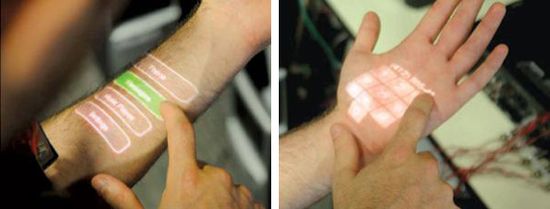
Called Skinput, the system is a marriage of two technologies: the ability to detect the ultralow-frequency sound produced by tapping the skin with a finger, and the microchip-sized "pico" projectors now found in some cellphones. The system beams a keyboard or menu onto the user's forearm and hand from a projector housed in an armband. An acoustic detector, also in the armband, then calculates which part of the display you want to activate.