How Can We Keep Religion Out Of Politics?

by Patrick Appel

Freddie responds to this Dish reader. A part of Freddie's rebuttal that I find convincing:

Let's talk tactics, shall we? This emailer with the terrible reading comprehension and I have as a first goal the same thing, which is keeping religious conviction out of politics, science and medicine. The history of the world teaches us that this is best accomplished not through atheism but through religious moderation. This is something many atheists must come to grips with if they are ever going to grow up: religious moderates do a far better job of opposing extremists than atheists do.

Look, aside from all of the "American theocracy" hysterics, this country does quite a good job of keeping the secular and the religious separate. There is much work to be done, but this is not Saudia Arabia, it is not Yemen. And why? Not because of atheism, but because of moderate religious people who have worked to divide theology from governance for centuries. When people express incredulity at the idea that people can both be practicing and religious and yet function in a secular society, I wonder what world they live in. Here on Planet Earth, in America, you interact with such people every day. They seem to have no trouble with it whatsoever.

Look to the Muslim world. Indonesia is the largest Muslim country in the world. It has a significant Muslim minority. And yet it also has significant Christian, Hindu and Buddhist minorities that live quite unmolested. Women wear pants, work in public, vote, hold office. Why? Not because some tide of atheism swept through Indonesia, but because of religious moderates embracing Enlightenment values and liberal democracy. I assure you, the large majority of these people are devout. They simply see no conflict between their religious devotion and their participation in civic life.

Another forceful point:

Which do you think is easier? To convince someone who has religious faith to totally abandon that identity? Or to convince them of the righteousness of dividing it from political life? Elementary human psychology teaches me that the more you attack the fundamental basis for someone's worldview, the more likely you are to earn violent pushback as a result.

The full post is here. Freddie writes that my reader's "strawmanning is so intense I'm shocked Patrick Appel posted it." I agree with Freddie that this reader badly misread his post, and I should have said as much at the time of posting. I certainly don't endorse this reader calling Freddie's thinking "childishly bad." Andrew Stuttaford, who largely concurred with Freddie, wrote that an "important qualification [to Freddie's post is]  that I do spend quite a bit of time pondering the implications of religious belief (to start with, there’s that whole rise of militant Islam business to think about)". Given that both my reader and Stuttaford responded in this fashion, I thought it prudent to air the argument in order to clarify the debate.
A Mechanical Mozart, Ctd

by Patrick Appel

A reader writes:

As a classical concert pianist, I was depressed to read your posting about computer-generated classical music “every bit as good as the originals.” For starters, it wouldn’t hurt to be suspicious of qualitative aesthetic statements posing as scientific assertions — Which originals? Good in what sense? According to whom?

I took a listen to EMI’s “Symphony in the Style of Mozart” and “Sonata in the Style of Beethoven.” Give me a break. Did you ask any professional musician friends to weigh in on this story before you linked to it? The Beethoven is a pale (and obvious) rip-off of the “Moonlight” Sonata, with the harmonies reconfigured. The Mozart is a inspiration-free classical style exercise, scales and harmonies in place, but absolutely none of the delicate synthesis of opposites and quirks that characterize Mozart. EMI (and Cope) are rearranging deck chairs on the ships of giants. It so happens that some aspects of the High Classical Style (1770-1820ish) lend themselves well to algorithm and mathematical understanding, especially in hindsight; but of course not all, and that last bit…well…it’s kind of important. To say that these are “as good as the originals” is silly, like saying a EZ Bake Oven is just as good as a Viking Range.

Unfortunately, we know stovels better than we know music, as a whole. It doesn’t prove anything that some audience members cannot tell the difference between EMI and Mozart: the type of thinking about Bach, Mozart, Beethoven that is required to appreciate their real inspirations, their profound shocks, their revolutions in tones: many audience members aren’t there, in the same way (for instance) that many people–myself included–cannot fathom all the nuances of health care policy. They recognize a certain sound and stylishness, in the same way many people respond to superficial talking points.

The Blitstein article you link to is full of dubious and inaccurate music-writing. For instance, talking about the nature of the composing process:

"…the most likely explanation, Cope believes, is that music comes from other works composers have heard, which they slice and dice subconsciously and piece together in novel ways. How else could a style like classical music last over three or four centuries?"

Well, the first bit of this quote is simply Musicology 101. Really, composers take things they have heard and rework them in novel ways?!? This is not a revelation, or a belief; it is just an obvious fact of any kind of writing (music, text) or any creative process at all. And the second bit of this quote— “a style like classical music”—made me want to stick a fork in my brain, made it obvious that the writer is (to put it politely) not knowledgeable about what we call classical music (for want of a better term). What style are you talking about? The style of Mozart? Or the style of Tchaikovsky? Or Josquin? We’re talking about hundreds of years of humans notating music, the massive Western heritage of humans communicating through music; it is not remotely a single style, it is an incredible evolving kaleidoscope of style and thought, even though it all basically gets dumped in the same section in the modern record store (such as it is).

Let’s concede the point that the human notion of originality has some element of cult in it, and some portion of what we call the creative can be easily simulated by the modern computer. It is fascinating to see what elements of creativity computers can ape, or hasten. But, Daily Dish, don’t aid and abet journalists who want to dupe us with naive broad-brush statements; why not have a real musical expert talk about EMI or Emily Howell? I notice a conspicuous absence of fellow musicologists or musicians in the Blitstein article, people who have devoted their lives to studying Mozart, Beethoven, etc. How come he didn’t talk to (for instance) Charles Rosen or Joseph Kerman or Richard Taruskin? I think the answer is obvious. The writer is nervous that the “hook” of the article (The Computer Mozart!!!) would be revealed as the total BS that it is.

Stuck

by Jonathan Bernstein

Barack Obama's approval rating today, according to Gallup, is 50%. 

Obama first hit 50% in Gallup's August 24-26 poll.  He bounced up against 50% several times, finally falling below that mark on November 20.  But instead of continuing to fall, he's just stuck.  Right around 50%.  Since the first time he hit 50% in August, his high is 56%; his low is 47%.  He has, as Pollster's invaluable chart makes clear, dropped a couple of points or so since mid-August, but that's about it, and it looks as if he's been just flat since around Thanksgiving.  Three months flat.

This seems fairly unusual to me: over three months with a total seven point range (47-53), and over six months with a ten point range (47-56). Let's see: OK.  Bill Clinton spent almost all of 1998, over ten months, between 60 and 66 on the Gallup scaleGeorge W. Bush had one long period of stability, ranging from 46 to 55 over about 12 months beginning in January 2004.  And then another from October 2006 through April 2008, he had a low of 29% and a peak of 38%. On the other hand, that was before Gallup started their daily tracking poll; it's fairly likely that with more polling that Bush or Clinton would have had a few outliers and the observed range would have been larger.  Going back in time only makes the frequency problem worse.  Gallup is now reporting more or less thirty polls a month, or the same number in a month now as it reported for all of 2006, and a bit more than all of 1996.  In 1986, Gallup only released thirteen presidential approval polls, all year.  So one can't really compare Obama's narrow range this year to, say, Reagan's plateau from fall 1985 through fall 1986, at least not well. 

Overall, however, and looking at these graphs as well, it does seem to me that this is a fairly unusual period of stability.  I shall conclude by making absolutely no prediction whatsoever about how long it will last, which direction he'll head next, or what will cause the eventual change, except for one thing: if Congress does pass health care reform, it will not cause his approval rating to plummet — and if Congress abandons health care reform, it will not cause his approval ratings to surge. 

Liberals and Atheists Are More Intelligent?

by Patrick Appel

A study (pdf) has found that monogamy (only in men), liberalism and atheism are correlated with IQ. PZ Myers isn't buying it. Joyner exercises appropriate caution:

The causality issue aside, the correlation seems to remain. But let’s not get terribly excited about what all this means. The vast majority of Americans — including high IQ Americans and well educated Americans — are religious. For that matter, the vast majority of Americans — including those of below average intelligence — are in monogamous relationships or strive to be. We’re talking about small differences in aberrant behavior, not a chasm.

It’s also noteworthy that the correlation is between intelligence measured at adolescence and ideology, religiosity, and monogamy as young adults.  It would be interesting to see if the correlation strengthens or fades with time. This particular cohort is being studied on through 2002; I don’t know if they’ll continue to be tracked.

Ilya Somin levels further criticism.

Anti-Gay Rhetoric And Unit Cohesion

by Chris Bodenner

Tony Perkins was disinvited from speaking at a national prayer luncheon on Andrews Air Force Base because the Chaplain's Office felt his outspoken opinions against gay servicemembers would not be "inclusive for the entire base community." Queerty sympathizes with Perkins' right to speak his mind, but:

The military is not civilian life! It is not a place where everyone gets an equal vote! It is not a place where personal freedoms are valued above unit cohesion! That's something defenders of DADT keep repeating in our ears and down our throats as a reason why, when gay soldiers voluntarily enlist, they are signing up to keep quiet about their sexuality.

Allahpundit, on the other hand, calls the disinvitation a "disgrace."

No Time for David Cameron to Go Wobbly

by Alex Massie

Hello everyone and many thanks to Andrew for the invitation to help mind the store while he takes a well-deserved breather. My day blog is at The Spectator but it's nice to moonlight occasionally…

The big news here in Blighty is the Tories vanishing lead in the opinion polls. As recently as December David Cameron enjoyed a 13 point lead; yesterday a poll was published that had the Tories on 37% of the vote and Labour on 35%. Since, thanks to the quirks of the current constituency boundaries, the Tories need to win by six or seven points to secure a majority, this result, if repeated at the election, would actually give Gordon Brown a victory that once seemed impossible.

The good news is that this means the election is going to be more interesting than once seemed likely. A betting man should still favour Mr Cameron, not least because the underlying fundamentals remain in his favour. So what's caused the Tory wobble? A mixture of complacency (a traditional Tory vice) and confusion, principally. What are the Tories really for? I wrote about this for the Daily Beast yesterday and Iain Martin has a measured judgement on the rallying call Cameron delivered to the Tories' Spring Forum yesterday:

David Cameron went to his party’s spring forum in Brighton with a rather serious problem. His poll lead has melted. His party’s campaign since the start of the year has been incoherent and ineffectual. Thus, once again the Tory leader found himself required (by dint of his own recent miscalculations) to make a big speech aimed at starting a fight back.

How did he do? It’s had some rave reviews, but I must admit that as a whole I thought it quite mixed in quality. Yes, parts were pretty punchy and fiery, with flashes of passion that suggest he’ll fight hard in the campaign proper. Overall, though? “Good, but not really great,” was how one friend of Cameron’s put it. That’s probably a fair summary.

Where it did work for him was in the delivery of clear messages in a very straightforward fashion. This is what Labour has understood brilliantly in its campaign so far (”take a second look at Labour, give the Tories a long hard look”). Elements of the Tory high command seemed to think they could get through a campaign without doing their version of the obvious stuff that works and wins in democratic elections. Instead, what they ended up with in the last seven weeks was a confusing cacophony with no easily understood story voters could comprehend.

The shrinking gap with Labour does seem rather to have energized Cameron, to have made him realize anew that he is actually in a fight. As a consequence, the Tory campaign seems a bit more disciplined and clearheaded in the last 48 hours. He’s decided to fight back by presenting the election as a straightforward choice between “five more years of Brown and change with Cameron.”

Quite. The Tories began the year with the slogan "We Can't Go On Like This" and, yup, finally they seem to have realised that this messge is equally applicable to their own faltering campaign. Time for Dave and his boys to get their game faces on. With just nine weeks to go before the likely May 6th election this is no time for mucking about.

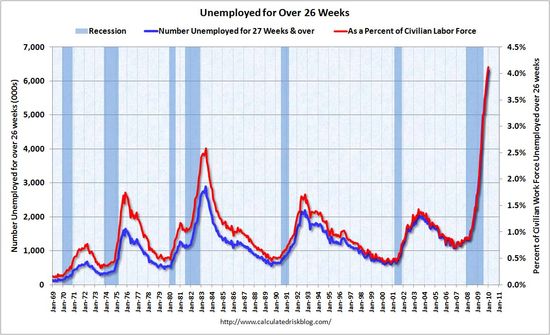
Chart Of The Day

UnemployedOver26Weeks
 
by Patrick Appel

From Calculated Risk:

The blue line is the number of workers unemployed for 27 weeks or more. The red line is the same data as a percent of the civilian workforce. According to the BLS, there are a record 6.31 million workers who have been unemployed for more than 26 weeks (and still want a job). This is a record 4.1% of the civilian workforce. (note: records started in 1948).

Are Summits Here To Stay?

by Jonathan Bernstein

Via a tweet from Ezra Klein, Jon Alter gets enthusiastic about the summit:

The face-off set a teleprompter-free precedent that will be tough for future presidents or members of Congress to break. Now the skills required to chair a bipartisan gathering, master complex policy details, and adeptly summarize relevant arguments will be added to those of anyone seeking the presidency. Being quick and cogent in response will be part of any calculation of who should be House speaker or majority or minority leader. Having experienced one of these summits, the press and public will demand more. So savor the good news for the future: smarter presidents, smarter leaders on both sides of the aisle.

Ezra says that this is extremely optimistic; I think a better way to put it is that it's extremely backwards.  Presidents will create events that play to their strengths.  A Bill Clinton (remember the economic summit he held before taking office) or a Barack Obama will try to hold public events that reward deep knowledge of public policy and the ability to form coherent sentences on the fly.  A George W. Bush or a Ronald Reagan won't.  If a president with mastery of detail is successful in the White House, people will look for similar presidents; if a president with mastery of detail fails (think Jimmy Carter), then people will conclude (erroneously, but nevertheless) that mastery of details is a disadvantage in the presidency.  

(Oh, and as for being quick and cogent in response — yes, the president interacted with the others on the panel, but as far as I could tell everyone else spent much of the time giving canned talking points).

Meanwhile, as far as events like these are concerned, I wouldn't hold my breath.  Barack Obama and his White House will continue to look for events that show off his skills, but it's hard to imagine the particular set of circumstances that made this event a good idea for the White House, difficult to turn down for the Republicans, and relevant enough that the cable news networks carried it live to repeat itself.  Like it or not, it isn't going to become a regular institutionalized part of the legislative process.

The Weekend Wrap

We tracked coverage of the Chile earthquake here and here. Andrew is mostly offline for the week, but before signing off, he replied to Chait's latest response, countered Clive Crook on the clarity of torture, commented on British evangelicals, took stock of HCR in his weekly column, and criticized the Atlantic redesign (more scrutiny from bloggers and readers here, here, and here).

The Dish welcomes two new guest bloggers this week: political scientist Jonathan Bernstein and Atlantic globetrotter Graeme Wood. Jonathan discussed misunderstandings over public trust in government, pondered the implications of a third-party run by Crist, critiqued the NYT's explanation of the House's HCR strategy, evaluated the state of the filibuster, and wondered who in America has moral authority.

Graeme sounded the alarm over a wheat fungus, called out Sting for accepting millions from an Uzbek dictator, updated us on the Dubai assassinations, directed us to a dramatic tale out of Russia, noted the latest nuttiness from Qadhafi, chewed the cud over qat, and highlighted the horribleness of Haiti.

In assorted coverage, Reihan slammed Crist over his fiscal character, Menachem Kaiser went looking for small condoms, Nicholas Sautin theorized over amateur war footage, Ryan Sager studied the effects of vacation, Patrick pointed to a blind painter, and I featured a revolutionary archeological find.

— C.B.