Wired For Choice

Capuchin monkeys like change:

The implications of this simple experiment shed some light on consumer behavior, [Dan Ariely, the James B. Duke Professor of psychology and behavioral economics at Duke University] said. Earlier work on variety-seeking has found that people eat 43 percent more M&M candies when there are 10 colors in the bowl instead of just seven. "People choose variety for variety's sake," Ariely said. "They often choose things they don't even like as well just for the variety. We knew about this, so the interesting thing was to figure out how basic it is."

The Basics Of Protesting

TNC remembers the Million Man March:

I hear GOP folks and Tea Partiers bemoaning the fact that media and Democrats are using the extremes of their movement for ratings and to score points. This is like Drew Brees complaining that Dwight Freeney keeps trying to sack him. If that were Martin Luther King's response to media coverage, the South might still be segregated. I exaggerate, but my point is that the whining reflects a basic misunderstanding of the rules of protest. When you lead a protest you lead it, you own it, and your opponents, and the media, will hold you responsible for whatever happens in the course of that protest. This isn't left-wing bias, it's the nature of the threat.

Defending The Pope, Ctd

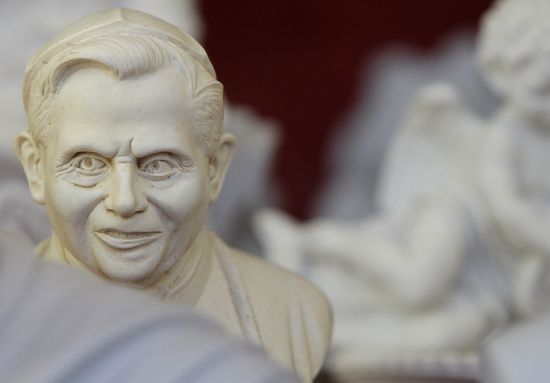
Cristina Odone argues that Benedict is being made into "the perfect scapegoat":

This Pope has done more than any other churchman to address the issue of priestly child abuse. He has stopped the practice of turning over  priests accused of abuse to therapists, as we now know that therapy seldom helps a paedophile. He has fast-tracked the defrocking of priests found guilty of abuse. He has promoted co-operation, at a diocesan level, between church authorities responsible for canon law and police. He can point to some real success in the protection of children: in England and Wales, for instance, child protection officers monitor every encounter between children and clergy. The result, is that, ironically, there is no safer place for a child today to be than with a Catholic priest.

But whom has he held actually accountable for child abuse and its cover-up? That's the test here. John Allen addresses several "misconstrued, or at least sloppily characterized," aspects of Benedict's role:

[H]ere's the key point about Ratzinger's 2001 letter: Far from being seen as part of the problem, at the time it was widely hailed as a watershed moment towards a solution. It marked recognition in Rome, really for the first time, of how serious the problem of sex abuse really is, and it committed the Vatican to getting directly involved. […] Beginning in 2001, Ratzinger was forced to review all the files on every priest credibly accused of sexual abuse anywhere in the world, giving him a sense of the contours of the problem that virtually no one else in the Catholic church can claim.

Allen's paper, the National Catholic Reporter, calls for a "full, personal and public accounting" from the pontiff.

The Daily Wrap

Today on the Dish we continued to focus on the Vatican unraveling. The NYT dropped another bombshell, Milwaukee's paper reported dark details, and Rome evaded any responsibility. Andrew turned up the temperature on Benedict and shared some of his own Catholic upbringing. The National Catholic Reporter also put pressure on the pontiff while Phil Lawler and a reader offered some context to the scandal. DiA and a reader marveled at the silence of theocon bloggers. A Wisconsin bishop spewed some cant, a reader pushed back against our post on the BBC documentary, and another differed with Andrew's lastest essay. More commentary from Joan Chittister and Amy Davidson.

We also concentrated on AEI's purging of David Frum. Reax here. Charles Murray savaged Frum, Mike Allen noted some inconvenient truths, and Bartlett stood by his cautious defense of David. A reader got the last word.

In other coverage, Allawi claimed victory in Iraq, we checked the pulse in Israel, Bibi apparently panicked, Obama got rowdy, and Andrew meep-meep'd. Pot-blogging here and here. More Google coverage here and here. Polling crack from Silver and Kos. Colorful rhetoric from Bachmann, Palin, and Newt.

— C.B.

The Context Of Priestly Child Abuse

A reader writes:

I agree with your anger at Benedict/Ratzinger. His reactionary policies have been damaging to the church and to everything that it touches. The role of his American allies in the U.S. debate over health reform was an unexpected demonstration of their power to interfere with our daily life in inflammatory and destructive ways. Moreover, like everyone else I have been horrified by the stories of children whose lives were ripped apart by clerical abuse. I readily accept your argument that such abuse was often the product of sexual repression. As a non-Catholic the lex continentiae strikes me as an obvious sham, with no support in the New Testament and such regular appearance in canon law, all the way up to Trent, that refusal to abide by it seems more like the rule than the exception. As if the Counter-Reformation was cooked up by continent men. I mean– Julius III!

All that said, everybody's rage at the hierarchy for their response to reports of child sexual abuse in the 1970s is totally anachronistic. As B.J. Nelson makes clear in his 1984 book "Making an Issue of Child Abuse" (University of Chicago Press) it wasn't even categorized as a matter for public policy, let alone a legal matter, until the Social Security Act began funding child welfare agencies in

1962.

This was followed by a 1967 Supreme Court decision (in re Gault) which extended the protection of the Bill of Rights to minors. It was during this five-year period that laws were first passed in all 50 states mandating that child abuse (including sexual abuse) be reported. But when Congress tried to pass Federal legislation Nixon vetoed the first attempt, saying that it "would commit the vast moral authority of the National Government to the side of communal approaches to child-rearing over (and) against the family centered approach." His position had overwhelming public support. National legislation on child abuse (sponsored by Walter Mondale) was not signed into law until 1974.

What all this points to is a bitter struggle between the American state and those of the church and other competing institutions, going on at the very moment that the molestations we are now reading about took place. The insistence of bishops on dealing with child abuse "in-house" was not only dictated by their pre-1960s conceptualization of the autonomy of the child, but were almost inevitable given their very accurate sense of a power play in the works. How could they possibly hand priests over to secular institutions that had defined, catalogued, and begun to litigate social boundaries in a way that fundamentally undermined their authority? Naturally they "swept it under the carpet," which is to say, treated it as a matter for penance, not prosecution.

Taking Obamacare as the logical conclusion of the Social Security Act, it seems amazingly providential that it came up for a vote in the same week that the news about Ratzinger broke. The bishops' stance on universal health care and their reactions to molestation in the 60s, 70s and 80s stemmed from exactly the same resentment: of Great Society programs that destroyed their hold over family law. So the apparently incomprehensible freakout of their allies in the Republican Party over the past few days begins to make a bit more sense. Mitch McConnell is proceeding from the same calculus as Archbishop Rembert Weakland when he covered up Father Murphy's abuse. There is a deeper game being played.

I'm not a moral relativist. I don't think the fact that community standards change over time, are the product of new laws and social measurements, and subject to bitter struggles, means they're meaningless. Nobody should be hurt like those children were hurt; since the church and other "traditional" institutions were promoting it, I'm proud that the American state stepped in. But we need to recognize social change for what it is, otherwise we can't understand the behavior of those whose values and institutional commitments we oppose. The bishops were proceeding under an old standard, which was replaced by the Great Society. It's the merits of these two *frameworks* that we should be debating.

This is getting totally lost in the personal denunciations of B16, and it's a real loss for our public discourse.
Malkin Award Nominee

"I think the Democratic leadership has to take some moral responsibility for having behaved with such arrogance, in such a hostile way, that the American people are deeply upset. So let’s be honest with this. This is a game that they’re playing. People should not engage in personal threats. I’m happy to condemn any effort to engage in personal threats. But I think the Democratic leadership has to take some real responsibility for having run a machine that used corrupt tactics, that bought votes, that bullied people, and as a result has enraged much of the American people. And I think it’d be nice for President Obama, Speaker Pelosi, and Majority Leader Reid to take some responsibility over what their actions have done to this country," – Newt Gingrich, asked about the recent death threats and vandalism leveled at Dem lawmakers.

Google In Space?

Bob Cringley insists that the company's revolt over censorship "makes no sense":

Google is going to have zero impact on China — zero — by abandoning that market, which Microsoft and Yahoo will gladly fill…Here’s a better approach for Google to take.

Stand in front of a bank of cameras and microphones my very impressive friend Tiffany Montague (Google’s link with NASA, keeper of the Google G-V parking spaces at Moffett Field, and internal space expert) to have her explain how Google is going to launch a satellite Internet service similar to one I described in a recent column, specifically to bring freedom of information (and advertising) to totalitarian regimes everywhere. The technology exists, Google could finance it, and China couldn’t stop it.

On Frum, Ctd

As the dust settles, a reader writes:

Basically, after all the non-sense of the past 24 hours, the story seems to be that Frum wanted to collect his $100,000 salary, but not come to the office, not work on or promote AEI events, not write pieces for AEI’s blog (though he founded and writes prolifically for his own), not contribute to the scholarship of other AEI scholars, and not mentor junior staffers – all things expected of AEI PAID scholars.

So he was offered a non-paid position that was more appropriate for his level of contribution, and he said no.