Why Stupak Matters

97922574

A reader writes:

I ran Bart Stupak's first re-election campaign in 1994, though I have only seen him once or twice since as my path led me out of politics and into corporate law. He's a protege of Rep. John Dingell, who has championed health care reform for half a century, a supporter of the labor movement, and a compassionate man.  He's both a good Democrat and a good Catholic.  He's a former state trooper and small town lawyer with a firm set of principles by which he lives his life. I suspect he's become more religious as age and life's tragedies have battered him and his family, but he could not be blind to the struggles of his friends and constituents in his rural, relatively poor Northern Michigan district.

There's nothing surprising about Bart's coming around to vote "yes."  He's a shrewd man — a lawyer — and I suspect the Executive Order solution was in the works for weeks, if not months.  And the timing was, quite simply, exquisite.

Bart's objections were maddening, but principled.  He conducted himself with dignity and firmness, never with vitriol.  His solution is imperfect, but reasonable.  I disagree with him on many issues, including abortion (how a liberal gay man found himself in Menominee, Michigan working for a pro-life, pro-gun candidate is a long story…), but Bart is, at heart, a decent man.  I was proud of him today.

And. The. Damn. Bill. Is. Passed.

Another writes:

A lot of people wanted Obama to "throw Stupak under the bus," but he didn't.  Obama won over Stupak.  He's a fucking genius.

Another:

Other than the sheer weight of this historic health-care moment, something even more significant may have transpired.  The Democratic party now is no longer the pro-abortion/pro-choice party, but the pro-life party as well.  Stupak will share the hero of the decade title with Obama for a while, and he's going to push into the public sphere the notion that pro-life matters for Democrats.

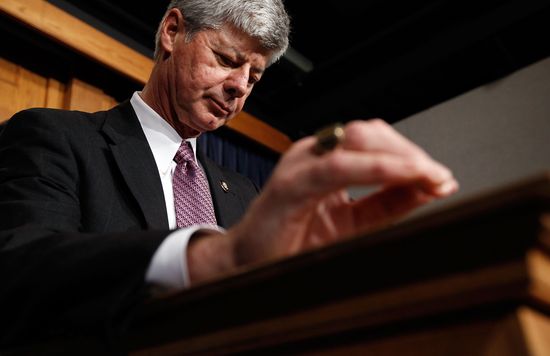
(Rep. Bart Stupak (D-MI) announces that he and other anti-abortion Democrats struck a deal with the White House and that President Barack Obama will sign an executive order guaranteeing no federal funding for abortion during a news conference at the U.S. Capitol March 21, 2010 in Washington, DC. Stupak said that with the support of the anti-abortion Democrats the health care reform legislation will pass the House of Representatives today. By Chip Somodevilla/Getty Images.)

Von Hoffman Award Nominees

"The health care bill, ObamaCare, is dead with not the slightest prospect of resurrection…. Democrats have talked up clever strategies to pass the bill in the Senate despite Brown, but they won’t fly…. ObamaCare went into the emergency room in Massachusetts and didn’t make it out alive." – Fred Barnes, Jan. 20, 2010. Yglesias pokes fun.

The Origin Of Sprawl, Ctd

Ryan Avent continues the discussion:

It is clearly true that some people prefer living in low density neighborhoods. Others prefer living in rural settings or small towns. Others prefer living in medium-density walkable areas, and still others like living in high-density neighborhoods with high-rises. It takes all kinds. What is clear from price data, however, is that there is unmet demand for walkable neighborhoods.

Homes in walkable neighborhoods are expensive, and not because those homes cost a lot more to build. Homes in safe walkable neighborhoods are really expensive. And homes in safe, walkable neighborhoods with good schools are mind-blowingly expensive. Some people prefer to live in low-density neighborhoods. Price data suggest that many, many others would love to live in walkable neighborhoods but simply can’t afford to, because it’s difficult to build them. If it weren’t difficult to build them, people would build them, because home prices are well above the cost of construction. This isn’t that hard.

Elections Matter

Jonathan Bernstein celebrates:

[O]ne of the things that makes politics hard for rank-and-file voters in the United States is just how impossibly large this nation is.  In a country of 300 millions, no matter what you do, it's often going to feel like it's a meaningless drop in the ocean.  And given the legislative process, time passes between campaigning and enacting bills into law, and by many people have moved on to other parts of their lives.  But individuals, and especially small groups of people, really can make a difference.  This battle over health care reform is one time when it wasn't just the lobbyists, or the interest groups, or the politicians…whole bunches of small groups of people, in states and Congressional districts across the nation, turned a handful of Senate races and a dozen or two House races around and, sixteen or so months later, their work is, today, most likely going to change the country.  If you're one of them, it's a day to be proud of what you've done.

AIPAC’s Moment Of Truth

Walt:

Speakers at the AIPAC conference will undoubtedly defend the special relationship and warn Washington against putting pressure on Israel. But this short-sighted approach would be a disaster for all sides. In her scheduled address to the conference, Secretary of State Hillary Rodham Clinton should reaffirm the U.S. commitment to Israel's existence but make it crystal clear that Washington will no longer tolerate Israel's self-defeating policy on settlements. She should explain unambiguously that Israel faces a choice: It can end the occupation, embrace a genuine two-state solution, preserve its democratic and Jewish character and remain a cherished U.S. ally. Or it can continue the occupation of the West Bank and the siege of Gaza — a course that will eventually force it to abandon either its Jewish character or its democratic principles, and jeopardize its standing with its most important partner.

The Weekend Wrap

This weekend on the Dish we rounded up reaction to the historic passage of the damn bill. Andrew's take here. More analysis from Andrew Sprung here and here.

In assorted coverage, Fareed Zakaria compared Netanyahu to Cheney, Pareene pegged Politico, and bloggers listed their favorite books. Andrew defended his conservatism to TNC commenters and highlighted a great poem. Dave Munger considered the personhood of pets, Jason Kuznicki thought over ex-gays, and Julian Baggini explained why the most sanctimonious people are often the worst among us. Get your Jonah Lehrer fix here and here. Cool ad here and creepy one here.

— C.B.

Blaming Gay Soldiers For Srebrenica

In case you missed this: testifying before Congress on DADT, retired US general John Sheehan raised eyebrows with the following exchange:

SHEEHAN: The case in point that I’m referring to was when the Dutch were required to defend Sbrenecia against the Serbs, the battalion was understrength, poorly led. And the Serbs came into town, handcuffed the soldiers to the telephone polls, marched the Muslims off and executed them. That was the largest massacre in Europe since World War II.

LEVIN: And did the Dutch leaders tell you it was because there were gay soldiers there?

SHEEHAN: It was a combination –

LEVIN: Did they tell you that?

SHEEHAN: Yes.

The Dutch are not pleased:

"It is astonishing that a man of his stature can utter such complete nonsense," Dutch defence ministry spokesman Roger van de Wetering said in response. "The Srebrenica massacre and the involvement of UN soldiers was extensively investigated by the Netherlands, international organisations and the United Nations. Never was there in any way concluded that the sexual orientation of soldiers played a role."

And from the defense minister himself:

Eimert van Middelkoop labeled Sheehan's comments "scandalous, and unworthy of a soldier." "I have nothing more to say about it."

Temporary Marriages

Nadya Labi checks out Iran's use of them:

In the Islamic Republic of Iran, sex outside of marriage is a crime, punishable by up to 100 lashes or, in the case of adultery, death by stoning. Yet the purpose of a temporary marriage is clear from its name in Arabic—mut'a, pleasure. A man and a woman may contract a mut'a for a finite period of time—from minutes to 99 years or more—and for a specific amount, mehr in Farsi, which the man owes the woman.