Bibi and Hagee’s Mutual Love-Fest, Ctd

Ari Morgenstern, spokesman for Christians United for Israel, emails:

I’m writing to address certain misconceptions and inaccuracies in your March 19th post “Bibi and Hagee’s Mutual Love-Fest.”

In your piece you assert that Pastor John Hagee is an “anti-Catholic fundamentalist bigot.” Your comment is no doubt fueled by a past controversy in which certain statements made by Pastor Hagee were mistakenly thought to have been referencing –and thus offensive to– the Catholic Church.

Although few papers covered it at the time, Pastor Hagee repeatedly clarified that all of his references in question were not to the Catholic Church, but to an entity referenced in the Book of Revelation that Pastor Hagee believes will come into being at the End of Days. Since this entity does not currently exist, there is no way it could be the Catholic Church. As you no doubt know, papers are often very good at reporting the mistake, less so at reporting the correction.

In addition, following the controversy in question, an exchange of letters between Pastor Hagee and Catholic League President Bill Donohue included the following comment from Donohue: “The tone of Hagee’s letter is sincere. He wants reconciliation and he has achieved it.” Donohue went on to say “Now Catholics, along with Jews, can work with Pastor Hagee in making interfaith relations stronger than ever. Whatever problems we had before are now history. This case is closed.”

Having closed the matter with the Catholic League, I know Pastor Hagee would hope that individuals from the Catholic community (yourself included) would look towards building a more constructive, inter-faith relationship, rather than deepening any Protestant-Catholic rifts.

Equally as unfortunate is your offensive mischaracterization of Evangelical-Christian theology as it pertains to Israel. You write “The evangelicals see permanent Israeli colonization of the West Bank as critical to End-times theology.” Minimal research into the subject would have shown you that this assertion is patently untrue. As I noted recently in a letter to the editor of the Jewish Telegraphic Agency (JTA):

Just as portions of the Tanakh and the Talmud discuss Jewish eschatology (‘end times’ theology), so do portions of the Christian Bible. However, Christian Zionism is no more motivated by Christian eschatology than Jewish Zionism is by Jewish eschatology.

The two faiths share a belief that the ‘end times’ and the coming of the Messiah will be centered on events in Israel. The primary differences between the two faiths are first, of course, that Christians believe it will be the Messiah’s second coming and Jews believe it will be His first. More importantly, while many Jews believe that there are certain things the Jewish people can do to hasten the coming of the Messiah, pre-millennial dispensationalist Christians (such as Pastor John Hagee and the majority of Christian Zionists) believe that the return of the Messiah is on a fixed, divine timetable that they are powerless to change. So while followers of this interpretation of Christian eschatology may see — as do many Jews — the rise of the modern State of Israel as Biblically prophesized, they do not believe the actions of any human can hasten the ‘end of days.’

To assert that Christian Zionism is driven by Christian eschatology is factually incorrect, theologically impossible, and deeply offensive to millions of Christians who know exactly why they stand with Israel. There are a variety of political, religious and historical motivations for Christian Zionism. As Eric Fingerhut noted in a JTA blog post discussing this subject: “As for the allegation that Christian support for Israel is all part of an eschatology having to do with the Second Coming, I've talked to enough Christian Zionists over the past few years to believe that for the vast majority of them, their support for the Jewish state is genuinely motivated by Genesis's admonition that God will bless those who bless the Jewish people, as well as their respect for Judaism as a foundation for Christianity or even their general beliefs about U.S. foreign policy.”

The Biblical foundation for Christian support for Israel is rooted in the promises of Genesis not the prophecies of Revelation.

You also assert that this theology drives Christian Zionist investment in West Bank “colonization.” By including this assertion in a piece about Pastor Hagee you incorrectly imply that his organizations are “helping fund [West Bank ‘colonization’] with millions.” Again, just the bare minimum of due diligence would have disabused you of this false opinion. Also from the aforementioned letter to the JTA:

1. The vast majority of the money that [John Hagee Ministries] gives to Israel stays within the pre-1967 green line. In 2009, for example, donations to entities in the West Bank comprised less than five percent of the $9 million JHM gave to Israeli causes.

2. What little money was given over the green line was given to those communities that almost all observers recognize will remain a part of Israel in any negotiated two-state compromise.

3. The funds given to these communities went to support social services such as schools, hospitals or youth/sports oriented facilities.

You conclude your piece by noting your fear that if your opinions are not heeded “Israel will be as polluted by the fumes of Christianism as the GOP.” I would wager that if in that sentence you replaced Christians with some other religious group, your editors would have been horrified at such a broad faith-based attack. Odd that just a few short paragraphs earlier you had accused Pastor Hagee of bigotry, and then sought fit to display a bit of your own.

Unfortunately your piece betrays a fundamental ignorance of both the theology and practices of Christian Zionists. I would welcome the opportunity to have a face-to-face dialogue with you in an effort to address your concerns. Hopefully, learning the truth about Christian supporters of Israel might enable you to let go of some of the false Christian Zionist stereotypes you seem to hold and start making distinctions among Christian Zionists as you do with Jewish Zionists.

Health Care Reform Reax

[Re-posted from late last night. My take here.]

Chait:

Let me offer a ludicrously premature opinion: Barack Obama has sealed his reputation as a president of great historical import. We don’t know what will follow in his presidency, and it’s quite possible that some future event–a war, a scandal–will define his presidency. But we do know that he has put his imprint on the structure of American government in a way that no Democratic president since Lyndon Johnson has.

Frum:

If Republicans succeed – if they govern successfully in office and negotiate attractive compromises out of office – Rush’s listeners get less angry. And if they are less angry, they listen to the radio less, and hear fewer ads for Sleepnumber beds.

So today’s defeat for free-market economics and Republican values is a huge win for the conservative entertainment industry. Their listeners and viewers will now be even more enraged, even more frustrated, even more disappointed in everybody except the responsibility-free talkers on television and radio. For them, it’s mission accomplished. For the cause they purport to represent, it’s Waterloo all right: ours.

Abraham Verghese:

I have been trying to explain to my youngest why this is such an exciting moment: front line soldiers in Afghanistan and Iraq take personal risks, put their lives on the line. But so few politicians put their careers on the line, even though they make decisions that have an impact on soldiers. President Obama (and to some degree every Democrat who supports this bill) is putting his political career on the line. The idea that you might do what you think is right and pay a penalty has been so foreign to politics that it surprises us when we see it. I think my son is surprised to hear all this. He assumes at 12 years of age that people, especially people we elect, go to Washington to do the right thing.

McArdle:

What I hope is that the Democrats take a beating at the ballot box and rethink their contempt for those mouth-breathing illiterates in the electorate.  I hope Obama gets his wish to be a one-term president who passed health care.  Not because I think I will like his opponent–I very much doubt that I will support much of anything Obama’s opponent says.  But because politicians shouldn’t feel that the best route to electoral success is to lie to the voters, and then ignore them.

I don’t think anyone will hold up the bill that will pass as exemplary, but it does reflect elements of health care reform that Democrats campaigned on and won on in 2008.  So I have a hard time seeing this as doing violence to the will of the people as it is typically expressed in our electoral system.  Elections matter.  This is how they matter.

Continetti:

Do not believe anyone who tells you they understand the path American politics will take after this vote. It is truly unique. And yet a few things are clear. One, the idea of the “pro-life” Democrat should be tossed into the dust-heap along with such outmoded concepts as cold-fusion. Two, Obama will achieve a short-term bump in his political capital, and likely his poll ratings, because he will have achieved something that every Democratic president since Harry Truman has been unable to accomplish. And three, Obamacare is a testable proposition. The proponents of this legislation have made distinct claims regarding its costs and consequences that should not be forgotten — especially when America encounters its first debt crisis some years from now.

Jonathan Bernstein:

The oddest thing about the health care debate, at least in my view, is that Republicans basically did not engage on the actual substance of the bill.  Lots of stuff about death panels, and lots of stuff about procedure, lots of stuff about backroom deals (most of which will be gone after reconciliation) but shockingly little about the individual mandate — or, as Tim Noah points out, about the actual taxes that really are being raised for this.  The only real substantive complaint they highlighted was Medicare, where they argued against their own position.

Ambinder:

Democrats are going to stress the parts of the bill that kick in immediately, including small business tax cuts, closing the Medicare donut hole, allowing adult children up to the age of 26 to stay on their parents’ health care plans, insurance industry reforms (ending recissions), free preventative, and temporary coverage for early retirees, among others.

Larison tackles Kristol:

Large-scale change naturally provokes anxiety, uncertainty, fear and resistance, which is inevitable and as it should be. It does not follow that the later backlash against large-scale change will be great enough to undo the change. The Medicare prescription drug benefit was not passed by large margins in the House, and its eventual passage was the product of some significant arm-twisting, maneuvering and vote-buying. It was also unfunded and therefore incredibly fiscally irresponsible! It was phenomenally bad policy! That doesn’t mean that there has been a groundswell of outraged voters ready to support its repeal. As far as I know, no one on the mainstream right, least of all the editor of the magazine that once championed big-government conservatism, has even proposed repealing it. After all, it is their monstrosity. It has become part of the structure of our unsustainable, disastrous entitlement system, and no politician with any self-preservation instinct would so much as suggest eliminating a benefit that millions of likely voters enjoy receiving.

Josh Marshall:

The Democrats won that battle because they said to themselves and the country: on this ground we’re willing to lose. And in addition to all the hard work and everything else in their favor, that commitment stiffened their spines and made them credible to the public at large. It made the political victory possible.

A genuine willingness to lose means just that: you might lose. You might lose big. And the dynamics of a mid-term election, amidst crippling unemployment and an energized right, have certain unavoidable implications. But I suspect the effect for the Democrats of actual passing this legislation will be considerably more positive than people realize.

Ari Kelman:

I’ve been saying for many months that if healthcare reform passes, I believe that Obama, for all of his myriad flaws, will be the best President of my lifetime and one of the ten best in the nation’s history.

Matt Steinglass:

To a significant extent, Ms Pelosi is viewed negatively because Americans think of her as a loser. This impression is understandable when you look at the way mainstream media have covered this Congress, but it’s utterly misplaced. She has presided over one of the most effective sessions in the history of the House [and she has] emerged the victor in the bloodiest battle America’s legislature has seen since the impeachment of Bill Clinton, if not longer. Maybe people (Democrats, at least) will finally start giving her the credit she deserves.

Yglesias:

Now that it’s done, Barack Obama will go down in history as one of America’s finest presidents. It’s always possible of course that, like LBJ, he’ll get involved in some unrelated fiasco that mars his reputation. But fundamentally, he’s reshaped the policy landscape in a way that no progressive politician has done in decades.

Massie:

Make no mistake: the more virulent GOP opposition to the plans became – and, if you like, the more hysterical – the more Democrats had to pass it if only to save face. Sceptical Blue Dogs, Pro-Lifers and Leftists were all forced to club together for the greater good of the party. Left to their own devices they almost certainly couldn’t have agreed on a bill, any bill.

E.D. Kain:

In the end, perhaps the greatest thing going for this bill is the possibility that it will open future avenues for better reforms down the road. That is not a very compelling argument, of course, but who knows? It may in fact be the most important argument of them all. The future will demand reform, and we may as well begin the process.

(Image: Lights are on at the US Capitol as the House of Representatives works during a rare Sunday session on March 21, 2010 in Washington, DC. By Mark Wilson/Getty Images.)

The Making Of A Great President

Andrew Sprung sees how it was the way this was done as much as the fact that it was done that will linger – to Obama's advantage:

The flip side of Obama's perhaps naive belief that he can win Republicans over is his ability to show them up. Americans are confused about the plan, but they are not confused about the man.  By large margins they trust Obama more than they do the Republicans to produce rational solutions to the country's problems. In the past month, he exploited his mastery of policy detail, his pragmatism, his focus on effectively alleviating the suffering he spotlighted, and his willingness to stake his political future on getting this bill passed to the utmost. The full eloquence and passion of the campaign came back to his lips in forum after forum and speech after speech. 

To Democratic legislators, his message was that this bill epitomized why they had sought public office and why they were Democrats; it was the raison d'etre for their careers; in effect, passing it was worth their

careers (and would make or break his own). 

In the bipartisan summit, he framed a core contrast: the Democrats would rein in the health insurers' worst practices; the Republicans would further enable them by weakening existing regulations. In rallies, he emphasized human suffering caused by leaving people uninsured and underinsured and enumerated the bill's benefits for ordinary people.  As noted before, too, he presented the effort as a litmus test as to whether the Federal government was capable of taking meaningful action to solve national problems. He moved the needle of public opinion enough to move enough House Democrats to "yes."

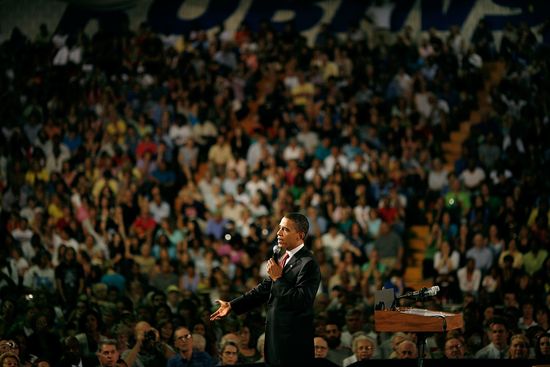
The process may have been frustrating, and long, and ugly, as Obama told the crowd at George Mason on Friday.  But it was also glorious. 

Victory

OBAMA08ChipSomodevilla:Getty

Obama's historic breakthrough just passed 219 – 212.  My take here. Stay tuned for reax. Now watch the narrative shift again. Sprung:

The flip side of Obama's perhaps naive belief that he can win Republicans over is his ability to show them up. Americans are confused about the plan, but they are not confused about the man.  By large margins they trust Obama more than they do the Republicans to produce rational solutions to the country's problems. In the past month, he exploited his mastery of policy detail, his pragmatism, his focus on effectively alleviating the suffering he spotlighted, and his willingness to stake his political future on getting this bill passed to the utmost. The full eloquence and passion of the campaign came back to

his lips in forum after forum and speech after speech. 

To Democratic legislators, his message was that this bill epitomized why they had sought public office and why they were Democrats; it was the raison d'etre for their careers; in effect, passing it was worth their careers (and would make or break his own).  In the bipartisan summit, he framed a core contrast: the Democrats would rein in the health insurers' worst practices; the Republicans would further enable them by weakening existing regulations. In rallies, he emphasized human suffering caused by leaving people uninsured and underinsured and enumerated the bill's benefits for ordinary people.  As noted before, too, he presented the effort as a litmus test as to whether the Federal government was capable of taking meaningful action to solve national problems. He moved the needle of public opinion enough to move enough House Democrats to "yes."

The process may have been frustrating, and long, and ugly, as Obama told the crowd at George Mason on Friday.  But it was also glorious.  Obama has been telling crowds since 2007 that change wasn't going to be easy, but that it was possible with focus and persistence and courage. He just proved it.

(Photo: Chip Somodevilla/Getty.)

Stupak: “John Dingell Had A Piece Of Me”

From Patrick O'Connor:

The deal came about after a personal appeal from Stupak’s longtime ally, fellow Michigan Rep. John Dingell, the former chairman of the House Energy and Commerce Committee whose father first offered legislation creating universal health care back in 1943. Dingell helped broker negotiations between an angry Stupak and party leaders at both ends of Pennsylvania Avenue when all looked lost. "John Dingell had a piece of me yesterday for quite some time," Stupak said. "He kept me well informed of what I should be doing."

Bibi: Israel’s Dick Cheney

Fareed explains why:

After watching Netanyahu's government over the past year, I have concluded that he is actually not serious about the Iranian threat. If tackling the rise of Iran were his paramount concern, would he have allowed a collapse in relations with the United States, the country whose military, political, and economic help is indispensable in confronting this challenge? If taking on Iran were his central preoccupation, wouldn't he have subordinated petty domestic considerations and done everything to bolster ties with the United States? Bibi likes to think of himself as Winston Churchill, warning the world of a gathering storm. But he should bear in mind that Churchill's single obsession during the late 1930s was to strengthen his alliance with the United States, whatever the costs, concessions, and compromises he had to make.

Obama’s Victory Of Persistence

Yes, in the end, he got all the primary delegates House votes he needed. Yes, he worked our last nerve to get there. But, yes, too, this is an important victory – the first true bloodied, grueling revelation that his persistence, another critical Obama quality, finally paid off in the presidency. He could have given up weeks ago, as the punditry advised (because they seem to have no grasp of substance and mere addiction to hour-to-hour political plays). But he refused. That took courage. And relentlessness. Fallows puts it well:

For now, the significance of the vote is moving the United States FROM a system in which people can assume they will have health coverage IF they are old enough (Medicare), poor enough (Medicaid), fortunate enough (working for an employer that offers coverage, or able themselves to bear expenses), or in some other way specially positioned (veterans; elected officials)… TOWARD a system in which people can assume they will have health-care coverage. Period.

The biggest shift in social policy since welfare reform – but involving far more people. My view is that it will also empower Obama abroad, because there is a linkage between domestic success and foreign policy clout. From my column today:

Watching the various whip counts going back and forth reminded me of the agonising, delegate-counting path to primary victory that Obama took. It works your last nerve. It’s like England in extra time at the World Cup.

Imagine the narrative shift if this bill is passed. Obama will not have imposed this monstrosity on the country from on high; he will have ground it through the bloggers, and the pundits will declare a resurrection. The narrative will be about his persistence and his grit, rather than his near-divinity and his authority. And suddenly it will appear — lo! — as if this lone figure has not just rescued the US economy from the abyss, but also passed the biggest piece of social legislation in decades.

There is only one story better than Icarus falling to earth; and it’s Icarus getting back up and putting on some shades.

The media will fall for it. The public will merely notice that the guy can come back and fight. Even when they don’t always agree with such a figure on the issues, they can admire him.

Again, the real parallel is Ronald Reagan.

People forget how unpopular Reagan was at the same point in his presidency — and passing a big tax cut was legislatively a lot easier than reforming a health sector the size of the British economy. But like Obama he persisted and, with luck and learning, aimed very high.

Obama has bet that this is his destiny. He is extremely cautious from day to day, staggeringly flexible on tactics, but not at all modest when you look at the big picture.

He still wants to rebuild the American economy from the ground up, re-regulate Wall Street, withdraw from Iraq, win in Afghanistan, get universal health insurance and achieve a two-state solution in Israel/Palestine in his first term. That’s all. And although you can see many small failures on the way, and agonising slowness as well, you can also see he hasn’t dropped his determination to achieve it all.

Meep, meep.

Under The Microscope

TNC's commenters have been having Oakeshottcaius conservative "movement" 1970s and 1980s, but obviously no longer. I'm very candid about this in The Conservative Soul. And one thing I'd ask of those who want to know how I understand conservatism is, well, to read that book. Or download it on your Kindle. I know that sounds corny and commercial, but look,  it's why I wrote it. The argument needs a book-length treatment. And the philosophical underpinnings of that book are in my dissertation on practical wisdom, Intimations Pursued.

I've been thinking about these things for a long time, and I appreciate that it all looks absurdly esoteric or simply solipsistic to many. My conservatism is not today's American conservatism, although it could easily find a place in Cameron's Toryism. I have a libertarian streak as well – which puts me at the right end of Toryism. But I hold, following Oakeshott and Burke, that the critical conservative virtue in politics is coherence and balance and practical, prudential openness to change and reform. Remember that Burke, as a Brit, favored American independence. If you cannot see that as conservative in some sense then my arguments will be lost on you.

And yes, it's wrapped up in religion, my inability to lose my faith and my attempt to grapple with what that means in today's increasingly fundamentalist world. That's why the core issue in the book is really Christianity, and why I increasingly feel I want to take some time out to explore these theological and spiritual questions with the time and silence they deserve.

As for conservatism in America, my own belief is that this, at the deepest level, is a philosophical struggle between the worldviews of Leo Strauss and Michael Oakeshott.

I respect Strauss a lot (and a lot more than some of his followers), but I am an Oakeshottian. We Oakeshottians – skeptical, non-violent, fickle, tolerant, but in love with individual freedom – will never be a political party. But I think at the deepest level, we're right and the Straussians are wrong. And that only Oakeshottians are capable of reconciling conservatism with modernity. At some point this is about whether conservatism is in the service of power or resistant to it.

For the rest, "cynic" gets it best:

Sure. He's prone to excess. Some of what he writes is misinformed, ill-considered, or flatly wrong. And all his views, positive or negative, are intense. I'm not claiming that he's the platonic ideal of a pundit.

But it's important, I think, to grapple with the ideas that undergird his particular stances, because it seems quite clear to me that his positions flow from his ideas.

In the same post to which I linked above, he approvingly cites Oakeshott to the effect that "the two deepest impulses in Western political thought – the individualist and the collectivist – need each other to keep our polities coherent." Andrew identifies as a conservative, because of where he would prefer to establish that balance, more toward the individualist than the collectivist. But the point is that the goal is not ideological purity. It is balance, above all, that he pursues.

Politicians are, in this scheme, tools for achieving balance. Which explains, I think, how Andrew can first extoll a politician, and then turn on him a few years later. That's a mark of consistency, not hypocrisy – a politician who pursues the same goals without respect to shifting circumstances will first offer a necessary corrective, and then go increasingly too far. The exceptions are those rare politicians whose views evolve substantially in office, as the solutions on which they campaigned get placed into effect, and they adapt accordingly.

One way to think about Andrew's views is to imagine the ship of state moving quickly downstream. Steer too far in either direction, and it runs aground on the banks. Andrew, I think, has a tendency to see this happening, and to overcorrect – to push the tiller too hard, first one way and then the other. And he would prefer that the ship keep a steady course closer to the right-hand shore, and I to the left. But the basic view – avoiding the perils of steering too close to either extreme, keeping a steady course, adjusting it with the bends in the river – is one I wholeheartedly endorse.