Leave NCLB Behind? Ctd

A reader writes:

If there is one issue on your blog I was ever qualified to write to you about, this is the one. I'm turning in my dissertation this afternoon, in fact, on the effects of NCLB on teachers' instruction. I think a lot of your readers' points are way, way off the mark.  Here are the facts as I understand them, from my work and the literature.

First, the effects of standards-based reform on student achievement (measured by test scores) are decent–as good or better than your typical whole-school-reform movement. They are about the same magnitude for white, black, rich, and poor students. In my opinion, these effects are mainly operating through the content of teachers' instruction–WHAT they are teaching, not necessarily how they are teaching. Teachers are responding to the assessments and standards by aligning their instruction, especially in mathematics and science. Some might call it teaching to the test, but I actually found that instruction moved more toward standards than it did tests.

Teachers' responses to the standards and assessments are, not surprisingly, strongest when the standards and assessments target the same content. That was, in my view, the #1 goal of standards-based reform, and yet I've found that state assessments often measure wildly different content than is specified in standards. In other words, the tests were supposed to be fair representations of the content specified in the standards, but that's simply not the case right now, and teachers don't know what to teach as a result.

Even more interestingly, I analyzed teachers' responses to standards and assessments and found that, in grades where the standards and assessments emphasized higher-level thinking, like the high school grades in English, teachers responded by increasing their focus on those skills. When the standards and tests emphasized procedural thinking, like all grades in mathematics, teachers responded by emphasizing those skills. Thus, if the standards and assessments were better targets (right now, they almost all stink), teachers would almost certainly respond by teaching in ways that are more desirable. Constructing high quality tests is only a measurement and, possibly, cost problem, but I am very confident we can overcome those obstacles.

As for the accountability measures, I agree that they are overly draconian. However, I did find that teachers paid more attention to the standards and assessments and aligned their instruction more in states with higher levels of accountability. Some degree of accountability is good, but the current system needs to be retooled.

Given these conclusions, I think it would be a massive mistake to abandon standards-based reform altogether. The fact is that the way we've done NCLB is not what the original "inventors" of standards-based reform had in mind. If we did it better, I am very confident that the results would be better and the negative externalities would be minimized. I am hopeful that that's where we're heading, but we'll see.

As for charter schools and urban flight, neither of which are my areas of expertise, I am neutral on charter schools–on average they do the same, but some clearly do better (again, I think, because they have more instructional time and teach more content). And people have been avoiding urban public schools for decades, so that argument is nonsense.

Anyway, I hope you find this information useful. None of my research is published yet, but I got a professor job at USC in this dreadful market based on this job talk, so I'm pretty confident that my results are legit and an important contribution to the field.
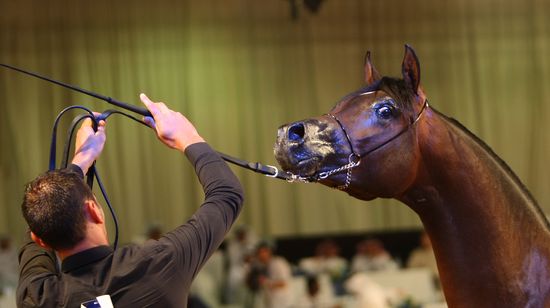
Face Of The Day

COLTKarimSahib:AFP:Getty

A two-year old Arabian Class 8 Colts, owned by Saudi Prince Abdul Aziz bin Ahmed bin Abdul Aziz, is paraded during the Dubai International Arabian Horse Championship in the Gulf emirate on March 19, 2010. The championship is a competition for purebred Arabian horses which parade during the three-day event to showcase their beauty and talents. By Karim Sahib/AFP/Getty Images.

Can The Pope Be Removed? Ctd

A reader writes:

All of this is true. But it does not imply that the answer is that a pope cannot be fired. The fact that the laws on the books provide no avenue for the removal of a pope doesn’t mean that the laws couldn’t be changed to make it possible.

There is an authority in the Catholic church that possesses power at least equal to that of the pope: the Ecumenical Council. The decrees of an Ecumenical Council have a force like that of Papal dicta, and they constitute the canon law by which the Pope governs. The Councils write the laws. So the Pope is supreme within the law, but the Council is supreme over the law. As a result, a Council can remove a pope. In fact, it’s happened several times.

The Councils of Pisa, Constance, and Basel all fired one pope or another. At the Council of Pisa in 1409, the bishops dethroned the two rival schismatic popes, Benedict XIII and Gregory XII, and elected a third, Alexander V. At the Council of Constance (1414-1418), the Council accepted the resignations of Benedict XIII and Alexander’s successor John XXIII and deposed the third papal claimant, Benedict XIII. Of course, this Council also settled matters by retroactively declaring some of the schismatic popes as “anti-popes,” so they weren’t popes to be deposed in the first place, and repudiating the Council of Pisa as a mere meeting of bishops, and not a Council at all. At Basel, Pope Eugene IV (who has no rival claimant!) was deposed in 1439, but the Council itself was declared illegitimate by the rival Council at Ferrara and Florence. So, on the books, it looks like no popes were fired. But that’s only because the Councils wrote the books.

It is still an open question as to whether Councils are supreme over the pope, and whether a Council can be convoked without papal authority. Right now, the consensus is perhaps in favor of the pope. But these are questions of doctrine and canon law, and questions of doctrine and canon law are ultimately decided by Council. There’s nothing preventing someone, if they can get sufficient support, to convene a Council that declares itself legitimate and then deposes the pope.

There’s an addendum to this. At the height of the Thirty Years War in 1632, the representatives of Spanish (i.e., Hapsburg) interests in Rome accused Pope Urban VIII of insufficiently supporting the Catholic cause in the conflict. Following a famously fractious consistory meeting, allies of the Spanish party privately threatened to convene a Council and remove the pope. Urban, for his part, took the threat seriously.

China, Realist

Kevin Sullivan posits:

China is behaving how many realists would expect a powerful state to behave. This doesn't preclude conflict (obviously it potentially heightens the chances of conflict) but it does present something of a rub for the United States, especially for our politicians and our foreign policy punditry. We love ideological enemies. Revolutionary regimes – be they in Moscow or Tehran – excite us in a way that grubby, material-interest seeking states do not. This, I think, explains the rather flaccid attempts to date to dress up China's fusion of authoritarianism and capitalism into some kind of looming ideological challenge to the U.S. Otherwise, China's deal cutting with third world tyrants, its military investments, its economic agenda, just doesn't pack that dramatic punch.

Mourning Neda In The New Year

An Iranian reader writes:

Only 21 hours left till the equinox and the arrival of spring/Persian New Year known as Nowruz. This ancient tradition is the most important of Persian festivities. We sit around a spread called the Haft Sin (seven items that start with the letter S).  Traditionally, families set as beautiful a Haft Sin table as they can, as it is not only of traditional and spiritual value, but also noticed by visitors during Nowruzi visitations and is a reflection of their good taste. Based on the same tradition, if a family has lost a loved one in the previous year, they take their Haft Sin to the grave of their loved one on the last Thursday of the year.

The painful scene of Neda Agha Soltan's mother and many people who joined her at the grave of Neda with her Haft Sin is a reminder of the terror and brutality Iranians faced for demanding their basic rights in the year that is about to end. She cries: "How do I change my year without you…my Neda..who do I scream this pain too…I wish I were dead and would never see this….."

The Origin Of Sprawl, Ctd

Drum argues that suburban residents love sprawl. Avent counters:

[T]he notion that suburban sprawl wins out simply because it is so popular is belied by housing cost data. People live where they can afford to live, and if they can’t afford to live in a walkable area, then they’ll opt to live in sprawl rather than go homeless. And once there they’ll act to defend their investment by fighting development projects that may have unpredictable impacts on the value of nearby single-family homes.

Meanwhile, Kevin asks if there are walkable areas built outside of urban centers. Yes, there are. In suburban Washington, municipalities have been extraordinarily successful building walkable neighborhoods around Metro stations. This is an increasingly popular model around the country.

The Dogs Of Afghanistan

Tom Ricks prints an e-mail from Army Capt. Michael Cummings:

What sticks with me most about war dogs was the lengths officers, NCOs and soldiers would go to keep them out of harm's way. I've seen Sergeants Major and Lieutenant Colonels risk their careers over their favorite dogs. About a week before we were supposed to leave country, word came down to get rid of all the animals on every FOB. They weren't authorized, we were told, so they had to go before the new unit came in. The day our full-bird colonel and his replacement came on a battlefield tour, suddenly all the dogs were gone.

I assumed they had been taken to the trash pit and executed, the fate of many dogs downrange. But as soon as the chopper took off, bounding around a corner were the mini-pack: Mama, K2 and the dog with no name.

One of the most vivid if vague memories of my childhood was my grandfather recounting how as a soldier in the British army in India, he felt he had to shoot his beloved dog before he left for home. He feared the dog would be mistreated if left to fend for himself, and did what he had to do. I cannot imagine doing such a thing. But I do remember being deeply shocked by this story at the time, one of my earliest premonitions that life is cruel, that choices are hard, that this tough old veteran (he used to order his children to chew their food a specific number of times) was also a man of deep love beneath.

And, of course, it just confirms my belief that the love between dog and human is real and deep and precious. Even in war. Perhaps especially in war.

Oh, and Washington.

Shadow Policy

William Shields reports on a debate between Steve Coll, Tom Friedman, and David Ignatius:

[Ignatius] recounted writing a column arguing that the United States should support Salam Fayyad's two-year transitional plan towards statehood. When a U.S. official called to tell Ignatius that this indeed was the United States' policy, Ignatius responded, "Well, it's news to me." (Anyone wanna contribute to hire him a researcher?) Ignatius…argued that the United States needs to more clearly articulate its policy to give Fayyad the political support he'll need to convince a Palestinian public that is skeptical of a phased transition.

Secular Accountability

Room For Debate addresses the question of how the Church should respond to the crisis. Here's David Clohessy:

[C]onsidering the fact that only two or three bishops, out of 5,000 worldwide, have resigned for covering up predator priests, it’s clear that church laws and courts are ineffective in doling out punishment. … Thus lawsuits, settlements and news media coverage don’t deter recklessness, callousness and deceit by bishops. The Vatican should order bishops to turn over priest personnel files to law enforcement. It should beg secular officials to launch investigations and prod lawmakers to reform archaic, predator-friendly laws (like statutes of limitations).

Nicholas P. Cafardi advises along the same lines:

[A]llow an investigation by a non-clerical panel, and cooperate with that investigation. That is what the American bishops did when they established the National Review Board for the Protection of Children and Youth, composed of lay people. The bishops cooperated with the review board and the John Jay College of Criminal Law, whom the board engaged to study the crisis. When the investigation is over, publish the results and apologize again. Transparency is critical to repairing this crisis.