Tolerance For Happiness

GallupWellbeing

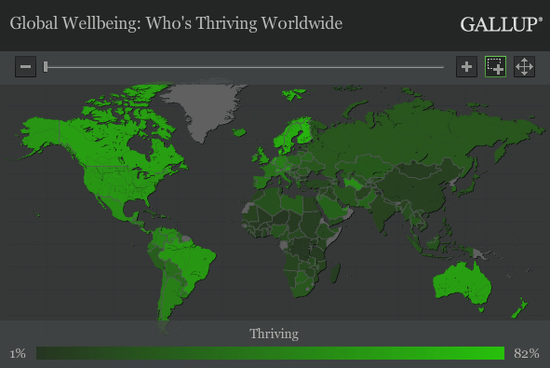
Richard Florida compares happiness levels across nations:

[W]hile income and the level of economic development play an important role in the happiness of nations, well-being is also related to the type and nature of economic development and the values it engenders. There is something in the nature of post-industrial economies and in their values that appears to affect the happiness of their people over and above the effects of income.

Perhaps it is that people with higher levels of education have more flexibility or choice in pursuing their dreams, building families and social relationships that are more fulfilling, or simply in their ability to adjust to misfortune or bad times. Perhaps it is that knowledge-based jobs are more challenging and fulfilling. It's also clear that the most troubled societies — those with the highest reported levels of suffering — also, generally speaking, face the highest levels of intolerance. While income and the level of economic development certainly need to be top of mind considerations when we think about or attempt to act on the happiness of nations, one simply cannot neglect the effects of economic and social structure and of values in social well-being.

(Image from Gallup. Interactive version here.)
What The Public Thinks

Drum grants that "polls do give us a general idea of where we're starting from," but also argues public opinion isn't hardened on a subject until it is the center of debate:

[W]e often take a look at polls and think they tell us what the public thinks about something. But for the most part, they don't. That is, they don't until the issue in question is squarely on the table and both sides have spent a couple of months filling the airwaves with their best agitprop.

Gender In The Masthead, Ctd

Friedersdorf joins the debate:

There is a case to be made for diversity in newsrooms, and if you’re running an all white newspaper in a multicultural town, you’re probably doing something wrong. But no one is helped by peddling diversity mantras that betray an utter failure to grapple with a difficult issue. Furthermore, should the Washington Post newsroom grow more diverse in future years — and I hope that it does — let me be the first to assert that the minority staffers should be covering Congress, Bethesda, and the University Club as often as sitting on the Metro desk or reporting on Southwest DC.

Mr. Alexander would probably say he’d never suggest otherwise, but when you approvingly quote someone saying, “If you have a community of basketball players, it’s difficult for a newsroom of opera lovers to cover them,” it’s fair enough to wonder if you’re also saying the opposite. Of course, this whole exercise presumes that basketball and opera themselves are inherently racial rather than cultural phenomena, which is also wrong.

In related news, Politico was recently scolded for its lack of non-white men in an editorial meeting.

The Daily Wrap

Today in Vatican watch, Douthat deflected the outcry of Archbishop Dolan, Paul Moses countered George Weigel, Andrew differed with Father Brundage, victims activist David Clohessy called for disclosure, Tom McNichol compared the crisis to Watergate, a reader raised a double standard for prison rape, and another asserted that abuse has gone undetected for centuries.

In other coverage, Obama hugged Romney tight, Friedersdorf instructed us not to donate to the RNC, Erickson faced the music on CNN, Ravitch graded the president, David Corn revisited Bush's war rhetoric, and Larison danced on the grave of the UK special relationship. Brooks and Andrew heralded marriage, Bella DePaulo differed, Kate Pickert killed the buzz over preexisting conditions, and TNC talked video games.

Readers continued the feminist threats on stripping and salary. Another alerted us to April 19. Tax-blogging here, here, and here. Beard-blogging here and here. Blog-blogging here. Winnie the Poof met Alien, Obama looked at awesome things, and LBJ said "bunghole." Adorable animals here, badass ones here, and suicidal ones here.

Get your civic asset forfeiture fix here.

— C.B.

Romney’s Long Road To ’12, Ctd

Chait thinks that Ambinder has it backwards:

Romney appears political viable right now because most Republican voters have not been exposed to the Romneycare-Obamacare comparison — or if they have, it's been made by advocates of the latter, rather than by Republicans who they trust. When the attacks come, Romney just has no convincing reply.

Reading The Fine Print

Kate Pickert decodes the pre-existing condition brouhaha:

Although insurers have promised to sell insurance policies to families with kids with pre-existing conditions, there is nothing to stop the insurance companies from charging whatever they want. Until 2014, insurers will still be allowed to set premiums rates in the individual market based on health status. For a kid with a bad health status – like cystic fibrosis, say, or cancer – that means very high premiums that families might still not find affordable. Insurers are not going to simply absorb the cost of covering these expensive cases; they will pass the expenses on to policy holders.

Taxes And Children

Nancy Folbre highlights a study (pdf):

Over all, parents pay less in net taxes than nonparents do — until the future net tax contributions of their children are taken into account.  These more than offset the difference, leading the authors to conclude that the average parent contributes far more than the average nonparent to net taxes — a difference of more than $200,000 in 2009 dollars…